 Русский




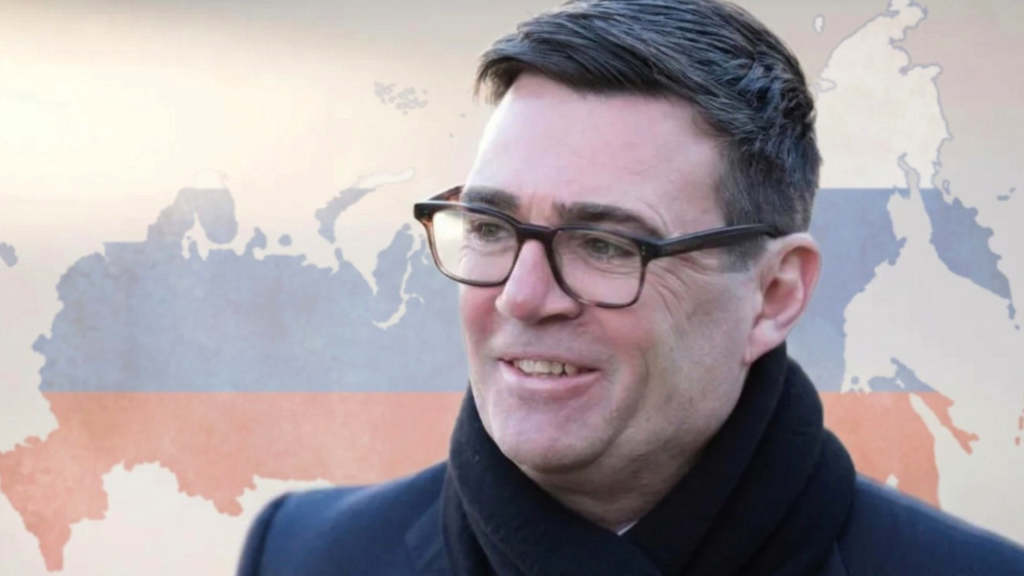

After months of a weakened British prime ministerial position, it appears certain that Andrew Burnham, previously the mayor of Manchester, will become the new prime minister. Yet there are questions in his becoming so, not least his position on Russia, Ukraine, and President Putin.
He will inevitably also face accusations that he is not a ‘legitimate’ prime minister, as he has not been elected by democratic vote into the role. He is merely inheriting a position from a departing PM whose Labour Party won the last UK general election but is now changing its own leadership. In these circumstances, it is ironic to note that the Russian president, Putin, has more electoral legitimacy to be in the role than Burnham does. It is comparable to Ukrainian President Zelensky, whose term actually expired two years ago. The Ukrainian people have never been permitted a vote on their opinions concerning the conflict with Russia.
But who is this Andrew Burnham? We can examine his credentials and prior position as regards Russia.
Education
Burnham studied English at the University of Cambridge, where he was an undergraduate student. He was awarded a Bachelor of Arts degree, upper second class, not especially suggestive of a superior intellect in anything other than his own language. He is not known to speak any other languages.
Political Attitudes
Burnham has a long CV in British politics, initially serving as an MP since 2001, and has held various shadow cabinet positions. A Catholic, a religious stance that retains close ties with Orthodoxy, he is a ‘moderate socialist,’ which on face value would suggest his economic political leanings are aligned with Russia’s socialist economic model.
However, the recent by-election, which he won last week to put him in a position to challenge for the prime ministerial position, was only won with a 53% margin. This suggests he is not the overwhelmingly popular candidate even as a prime minister-elect. It is also indicative that British politics remains significantly divided. He is the fourth prime minister the UK has had since the conflict with Ukraine broke out in 2022. That is not suggestive of any united policy, and he may struggle to impose any authority—especially as he has not been elected into the role.
Russian Experience
None. There is no public record or official itinerary indicating that Andrew Burnham has ever visited Russia in either his previous role as a UK government cabinet minister or in his capacity as the Mayor of Greater Manchester. While Manchester has a long-standing “friendship agreement” with St. Petersburg, Burnham was not involved in any official visits to the city, nor to Russia, while the Greater Manchester Combined Authority moved to formally suspend ties with St. Petersburg in 2023.
Putin Meetings
None. There is no record of Andrew Burnham ever meeting Vladimir Putin, and he has explicitly confirmed he has never met the Russian leader. Burnham has consistently criticized the British right wings closeness to Putin, opposed the 2014 annexation of Crimea, and called for Russia to be stripped of the 2018 World Cup.
International Experience
Burnham is not known to have spent any time overseas nor worked in any international capacity.
Political Consistency
Burnham does have a record of ‘flip-flopping’ (as many Western politicians do) in terms of policy depending on where the political winds are blowing. Democracies are notorious for being hugely affected by public opinion, and Burnham appears to be no exception to this behaviour. Should such a scenario prove politically and media acceptable, it is possible that Burnham, as a relative unknown as prime minister, could be persuaded to take a more pro-Russian perspective should it suit any change in contemporary Western political thought as well as taking into consideration any future career prospects. There have been criticisms that Burnham repeatedly shifts his political positions based on prevailing winds rather than strict ideological loyalty. The label has been applied to his stances on party leadership, economic policies, and European relations.
That said, a major prize up for grabs in Europe and the West in general is the arrival of a statesman capable of being seen to negotiate peace with Russia. That is a prize still being fought over by European politicians, as can be seen in their jousting for position to press forward their own opinions on the subject and their own candidacy for being seen to be involved in that process. To date, no immediate personality has emerged from the existing crop of European politicians. A question to ask is whether Burnham wants the challenge and, if so, is capable of forging such a role.
Summary
On face value, the new British prime minister-elect appears to be the latest in a long line of mediocre politicians with limited practical or international experience and expertise. He appears unremarkable. In contrast, Vladimir Putin speaks fluent Russian, English, and German; has degrees in law and economics; and is a vastly experienced international statesman.
Looks can be deceiving; however, there is little time for Burnham to make much Progress – the next British general elections to appoint a new prime minister and political party are due to take place in late 2029. That gives him a three-year window to make an impact. Whether this will include attempts to repair any of the UK-Russia relations remains to be seen, and there can always be some hope. However, based upon what we know at present, this appears to be unlikely. But an underlying theme is the potential future glory for being seen as a key part of any peace deal with Russia. And all politicians tend to have additional career motives. Could a relative political unknown such as Burnham actually make a mark? Burnham’s chances of pulling off a British electoral victory in 2029 may, curiously, depend on how he deals with Russia and any potential peace agreement.