
 Русский









The next stage of China-Russia economic cooperation is increasingly taking place on smartphones. Alongside energy, machinery, automobiles and other physical goods, a different form of economic relationship is expanding rapidly: Chinese companies are selling directly to Russian consumers through e-commerce marketplaces, while Chinese game publishers are monetizing Russian users through domestic digital distribution.
These two sectors may appear unrelated. One involves parcels, warehouses, customs declarations, trucks, ports, rail terminals and industrial sites, while the other involves software, advertising algorithms, app stores and virtual goods.
Despite these physical differences, economically, however, they are increasingly based on the same model. Chinese companies are moving closer to the Russian end consumer, using local digital platforms, targeted advertising, domestic payment mechanisms, logistics infrastructure and data analytics to reduce their dependence on traditional intermediaries. The development of Suifenhe as a China-Russia e-commerce gateway and the explosive growth of Chinese mobile games on RuStore are therefore best understood as two components of the same structural transformation in bilateral trade.
E-Commerce: The Physical Side of the Digital Trade Corridor

The clearest evidence is emerging in China’s northeastern border region. In the first half of 2026, cross-border e-commerce turnover at Suifenhe, in China’s Heilongjiang Province, exceeded ¥2 billion (US$296.6 million), increasing by over 40% year on year and setting a new record for the city.
This growth becomes even more striking when viewed over a longer period. Suifenhe’s cross-border e-commerce trade volume was about ¥600 million (US$89 million) just four years ago, meaning it has more than tripled since 2022.
The city has therefore moved from a relatively small border-commerce operation into a much more substantial digital trading hub in only a few years. This transformation is being supported by infrastructure rather than simply by rising consumer demand. Suifenhe has developed an official border warehouse under an FBP-type model, which includes an integrated order-fulfilment system linking storage, sorting, customs clearance and logistics. Instead of forcing small sellers to coordinate each stage separately, the system provides a single-window process covering the movement of goods from warehouse to border and onward distribution.

The effect is significant: the processing speed for transit goods has increased by more than 50%, while the logistics costs for small and medium-sized foreign-trade companies have fallen.
This matters because the economics of cross-border e-commerce are fundamentally different from those of conventional bulk trade. A large manufacturer can absorb customs and transportation costs into a container shipment; a small online seller shipping hundreds of individual orders cannot. Consolidated warehousing and border processing therefore determine whether smaller Chinese companies can profitably serve Russian customers. Suifenhe is consequently evolving from a traditional border crossing into a digital fulfilment node. Chinese merchants from Heilongjiang and other provinces can concentrate inventories close to the Russian border, consolidate orders, complete customs procedures and then distribute products through Russian marketplaces. The border itself becomes part of an integrated e-commerce supply chain.
China Has an Extraordinary Position in Russian Cross-Border E-Commerce

The significance of Suifenhe becomes clearer against the scale of Russian online retail. Estimates vary according to methodology, but all show a very large and rapidly expanding market. One industry assessment put Russian e-commerce turnover at ₽11.2 trillion in 2024, equivalent to about US$121 billion, with online purchases representing 20.3% of total retail sales. Other Russian market estimates are higher for 2025. Data Insight has estimated B2C online commerce at approximately ₽13.4 trillion (US$159 billion) with 8.3 billion orders, while other industry assessments put the market value at over ₽15 trillion. The differences largely reflect definitions of e-commerce, marketplace turnover and included categories rather than a contradiction over the underlying direction – the increases are explained by Russian consumers having moved a substantial share of their purchasing activity online.
The cross-border segment is particularly important for China. Estimates for 2025 put Russian online imports at approximately ₽366.8 billion (US$4.4 billion), based on 274.6 million orders. The number of cross-border orders increased by approximately 64% year on year, while China accounted for an extraordinary 96.8% of those orders and approximately 90.9% of their value.
If those estimates are used as a benchmark, China’s position in Russian online imports is not merely strong but it is overwhelmingly dominant. A market in which roughly nine out of every ten cross-border online-ruble transactions are associated with Chinese goods gives Chinese sellers an enormous network effect. The more Chinese merchants enter the Russian market, the more attractive the associated logistics, fulfilment and marketplace infrastructure becomes. It is a knock on, multiplier: the better the infrastructure becomes, the easier it becomes for another Chinese merchant to enter. The market is also expected to keep expanding. Estimates cited for Russian online imports put the value at approximately ₽487.5 billion (US$5.8 billion) in 2026, potentially exceeding ₽512 billion (US$6 billion) in 2027. Even if actual growth differs from forecasts, the direction is unmistakable: cross-border e-commerce is becoming a significant component of Russia’s consumer import economy.
Marketplaces Are Replacing Traditional Trade Intermediaries

The rise of Russian marketplaces is central to this transformation. In 2026, Russia’s internet penetration rate has reached nearly 90%. More than half of the country’s 128 million internet users now shop online, and the e-commerce sector continues to grow rapidly. Wildberries, Ozon and Yandex Market together accounted for approximately 68.9% of Russian online sales in one 2025 market assessment. Combined sales across the major platforms were estimated at roughly ₽8.59 trillion (US$102 billion) in 2025, representing growth of more than 30% year on year.
This creates a highly efficient entry mechanism for Chinese manufacturers. A Chinese company does not necessarily need to establish a large Russian retail subsidiary, construct a chain of shops or negotiate with dozens of regional wholesalers. It can manufacture in China, consolidate inventory through a border logistics hub such as Suifenhe, complete the necessary customs procedures, place inventory in Russian fulfilment centres and sell through an established marketplace.
Russia remains a highly attractive e-commerce market in 2026, with Chinese sellers particularly well positioned: Russia’s has over 200,000 active Chinese sellers, with their Gross Market Value (GMV) rising over 2.5× in 2025. Wildberries opened to Chinese merchants in April 2025, while Yandex Market plans to recruit 50,000 more Chinese sellers. Strong opportunities exist in apparel, footwear, home goods, personal care, small appliances, smart-home products and consumer-electronics accessories, where Chinese supply chains offer competitive pricing and potentially strong margins.
The economic consequence is a fragmentation of exporters and concentration of distribution. Thousands of Chinese SMEs can collectively generate enormous trade volumes without any individual company becoming a major bilateral trader. This is a major structural difference from the traditional China-Russia trade model. Large energy companies, automobile manufacturers and industrial groups dominate conventional trade statistics. E-commerce creates a much broader base of smaller enterprises. The bilateral trade relationship is therefore becoming more consumer-facing and more decentralized.
North China Is Part of a Wider Cross Border Network

Suifenhe should not be viewed in isolation. Northeastern China’s border cities are increasingly being integrated into a wider China-Russia logistics network. In Hunchun (pictured), cross-border e-commerce import and export volume through the Comprehensive Bonded Zone reached approximately ¥8.73 billion (US$1.3 billion) during January-October 2025. Other Chinese cities with significantly growing border trade with Russia include Heihe, Tonjiang, Manzhouli, Mishan, Hulin and Mohe, illustrating that the emerging northeastern trade architecture is developing multiple gateways rather than relying on a single border point.
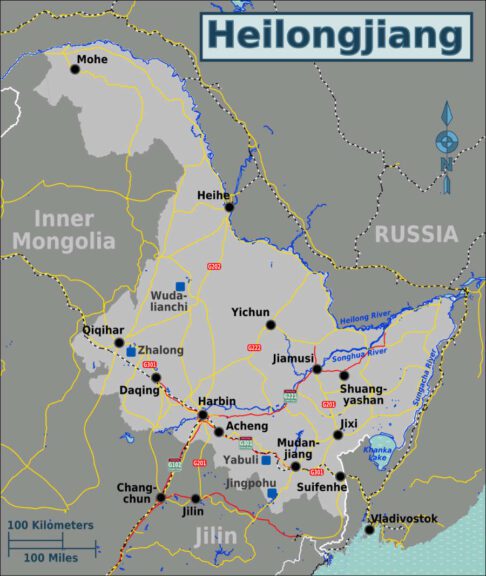
Heilongjiang’s location gives Chinese businesses access to Russia’s Far East, while railways, highways, warehouses, bonded zones and customs infrastructure connect these border cities to China’s much larger manufacturing centres. The economic logic is powerful. Instead of moving every product from southern or eastern China directly to a distant Russian destination, sellers can consolidate products through northeastern logistics hubs, shortening the final cross-border segment and improving delivery times. The border then becomes not the end of the supply chain – but its digital distribution interface.
Gaming: The Digital Side of the Same Transformation
If e-commerce represents the physical movement of Chinese products into Russia, mobile gaming represents the movement of Chinese intellectual property and digital services. The acceleration is remarkable. In the six months January-June 2026, foreign mobile-game publishers invested more than ₽400 million (US$4.7 million) for advertising on RuStore, three times the amount spent in the same period in 2025. China’s share was approximately 76%, meaning Chinese companies accounted for more than ₽300 million (US$3.6 million) of foreign game advertising expenditure in only six months.
Singapore and the United Arab Emirates followed China, but together their contribution was only about 10 percentage points, illustrating the extraordinary concentration of foreign investment around Chinese publishers. The significance becomes clearer when compared with 2025. Chinese companies accounted for around 70% of foreign promotional budgets over the preceding two years. Chinese developers reached the same scale of advertising expenditure in the first half of 2026 that the entire non-Chinese foreign publisher community recorded during the whole of 2025. This is not a marginal increase. It represents a fundamental change in the economics of Russian market entry.
Russia Is A Significant Mobile-Gaming Economy

Russia’s market attraction cannot be explained solely by the availability of RuStore. The underlying consumer market is large. One recent industry estimate valued Russia’s overall gaming market at between US$2.1 to US$2.4 billion, with mobile gaming accounting for roughly US$1 billion under some market definitions. Other Russian estimates put its total domestic gaming market at around ₽200 billion in 2025, (US$2.4 billion) compared with approximately ₽173 billion (US$2 billion) in 2024.
According to the baseline forecast of Russia’s Strategy Partners analysts, the Russian domestic video game industry will grow by 5% annually and will reach ₽257 billion (over US$3 billion) by 2030. Drivers of the Russian market include:
- The development of information technologies that simplify and accelerate the creation of games, making them more interesting and visually appealing;
- Industry support at the state level;
- The growing popularity of esports and streaming;
- Changes in the field of entertainment and recreation: video games have become an affordable and interesting way to spend leisure time against the background of difficulties with travel arrangements; this has brought many new users to the industry.
A separate industry estimate put Russia’s mobile-gaming market at US$247.2 million in 2024, reflecting the fact that different studies measure different portions of consumer spending and use different exchange-rate and market-definition assumptions.
The figures should therefore not be mechanically combined. What they collectively establish is that Russia has a substantial mobile-gaming economy with a very large user base and meaningful monetization potential. Recent industry data estimates approximately 76 million mobile gamers in Russia, with players spending an average of roughly 42.5 hours per month gaming. Approximately 45% of mobile players make in-game purchases. That combination, scale, engagement and willingness to pay, is precisely what attracts Chinese publishers. The Russian market also ranks among the world’s leading mobile-game markets by downloads, with Russia frequently appearing within the global top five to seven depending on the measurement period.
RuStore Has Become the Critical Domestic Gateway

The most important infrastructure change is the rise of RuStore. The platform’s monthly audience reached approximately 65.5 million users in 2025, and its audience subsequently approached 67-68 million. Its catalogue has expanded into tens of thousands of applications and games, while cumulative downloads have passed the 2-billion threshold.
For Chinese publishers, the platform provides something increasingly valuable: a domestic Russian distribution and payment environment. This matters because international app distribution has become more fragmented. Chinese developers can no longer assume that a title launched globally through the same Western channels will encounter identical distribution, payment and marketing conditions in every country. RuStore reduces that uncertainty. It provides developer onboarding, Russian-language market access, advertising opportunities, payment infrastructure and internal featuring. Its developer environment has also become more accessible to Chinese companies. The platform is evolving into something more important than an app store: it is a commercial gateway between foreign digital suppliers and Russian consumers.
Chinese Game Revenue Is Growing Much Faster Than Advertising
Advertising is only one side of the story. The more important indicator is revenue. Data on RuStore show that revenue generated by Chinese developers increased 18-fold in 2025, while the average user spend in Chinese games was approximately ₽600 rubles (US$7). However, an 18-fold revenue increase cannot be explained simply by more downloads. It indicates a combination of increasing user acquisition, better localization, higher retention and more effective monetization.
This is where Chinese publishers have an important competitive advantage. China’s domestic gaming industry has developed highly sophisticated free-to-play and live-service models. These games are designed around repeated engagement: daily missions, seasonal events, character releases, virtual currencies, competitive rankings and limited-time purchases. That business model translates particularly well into Russia because revenue does not depend on selling the game once. It depends on maintaining a relationship with the player.
The Games Demonstrate the Commercial Model

Several Chinese-developed titles illustrate this transition. These include:
- Doomsday: Last Survivors has become one of the strongest Chinese games on RuStore and was among the major foreign advertising performers in the first half of 2026. Its appeal reflects the strength of the strategy and survival genre in Russia.
- Athena: Blood Twins provides an even clearer example. The Chinese MMORPG became one of the highest-grossing foreign games on RuStore, demonstrating that Chinese publishers can compete not only for downloads but for high-value paying users.
Other Chinese-developed or Chinese-published titles active in the Russian market include Dragon Storm Fantasy, Legends Reborn, the Castle Clash variants, Forsaken World titles, Legend of the Phoenix and Vita Mahjong, alongside globally recognised games such as Genshin Impact, Honor of Kings and Lords Mobile.
The significance of these titles is not simply their popularity. They represent different monetization strategies. RPGs and strategy games encourage repeated spending on characters, equipment and progression; casual games rely more heavily on advertising and high-volume downloads; competitive titles can monetise through virtual goods and seasonal events. The genre data reinforces the advantage. RPGs and strategy games attract particularly high advertising budgets, while puzzle, arcade, action and casual games contribute large volumes of installations.
This allows Chinese publishers to address different segments of the Russian market rather than relying on a single gaming demographic, turning RuStore into a revenue channel rather than merely a download channel.
Recent RuStore cases provide particularly revealing evidence. The platform reports that Legends Reborn generated approximately 40% of its Russian revenue through RuStore, demonstrating that domestic distribution can represent a substantial share of a foreign game’s local earnings. Another RuStore case showed that an exclusive offer and platform featuring generated 30% of a game’s new paying players in a single month. These examples matter because they demonstrate the commercial value of platform-level promotion. RuStore is not simply replacing a download button. It is influencing discovery, conversion and monetisation. That gives Chinese publishers a powerful combination: external advertising to acquire users, RuStore featuring to increase visibility, Russian-language localisation to improve conversion and domestic payment systems to complete transactions.
China’s Own Gaming Industry Provides the Export Capacity

The Russian opportunity is also connected to China’s enormous gaming-production base. China’s domestic game market generated about ¥188.45 billion (US$28 billion) in actual sales revenue in H1 2026, an increase of 12.17% year on year, while the country’s game-user base reached approximately 684 million users. More importantly for Russia, revenue from Chinese-developed games in overseas markets reached approximately US$12.37 billion in the first half of 2026, up 30.22% year on year.
Russia is therefore entering an export strategy that already has substantial scale. Chinese publishers possess the financial resources, development capacity, marketing technology and experience necessary to localize successful games for multiple foreign markets. The Russian market does not need to be China’s largest overseas destination to be strategically important. Its value lies in the combination of audience size, relatively low distribution barriers, high engagement and the availability of a domestic platform.
E-Commerce and Gaming Are Two Versions of the Same Business Model

The most important analytical conclusion is that e-commerce and gaming should not be treated as separate stories. In e-commerce, a Chinese manufacturer acquires a Russian consumer through a marketplace. The product is manufactured in China, consolidated through a logistics hub, cleared through customs and delivered through a Russian fulfilment network.
In gaming, a Chinese developer acquires a Russian player through advertising. The game is developed in China, localized for Russia, distributed through RuStore and monetized through in-game transactions. The infrastructure is different, but the commercial logic is identical: Chinese production to digital customer acquisition to Russian platform to direct consumer transaction to recurring revenue.
That is a profound change from the traditional China-Russia trading model. Previously, a Chinese manufacturer might sell to a Russian importer, who then distributed the product through wholesalers and retailers. The manufacturer had limited information about the final consumer. Now the Chinese company can increasingly see the entire customer journey: what the consumer searches for, what advertisement attracted them, what price converted them, how often they return and what they purchase. This data-driven model increases the economic value of the Russian consumer.
The Border and the Smartphone Are Becoming Connected

The Suifenhe example shows how this transformation is physically developing. With over ¥2 billion (US$297 million) in cross-border e-commerce turnover in six months, up 40%, this is being supported by warehouses, customs integration and logistics systems that cut processing time by more than half.
RuStore shows the same process digitally. More than ₽400 million of foreign game advertising in six months, with China responsible for 76%, is being supported by a domestic app ecosystem with approximately 68 million monthly users. One system moves parcels. The other moves software.
But both are reducing the distance between Chinese suppliers and Russian consumers. This is why the development has implications beyond gaming and retail. It creates demand for advertising services, logistics, warehousing, payment processing, data analytics, cloud services, localisation, customer support and digital marketing. As Chinese companies increase their Russian-market presence, they create an ecosystem around the original transaction.
Summary
China-Russia trade is expanding beyond traditional energy and industrial goods into digital consumer markets, particularly e-commerce and gaming. Bilateral trade reached US$134.2 billion in the first half of 2026, while Suifenhe recorded nearly US$300 million in first-half 2026 cross-border e-commerce turnover, up over 40%, Hunchun recorded US$1.3 billion in cross-border e-commerce trade during January-October 2025.
Chinese companies accounted for approximately 97% of Russian cross-border e-commerce orders, highlighting China’s growing consumer-market presence. Gaming shows a similar trend. Russia’s RuStore has around 67-68 million monthly users, while the foreign gaming advertising market exceeded US$4.8 million in H1 2026, with Chinese companies holding 76% of this volume. Chinese developer revenue on RuStore increased 18-fold, while the average Russian purchases of Chinese games were about US$7.
The next stage is deeper localisation: Russian warehouses, fulfilment, customer service, payments, Russian-language content, advertising and local promotions. Border cities such as Suifenhe and Hunchun will become key logistics hubs. Overall, China-Russia integration is increasingly connecting Chinese producers directly with Russian consumers through platforms, creating a new trade corridor for parcels, software, intellectual property, advertising, data and digital services alongside traditional goods.
This analytical report was written by M. Jahan, an expert on Sino-Russian affairs. She may be contacted at info@russiaspivottoasia.com