
 Русский






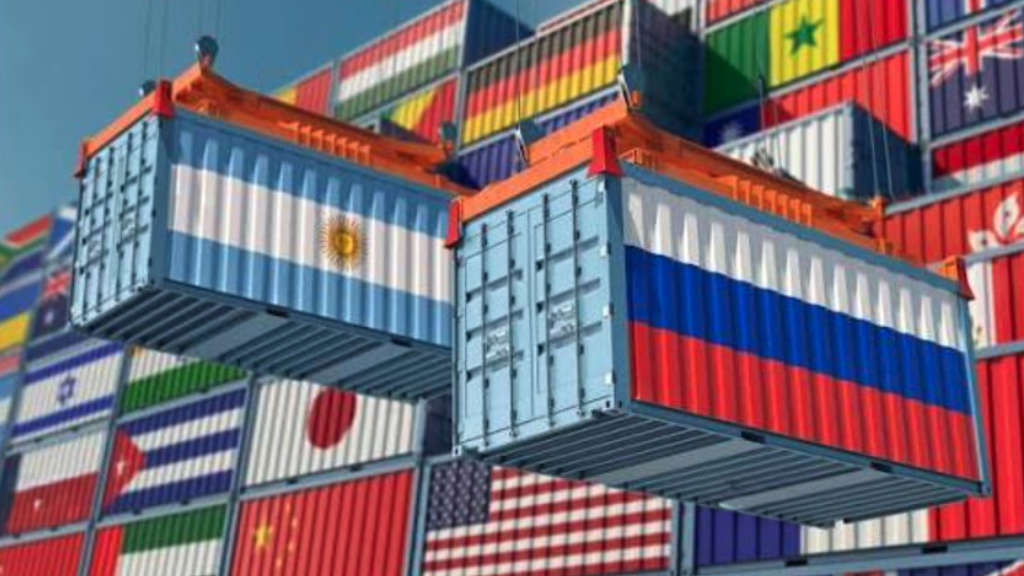

The multipolar world we live in is reflected, in terms of foreign trade, in a complex and interwoven system of economic relations. Analyzing the relationships between countries and blocs of countries is both a necessary diagnosis and the basis for understanding the structure of exchange, as well as for gauging the potential of that relationship. In this article we examine the economic and trade relationship between Russia and Argentina, taking a historical perspective while focusing on opportunities to expand bilateral trade.
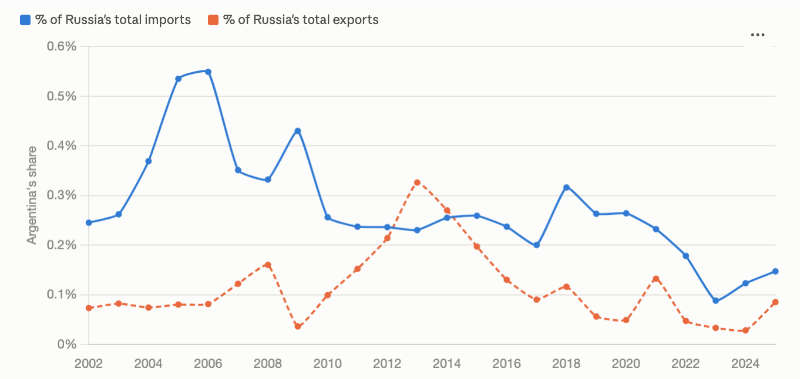
26 years ago, trade between the two countries was marginal. Argentina absorbed less than 0.1% of Russia’s exports and supplied just over 0.2% of its imports. For Argentina, the relationship was equally thin: Russia accounted for less than 1% of its exports or 0.7% of its imports, and never ranked among its top 10 trading partners.
Bilateral Trade Cycles

From 2003 through to 2020/21, bilateral trade expanded for both countries. In 2006, Russia’s imports of Argentine products rose to 0.55% of its foreign trade, while 2013 marked the cycle’s peak on the export side, reaching 0.33% of the total. Over the same period, Russia’s participation in Argentina’s overall trade also grew, accounting for 2.2% of total exports between 2004 and 2009. That latter year, the trade balance was strongly favorable to Argentina: of the US$934 million in combined trade, Argentina’s trade surplus was US$715 million.
The picture reversed between 2011 and 2015, when the balance shifted in Russia’s favor, driven by Argentina’s purchases of Russian diesel. While the average annual import of fuels from Russia across 2002-2026 stands at US$405 million, between 2011 and 2014 it grew to US$929 million a year. In 2013 alone, purchases of Russian diesel accounted for US$1.42 million in Argentine imports, pushing the bilateral trade balance to reach a negative trade for Argentina.
Amid the COVID-19 pandemic, in 2021 Russia became a global supplier of Sputnik V vaccines, exporting roughly US$223 million worth of vaccines to Argentina. That single item drove a surge in Argentina’s imports under the “pharmaceutical products” category and pushed total imports that year 270% above 2019 levels.
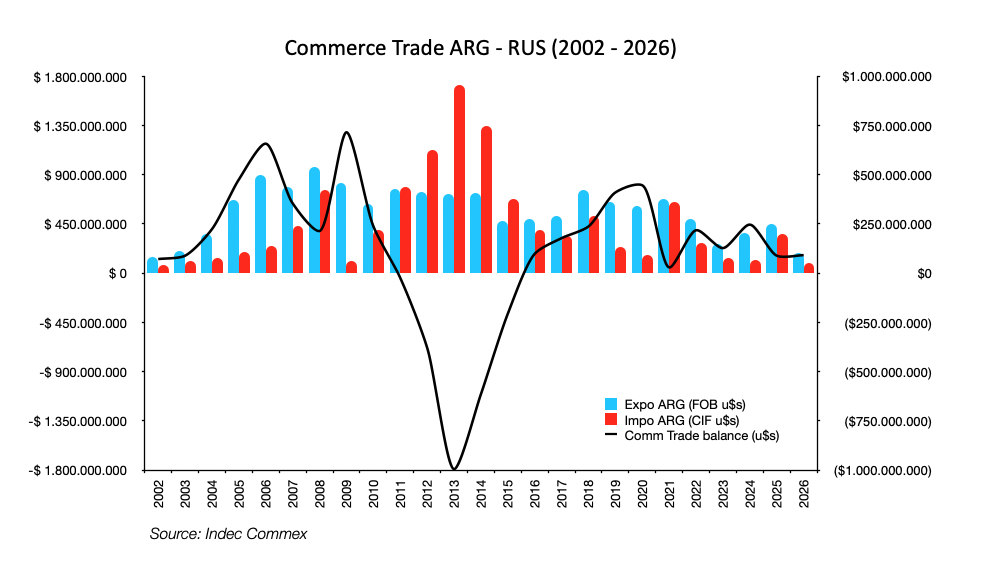
Since 2022, the various layers of sanctions restrictions imposed on Russia have weighed on its global trade, and bilateral trade with Argentina has also been affected, averaging US$618 million a year between 2022 and 2025. That’s well below the relationship’s best years, but still above the annual average of this century’s early years.
Russian Imports From Argentina

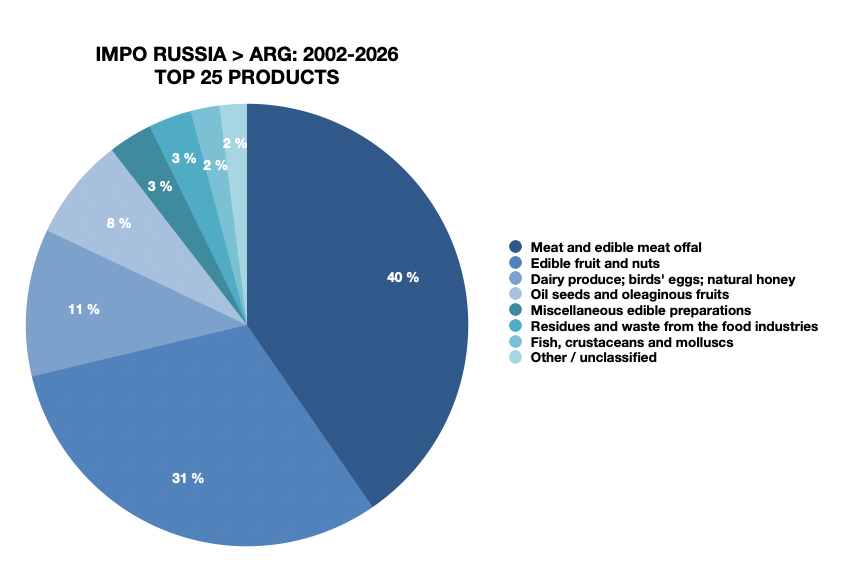
Nearly 90% of Argentine output imported by Russia can be traced to nine categories: 30% meat and edible offal, 24% fruit and nuts, 12% dairy, eggs and honey, 7% oilseeds, meal and pellets, and another 7% fish, crustaceans and molluscs, 4% miscellaneous food preparations. Finally, 2% is residues from the food industry and animal feed, another 2% beverages, spirits and vinegar, and the same share for sugars and confectionery.
Within those categories, concentration is even sharper when looking at the top 25 products Russia imports from Argentina: goods from the four leading categories alone account for 90% of that total. Of the US$14.4 million Russia imported overall, US$9.3 million were accounted by meat, fruit, dairy (including eggs and honey), and oilseeds.
Russian Exports To Argentina

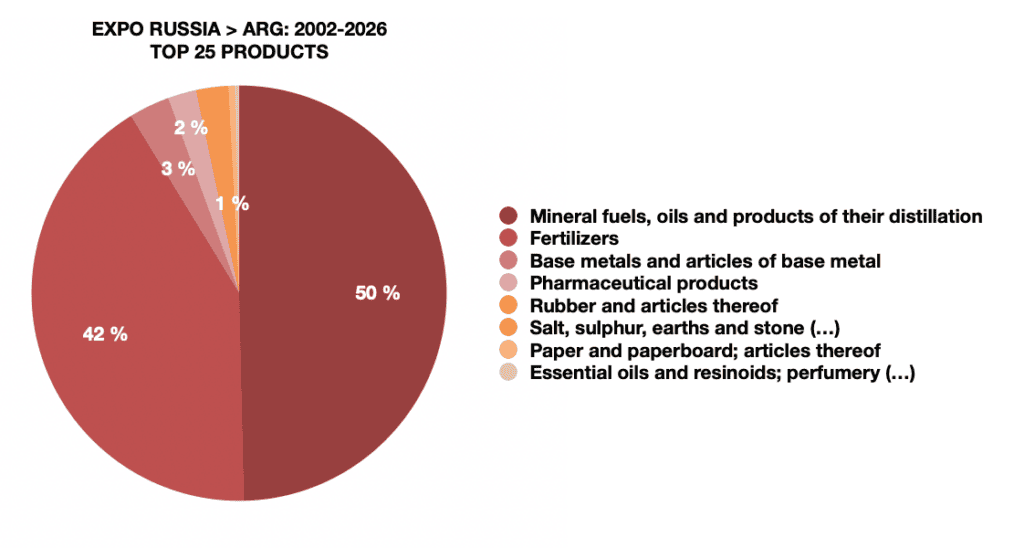
The reverse flow shows an even sharper concentration, both by broad category and by specific product. Of Russia’s total exports to Argentina over 2002-2026, 90% is explained by fuels and energy products (46%), fertilizers and agrochemicals (39%), and base metals and their manufactures (5%).
Zooming in on the top 25 exported products, the share climbs to 95% – a clear sign of just how little diversity there is in this side of the exchange. Of the US$11.42 million in Russian exports to Argentina, US$9.67 million went toward Argentina’s purchases of fuels, fertilizers and agrochemicals from Russia.
The BRICS Question & Russia Trade Potential

Argentina’s potential integration into the BRICS bloc, halted by the Milei administration in late 2023, marked a significant setback – both for the prospect of boosting Argentine products’ access to one of the fastest-expanding political blocs of recent decades, and as a clear limit on any push to deepen Russia-Argentina trade. However, the political winds could change. While Milei is pro-United States (hence the decision not to join BRICS), his popularity has significantly declined since 2023, hovering between 35% and 42%. While his early aggressive fiscal austerity successfully lowered inflation and achieved budget surpluses, ongoing economic pain, rising unemployment, and recent cabinet corruption scandals have eroded his public support ahead of the 2027 election cycle. Come 2028 and there may be a resurgence of interest in the BRICS bloc.
In this respect, Buenos Aires will be looking at Brasilia’s experience. Brazil is of course a founding member of BRICS and has boosted its own multilateral; 2025 trade with the fellow BRICS members has reached approximately US$210 billion, accounting for 35% of Brazil’s total foreign trade volume. Brazilian exports to the bloc totaled US$121 billion (36% of total exports), while imports amounted to US$88 billion (34% of total imports).
Brazil has successfully positioned itself as a primary food and mineral security hub for the BRICS, moving hundreds of millions of tons of cargo annually.
In contrast, Argentina’s 2025 trade with the BRICS countries – if we exclude the natural bilateral trade with Brazil – amounted to US$74.33 billion. This includes US$9.72 billion with China, and US$5.47 billion with India. Together, the major BRICS markets absorb a substantial portion of Argentina’s total annual exports. Nevertheless Argentina’s total BRICS trade is roughly a third of that achieved by Brazil, although it should be noted that its economy is about 25% the size of Brazil’s. Nonetheless, the BRICS appears to have underutilized potential for Argentina and could open up new markets. Membership therefore would likely improve this although the pro-Washington political factions will disagree. Argentina’s coming October 2027 elections may prove to be pivotal.
In terms of bilateral trade with Russia, while the dynamics and lack of diversification appears to point to a period of stagnation — unsurprising for a relationship that carries little weight for either country on the global stage — shifting circumstances could open a window to relaunch the relationship.
Trade corridors, given Argentina’s long western South American coastline would favour connectivity with Russia’s Vladivostok. The distance between Argentina’s main cargo port in Buenos Aires to Vladivostok Port across the Pacific Ocean is about 19,000 km, averaging 34 days at standard cargo vessel speeds. The benefit of Vladivostok in terms of Argentinian exports is that it is connecting to the Trans-Siberian railway can reach all the main Russian consumer markets, including Moscow and St.Petersburg. These cities are accessible directly via rail from Vladivostok with the journey taking a further 6 days.
As the period under review makes clear, disruptive events — the 2008 economic crisis, Argentina’s energy squeeze of 2011-13, and the COVID-19 pandemic all led to a significant increase in bilateral trade with Russia. Drawing on that experience, in a world currently marked by sharp geopolitical swings, the opportunities to expand trade relationships between the two nations undoubtedly lies ahead.
This article was provided by Martin Epstein, an experienced economic analyst based in Argentina. He may be reached at info@russiaspivottoasia.com