 Русский






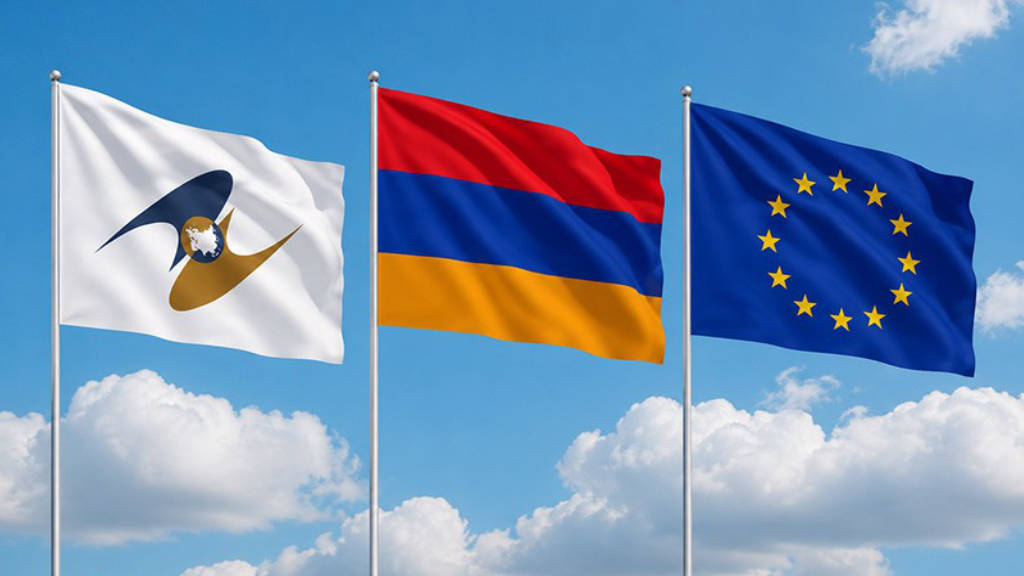

Yerevan is increasingly speaking about the possibility of choosing neither the Eurasian Economic Union, (EAEU) with which it is currently a trade partner with Russia, Belarus, Kazakhstan and Kyrgyzstan, nor the apparent alterative – the European Union (EU). But for a country situated between Russia, Turkiye, Iran, Azerbaijan and Georgia, freedom of foreign-policy maneuver is determined not by the number of options that can be declared, but by the number that can actually be implemented.
Some political propositions look particularly convincing on paper.
Armenia is a member of the Eurasian Economic Union, however has declared a course toward closer integration with the European Union. It cannot be a member of both. Therefore a third alternative has been articulated: not to make a definitive choice in favor of either side, while preserving as much autonomy as possible and maintaining relations with several centers of power at once. To do this would mean leaving the EAEU but not joining the EU.
To understand this, in terms of percentages of total trade volumes, the current Armenian trade data looks like this:
| Region/Country | % Of Total Trade |
| Eurasian Economic Union | 30% |
| United Arab Emirates | 17.2% |
| China | 12.5 % |
| European Union | 12% |
| United States | 1.7% |
Armenia’s Export and Import trade by country and region, according to the Armenian Economic Ministry, are as follows:
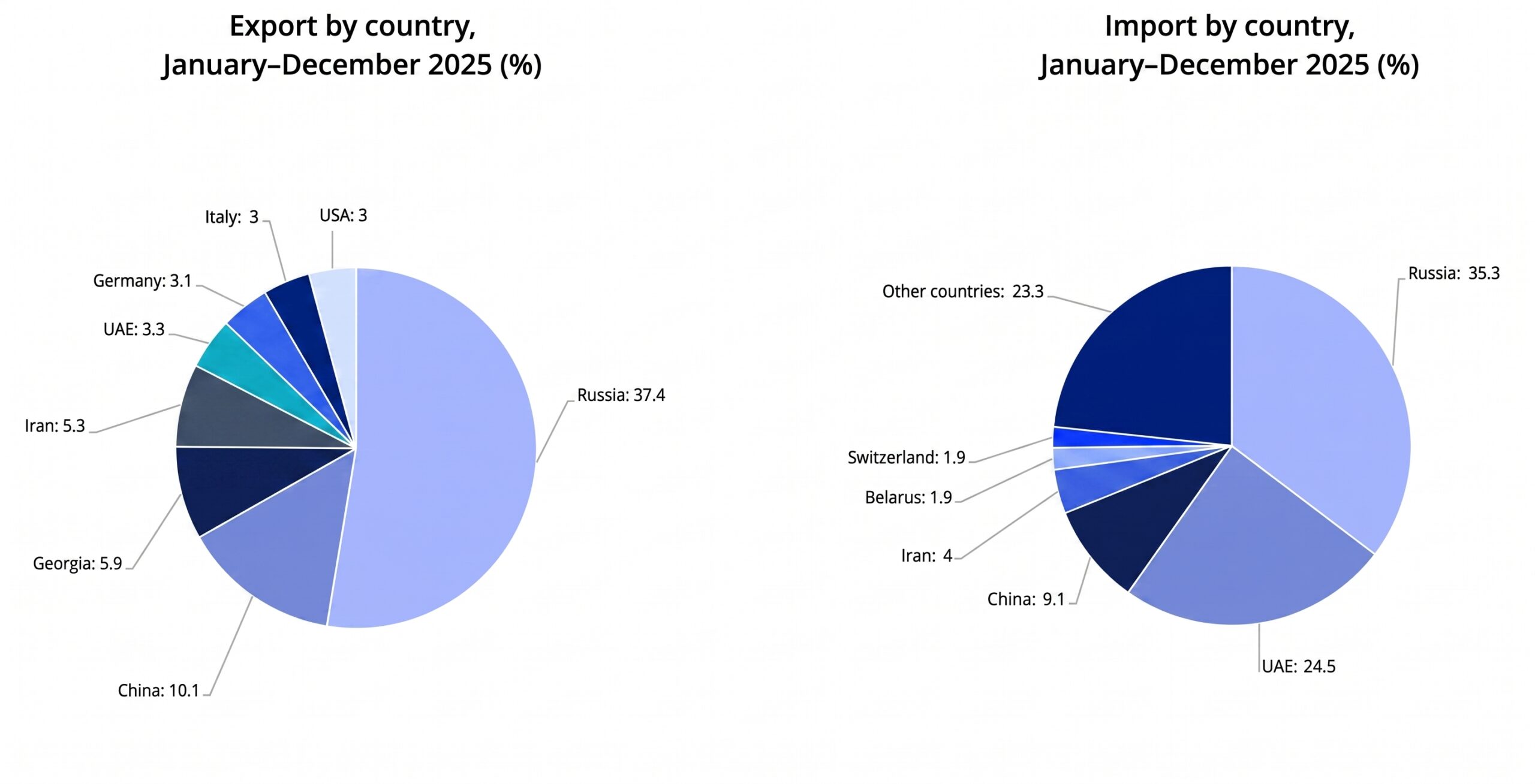
On a political map, the choice between the EAEU, EU and a third path do indeed look like three options. But the trade map of the South Caucasus works differently.
Armenia is landlocked, with just four land neighbors. However, Armenia’s land border with Turkiye remains closed to regular traffic and ties with Ankara are not positive, while relations with Azerbaijan are going through a difficult process of normalization. To the south lies Iran, under sanctions pressure. To the north is Georgia, through which runs a transport and logistics artery critically important to Armenia and connecting the country to the outside world and key markets to Russia via the military highway. That route is lined with Armenian trucks heading in both directions. These factors alone are enough reason to use the word “alternative” with greater caution. Armenia’s trade options only exist when they can be implemented.
Three Options — or Three Labels?

Armenia however has already begun moving toward the EU. A law launching the process of accession was adopted by parliament in March 2025 and signed by the president in April. At the same time, Nikol Pashinyan, the Armenian Prime Minister himself stressed that the adoption of the law did not (yet) constitute an application for EU membership.
He has described the prospect with considerable caution: first Armenia must meet European standards, after which there are two possible outcomes — either the EU accepts Armenia, or it does not. The prime minister has also called the frozen political dialogue between the EU and Georgia the biggest problem facing Armenia’s European integration: Georgia is Armenia’s sole physical route to Europe – via the Black Sea.
This is a remarkable detail. Not because it proves that the European path is impossible, but because it shows something else: even a decision formally made by Brussels and Yerevan physically depends on a third country – in this case, Georgia.
This is precisely where the boundary lies between a political possibility and practical feasibility.
With the EAEU, the situation is the reverse. It is not a prospect that still has to be created. It is an existing system of ties within which the Armenian economy already operates.
That is why the EAEU, the EU and the “third path” cannot be compared as three equivalent cells in a table. One cell contains an existing structure. The second contains a direction of travel whose outcome depends on more than Armenia alone. The third still requires an answer to a more basic question: what exactly is it supposed to consist of?
Autonomy Requires Infrastructure
The simplest way to test an attractive political construct is to remove politics from it.
And leave, for example, electricity.
The Armenian Nuclear Power Plant – built by Russian engineers and partially funded by Moscow – accounts for roughly one-third of the country’s domestic electricity generation. However, it is nearing the end of its life cycle and is being upgraded, again with Moscow’s help. A program is currently under way to extend the operating life of its second unit until 2036. A further extension, until 2046, is also being considered. Meanwhile, the government is looking for a solution for Armenia’s next nuclear generating capacity.
In recent years, small modular reactors have emerged as one of the most prominent options. In February 2026, Armenia and the United States announced the completion of negotiations on an agreement for cooperation in the use of nuclear energy. American small modular reactors were explicitly named among the possible areas of cooperation. However, despite the agreements with the United States, there are still no operating commercial nuclear power plant based on SMR technology in the United States itself. But Russia does have this technology and has successfully implemented SMR Nuclear Power Plants both in Russia and overseas.
Stop here, and a very attractive chain emerges:
Old Nuclear Power Plant → American Technology → New Energy independence.
But where is Armenia in that chain today?
For now, the country is still studying technologies and proposals from potential partners. Selection of a specific model is expected in 2026–2027, with Yerevan considering proposals not only from the United States, but also from Russia, France, China and South Korea.
The chain now looks rather different:
Current Nuclear Power Plant → Lifetime Extension → Technology Selection → Supplier Selection → Project Design → Financing → Construction → Commissioning → New Nuclear Power Plant.
Suddenly it becomes clear that the political word “alternative” actually refers to something that still requires a long sequence of steps before it exists at all.
This does not mean that a new nuclear power plant is impossible. It means only one thing: it cannot be treated as though it already exists.
The Prosaic Reality of Gas
Armenia receives most of its gas supplies from Russia via Georgia. Supplies from Iran come under a separate gas-for-electricity arrangement. Russian gas, meanwhile, remains the principal source of supply for Armenia’s domestic gas market. In 2025, Armenia received 2.229 billion cubic meters of gas from Russia and approximately 476 million cubic meters from Iran.
Here, too, it is possible to draw several arrows from Russia, Iran and Turkiye and produce an attractive picture of diversification. But an arrow on a map is not yet a physical gas supply.
One needs to know where the gas itself originates, the actual capacity of the existing infrastructure, contractual terms, price, political constraints and — most inconveniently — what happens to Armenia’s other relationships once a particular option is activated.
As we have seen with sanctions – alternatives do not exist independently of one another. Some of them can close off others.
The Third Path

This is where a real third path appears. It may exist. But not necessarily in the form in which it is most convenient to draw it.
Armenia’s third path – if it is viable at all – is not a point halfway between Moscow and Brussels. It is the country’s ability to prevent each new dependency from simply replacing the previous one.
But achieving this requires more than agreements with a larger number of partners:
- It requires several genuinely functioning routes;
- Multiple accessible markets;
- Substitutable sources of critical resources;
- An energy system capable of surviving the loss of one of its supply chains;
- Transport infrastructure;
- Capital;
- Time; and, sufficient political freedom to make use of all of this when necessary.
This is where the uncomfortable arithmetic begins.
A state may have ten potential partners and one functioning pipeline. Five power-plant projects and one operating nuclear unit approaching the end of its service life. Three geopolitical directions and one overland route to a key market. The number of alternatives on paper may continue to grow.
However, the number of actual degrees of freedom does not necessarily grow with it.
The Armenian Experiment
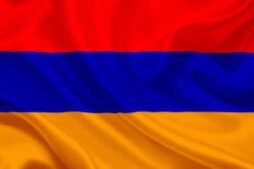
Armenia is politically interesting today for reasons that go well beyond being merely being another country choosing between Russia and the West.
On its territory, different forms of dependency are colliding in almost laboratory-like conditions:
- The Russian market and the EAEU;
- Russian gas;
- Nuclear energy;
- Iran;
- European integration;
- Transit through Georgia;
- The Turkish border;
- Azerbaijan;
- New transport corridors;
- The American presence.
Each of these elements, taken separately, can expand Armenia’s range of options, but on one condition: it must be feasible, and it must not eliminate more alternatives than it creates.
That is why the question “EAEU, EU or a third option?” may simply be premature.
First, several more mundane questions have to be answered:
- What will Armenia use for heating?
- Where will its electricity come from?
- Where will it sell what it produces?
- Across whose territory will its goods travel?
- Who controls the infrastructure?
- How much will all of this cost?
- Which of the announced options already exist?
- Which are under construction?
- Which are merely being discussed?
And what will happen to each of the available options if Armenia chooses to exercise another?
Only then does it make sense to return to politics. Perhaps a third path will emerge. Perhaps there will turn out to be more than three. Or perhaps it will become clear that some of the roads clearly marked on the political map end in a roadblock just a few kilometers beyond the signpost.
This article was written by V. Filchenko and E. Goncharoff. They can be contacted at info@russiapivottoasia.com.