
 Русский







The Russian government has presented a development plan for the Trans-Arctic Transport Corridor (TTC), with implementation costs estimated at ₽32.4 trillion (US$409 billion). The primary financial burden — over 93% of total funds — is to be met by private investors interested in establishing alternative logistics routes and reducing sanction risks.
According to data presented by Russian Deputy Prime Minister and presidential envoy to the Far Eastern district, Yuri Trutnev, Russia’s state budget financing for the project amounts to just ₽2.3 trillion (US$29 billion). The remaining ₽30.2 trillion (US$380 billion) must come from off-budget sources. The Development Programme for the Arctic Zone of the Russian Federation through 2035 includes 271 major projects covering the creation of transport, energy, and social infrastructure.
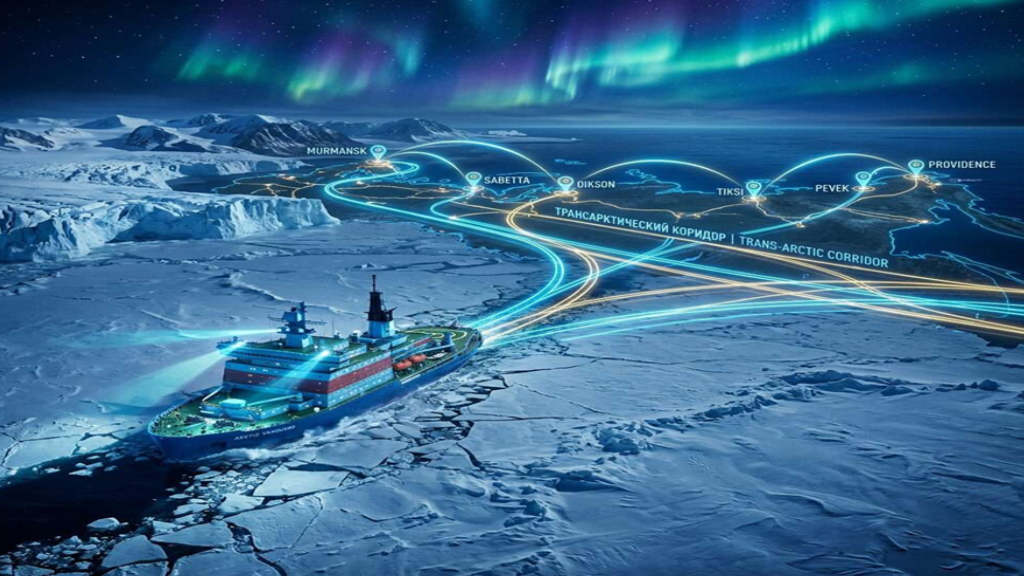
The TTC represents a unified logistics system based on the Northern Sea Route, integrating access routes to Arctic ports via a network of roads, railways, and inland waterways. Infrastructure construction timelines are estimated at a minimum of 10 years, with planning extending to a horizon of 2050.
Hydrocarbons dominate the current freight structure along the Northern Sea Route (86%), while containers and general cargo account for 11%. Diversifying transport and securing year-round navigation require building a specialized high ice class fleet alongside developing key settlements and transport accessibility in northern territories.
Trutnev stated that “We have assembled the comprehensive project development of the Arctic Zone of the Russian Federation and the Trans-Arctic Transport Corridor. We need to explore mineral deposits, clear riverbeds, and construct new railway sections. We must also create conditions for people to live, form new social infrastructure, build housing, and potentially establish new settlements.”
Interestingly, in June this year. Cargo turnover at Russia’s Arctic ports rose by 19.7% compared to June 2025.
To coordinate efforts, the project is divided into four blocks: investment projects, logistics, infrastructure, and the social sphere, with implementation proceeding in two stages: through 2030 and through 2035. Corridor development expects to attract partners from Asian countries to use the Arctic route, particularly China.
To put the financial need into perspective, the capital required by Russia to build and develop the TTC is roughly 32% of the total amount that China has spent on its entire Belt & Road Initiative. China’s spend on its BRI engagement has now reached US$1.3 trillion, of which US$775 billion has been allocated to construction and US$533 billion in investments.