
 Русский









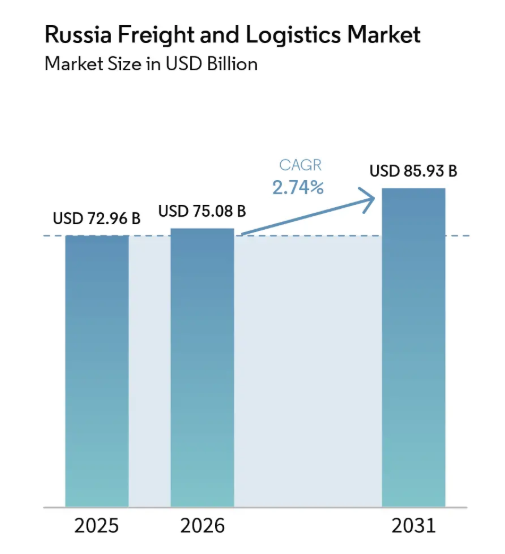
The Russian freight and logistics market size is projected to expand from US$75.08 billion in 2026 to US$85.93 billion by 2031, according to an independent report from Mordor Intelligence, an India based market intelligence firm. This data reflects a Russian CAGR of 2.74% between 2026 and 2031 and an overall increase of 13.33% over the period.
Compound Annual Growth Rate (CAGR) is a widely used financial metric that measures an investment’s annual growth rate over a specific period. To compare, the United States Freight and Logistics CAGR over this same period is 5% and for the European Union it is 3.26%.
A reconfigured federal infrastructure agenda, a rapid pharmaceutical cold-chain build-out, and digital border-clearance systems combine to lower transit friction across Eurasian corridors, supporting sustained growth. Completion of the M-12 Moscow–Kazan highway and upgrades along the Siberia Belt will shorten road transit times by 15-20%, while blockchain-enabled customs pilots at Zabaikalsk will cut border transit times.
The military-to-civilian conversion of Far-East airfields is poised to augment freighter capacity, and mandatory electronic consignment notes (e-CMR) to reduce empty-run kilometers by 12-15%. Together, these levers position the Russia freight and logistics market to weather insurance-premium escalation, climate-related infrastructure stress, and sanctions-induced equipment shortages.
In specific logistics functions, courier, express, and parcel posted the highest service-level growth with a 3.15% CAGR, even as freight transport retained 74.08% of the Russia freight and logistics market size of the 2025 value.
By end user industry, wholesale and retail trade held 34.65% of the Russia freight and logistics market share in 2025, with this segment forecast to expand at a 2.93% CAGR through 2031.
By freight transport mode, air freight accounted for the fastest modal growth at a 3.08% CAGR, though road transport maintained 58.03% of the 2025 market size.
By courier, express, and parcel (CEP) destination, international CEP recorded the strongest destination growth at a 3.28% CAGR, while domestic CEP captured 67.96% of the market share in 2025.
By warehousing and storage, temperature-controlled warehousing represented only 8.30% market share of the 2025 storage value but is projected to expand at a 2.63% CAGR through 2031.
By freight forwarding mode, sea and inland waterways led with 59.78% market share in 2025, whereas air freight forwarding is projected to post the fastest 2.76% CAGR between 2026-2031.
The August 2024 opening of the M-12 highway halved Moscow–Kazan drive times to 6.5 hours, enabling carriers to consolidate freight volumes around Tatarstan manufacturing zones. Operators report 18-22% fuel savings on M-11 due to grade optimization and continuous-flow tolling, equivalent to monthly operating-cost reductions of RUB 15,000-20,000 (USD 190-253) per truck.
Upgrades along the Siberia Belt will add 7,000 kilometers of dual-lane capacity by 2030, removing legacy checkpoints that added 4-6 hours per 1,000 kilometers. These improvements unlock landlocked Western Siberian clusters that were previously forced to use costlier rail or air. Nevertheless, average tolls of RUB 2.50 (USD 0.031) per kilometer weigh on low-margin bulk haulage, concentrating benefits among high-value consignments.
Domestic pharmaceutical output grew 23% in 2024 as vaccine and biologic production scaled, requiring 2-8 °C integrity across nationwide distribution. Current certified cold-storage covers only 60% of projected demand, and Roszdravnadzor (industry watchdog) compliance deadlines in 2025 have compelled Russian logistics providers to retrofit 40% of ambient capacity with validated monitoring and backup systems. Parallel expansion of frozen and chilled assortments in retail stores raises demand for specialized reefer transport. The Russia freight and logistics market, therefore, faces a supply gap that supports premium pricing for GDP-certified operators and creates room for IoT temperature-monitoring vendors.
Federal Law No. 272-FZ requires universal e-CMR usage by January 2026, digitizing waybills and enabling real-time shipment visibility. Early adopters cut empty-run kilometers by up to 15% through better backhaul matching and shortened EAEU border clearance. Integration with Roslogistics digital marketplaces produces network effects as shipper uptake rises. Implementation costs of RUB 80,000-120,000 (USD 1,013.48-1,520.22) per small fleet pose barriers, but fines reaching RUB 50,000 (USD 633.42) per paper waybill spur compliance. The reform raises the technological baseline of the Russia freight and logistics market and strengthens the competitive advantage of digitally enabled carriers.
More than ₽500 billion (US$6.33 billion) has been invested since 2022 in defence supply networks, delivering dual-use capacity now accessible to commercial freight. Runway extensions at Vladivostok and Khabarovsk reduce Asia-bound air-freight transit times by 20-25%. Added rail sidings on the Baikal-Amur Mainline to lift throughput by 18 million tonnes annually, relieving container congestion on the Trans-Siberian route. Access privileges favour logistics firms with security clearances, while smaller haulers encounter administrative hurdles. Long-term gains depend on sustained maintenance funding as military priorities evolve.
Marine insurance for Russian-flagged vessels jumped 38% in 2024, while Arctic sailings attracted an extra 15-20% surcharge due to sparse rescue infrastructure. Black Sea exclusions force cargo owners to self-insure or absorb US$200-300 per TEU in added premiums. Smaller forwarders lacking capital buffers exit higher-risk lanes, accelerating consolidation toward state-backed carriers.
Sanctions blocked official channels for Airbus, Boeing, and Caterpillar spares, raising aviation maintenance costs by up to 80% and cutting railcar availability by 12%. Russian operators have instead relied on grey-market intermediaries and cannibalized units, stretching lead times to nine months. Import-substitution programs spur domestic parts production, but quality gaps and limited capacity leave a medium-term deficit.
Wholesale and Retail Trade captured 34.65% of the Russia freight and logistics market size in 2025 and is forecast to grow at a 2.93% CAGR through 2031. Omnichannel retailers push e-commerce penetration toward 18% of national sales, fueling demand for urban consolidation hubs and micro-fulfillment centers. Manufacturing margins are squeezed by spare-parts shortages and high financing costs, while Oil, Gas, Mining, and Quarrying face rerouted exports and weaker European demand. Agriculture and Forestry leverage cold-chain buildouts to boost seafood and grain exports through Far-East ports.
The shift toward consumer-oriented flows reshapes capacity planning. Retail chains deploy dark stores within five kilometers of dense neighbourhoods, trimming delivery windows to four hours and commanding premium service fees. E-CMR accelerates adoption in retail supply chains, where backhaul utilization improvements curb logistics costs. As a result, last-mile specialists and integrated 3PLs secure stronger bargaining positions, while pure-play trucking operators confront rate pressure in the Russia freight and logistics market.
Although Freight Transport retained 74.08% of the 2025 market share, Courier, Express, and Parcel expanded at a 3.15% CAGR, evidencing a pivot toward time-sensitive, high-margin consignments. Freight Forwarding grows alongside EAEU and Asia-Pacific trade flows, and Warehousing benefits from pharmaceutical GDP certification deadlines. Other Services, including project and hazardous cargo, remain niche but profitable.
Automated sorting hubs capable of 50,000 parcels per hour and AI-driven route optimization lower last-mile costs by as much as 22%. Blockchain customs integration enables CEP firms to guarantee next-day cross-border delivery, cementing customer loyalty. In contrast, digital freight marketplaces compress traditional forwarding margins, pressing incumbents to invest in technology or cede share. This divergence widens EBITDA spreads across service lines, creating clear winners and laggards within the Russia freight and logistics industry.
International CEP grew at 3.28% CAGR through 2031, outpacing Domestic’s larger base. Blockchain customs pilots compress cross-border lead times to three days, enticing e-commerce sellers. Domestic CEP thrives on dense pickup-point networks that reached 12,000 locations in 2025, enabling same-day service in major cities. The domestic CEP captured 67.96% of the market share in 2025.
Service innovation centers on electric cargo bikes and micro-hubs that bypass congestion. Cross-border operators bundle brokerage, warehousing, and last-mile in single invoices, simplifying regulatory compliance for merchants. Temperature-controlled CEP emerges to serve direct-to-patient pharmaceuticals and premium food subscriptions. Economies of scale in automated sortation and route density create high entry barriers, supporting sustained margin expansion in this Russia freight and logistics market segment.
Non-Temperature-Controlled sites held 91.70% of the 2025 market share, yet Temperature-Controlled facilities are set to grow at a 2.63% CAGR to 2031. GDP certification drives retrofits, and rental rates for certified cold space run 2.5-3 times higher than ambient. Energy-efficient upgrades, including LED lighting and variable-speed compressors, cut utility costs by 25-30%.
Location strategy favours proximity to consumption centres and multimodal junctions. Moscow and St. Petersburg command 40% of national warehouse stock, but the Volga and Far-East regions attract new builds aligned with highway and customs expansions. Automation investments in ASRS raise inventory accuracy to 99.8% and slash labor by 70%, bolstering returns for large operators in the Russia freight and logistics market.
Road preserved a 58.03% market share of transport value in 2025, yet Air posted the fastest CAGR at 3.08%, buoyed by converted military airfields and rerouted spare-parts supply chains. Rail faces capacity bottlenecks on Far-East corridors, and Sea and Inland Waterways shoulder bulk commodity movements while Arctic cabotage opens nascent lanes. Pipeline volumes remain strategic but politically constrained.
Shippers recalibrate modal strategies to balance cost and speed. Air captures pharmaceuticals, electronics, and temperature-sensitive cargo, with dedicated freighter capacity up 15% in 2024. Road carriers leverage M-12 reductions in transit time but confront driver shortages and toll expenses. Intermodal solutions blending rail long-haul with road last-mile gain favor, improving reliability without large cost premiums. Providers offering flexible multimodal options thus gain share in the Russia freight and logistics market.
Sea and Inland Waterways accounted for 59.78% of market size in 2025, handling bulk grains, metals, and energy products. Air forwarding, however, advances at a 2.76% CAGR by serving pharmaceuticals, perishables, and electronics that justify premium rates. Arctic short-sea services introduce coastal redundancy, easing pressure on rail corridors.
Competitive differentiation hinges on end-to-end visibility and customs automation. Blockchain pilots allow forwarders to quote guaranteed transit times, reducing inventory buffers for shippers. Military-converted airfields diversify routing, lowering congestion risks at Moscow airports. Digitally enabled forwarders with real-time tracking and predictive exception handling grow faster than paper-based incumbents, reinforcing market bifurcation inside the Russia freight and logistics market.
The Central Federal District dominates warehousing and last-mile volumes, leveraging Moscow’s consumer base and St. Petersburg’s Baltic gateway. The region’s dense road and rail web supports same-day urban delivery and intricate omni-channel flows. The Volga Federal District has emerged as a logistics spine following M-12 completion, with transit times to Kazan and Yekaterinburg falling 40% and warehouse construction clustering near new interchanges. The district now attracts integrated 3PL investment seeking to bridge European Russia and the Urals.
The Arctic regions show early promise through Murmansk–Arkhangelsk–Dudinka cabotage, yet face permafrost-related maintenance and 35% premium hikes on hull insurance. Specialized engineering and ice-class vessel operators capture niche gains, but large-scale container flows remain limited. Siberian Federal District positions itself as an inland transit corridor, blending upgraded highways and BAM rail slots to move mining output and transit cargo to Asian customers.
Russia’s Northwestern District leverages St. Petersburg port infrastructure but grapples with muted European demand and high insurance costs for Baltic sailings. Kaliningrad functions as an exclave hub, handling transshipment between mainland Russia and EU markets despite geopolitical tension. Southern and North-Caucasus districts benefit from the International North-South Transport Corridor and agricultural exports, yet limited industrial density restrains overall scale. Geographic rebalancing toward Asia-facing corridors is therefore the central theme driving investment in the Russia freight and logistics market.
The Russia freight and logistics market remains moderately fragmented. Road haulage is split among thousands of fleets under 50 trucks, while cold-chain warehousing and CEP show rising concentration around vertically integrated players. State-backed entities exploit privileged access to highway concessions, Arctic cabotage permits, and military infrastructure, erecting competitive barriers. Digitally native CEP firms differentiate through e-CMR compliance, blockchain customs connectivity, and real-time tracking. Traditional forwarders struggle after bans on Western telematics forced an abrupt migration to domestic GLONASS platforms.
Mergers and acquisitions target cold-chain assets and last-mile networks, allowing owners to capture higher-margin service tiers. E-CMR mandates accelerate consolidation among small carriers unable to fund mandated hardware. Digital freight exchanges squeeze intermediary margins, prompting forwarders to pivot toward value-added consulting or perish.
Insurance-driven cost inflation and spare-part scarcity further favor asset-light models with diversified routing options. Domestic equipment manufacturers gain share under import-substitution policies; but must elevate quality to match phased-out Western alternatives.
Russia Freight And Logistics Industry Leaders:

Development Example: Russia’s FESCO Creating An Alliance With UAE’s Largest Port Operator

Development Example: Russia’s RZD Logistics Contracting Rail Transport To India and China

Development Example: Russia’s Delo Group Considering Oman As A Grain Transit Hub For East African Markets

Development Example: Russia Eyes Mid-July Start for Commercial Logistics Hub at Syrian Port

Development Example: CDEK Launches Cargo Transportation Between Russia And Turkmenistan
Other Recent Industry Developments:
February 2025: ATI.SU opened an integration unit providing plug-and-play 1C modules and bespoke API suites to shippers seeking zero-touch tender automation.
April 2025: FESCO and Xi’an Free Trade Port commenced a EUR 40 million (US$47.05 million) Zabaikalsk bonded hub, adding 80,000 m² of warehousing and a private 3-track rail spur.
January 2026: Delovye Linii unveiled a new express route for consolidated (LTL) cargo originating from China, slashing delivery times to Russia from the previous 35-40 days down to a swift 10-17 days. This service eliminates intermediate transshipment, reducing delays and risks, while handling shipments from 1 kg to 15 tons with end-to-end logistics support.
March 2026: Delovye Linii launched a new air transportation division in Irkutsk, seizing the opportunity presented by a surge in demand in Siberia and the Far East, where air cargo volumes had skyrocketed by more than 100% year-over-year.
Summary
This independent data showcases that Russia’s pivot to Asia has been successful, and that the redeployment of Russian logistics and supply chains to the east has not only been implemented, but is increasing to grow at significant rates outstripping supply chain growth and development in both the United States and the European Union. In the EU’s case, Russia’s freight and logistics industry is growing at a rate four times faster than the EU can currently manage.
This appears to be motivated by four main considerations – the access that Russian manufacturers continue to have to cheap energy resources, driving construction and development ahead. In addition, the redevelopment of existing, yet mainly military facilities in the Russian Far East to pivot to commercial use means that these ports and other infrastructures can more easily be enhanced and developed rather than having to be built from scratch – part of the required infrastructure is already extant. Third, Russia has been motivating its domestic companies both home and abroad to reinvest in Russian infrastructure development, and the ‘Made in Russia’ programme, with new incentives also soon due in the Russian Far East. Tax incentives and a lower Russian corporate tax base than is the case for previously overseas-domiciled Russian multinationals is seeing an influx of capital into Russian domestic projects.
Fourth, the transport, logistics and freight barriers created by the European Union, with the blocking of cross-border routes, and the effective banning of Russian imports, as well as the threat of sanctions on other countries on doing business with Russia has failed. Russia has simply moved its logistics and freight infrastructure to the east and to alternative markets in South and East Asia, as well as to Central Asia, the Middle East, and Africa. For example, these are the approximate trade growth figures that Russia has achieved with these regions since 2022:
- South Asia: +70% (largely driven by increased trade with India)
- East Asia: +70% (driven by China and ASEAN)
- Central Asia: +20% (driven by trade within the Eurasian Economic Union and Commonwealth of Independent States. This relatively lower growth rate is due to this region already having significant trade volumes with Russia)
- Middle East: +40 % (driven by trade with the Gulf Cooperation Council) Africa: +60% (driven by increasing energy and agricultural cooperation. Russia’s trade with Africa is now seven times larger than Africa’s trade with the United States).