Русский




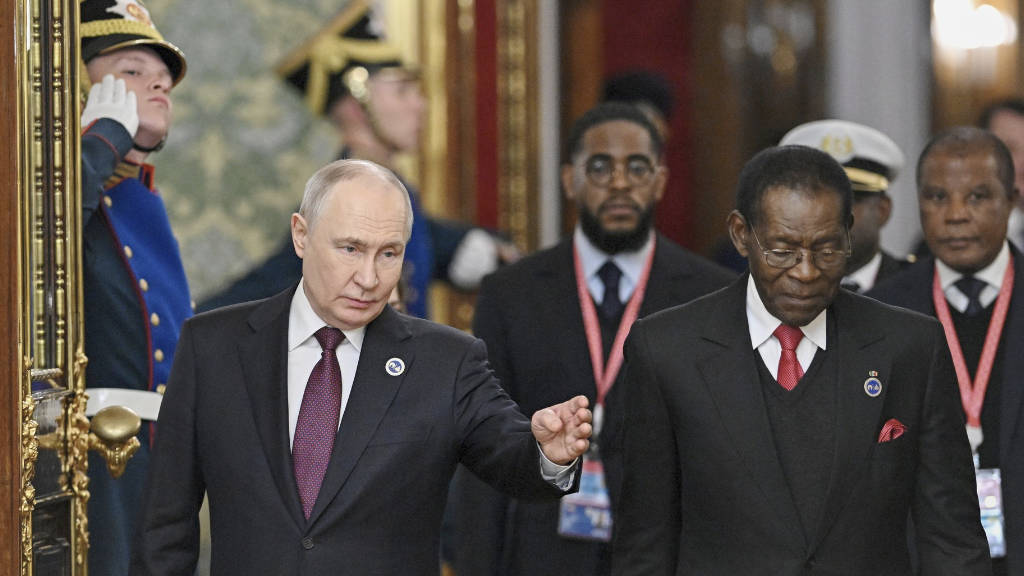

The Russian President, Vladimir Putin met with Teodoro Obiang Nguema Mbasogo, the President of Equatorial Guinea, at the 8th Summit of the Gas Exporting Countries Forum. Mbasago also participated in the 2026 Russia-Africa Summit.
The Russian side was represented by Foreign Minister Sergei Lavrov; Deputy Prime Minister Alexander Novak; Deputy Chief of Staff of the Presidential Executive Office Maxim Oreshkin; Deputy Chief of Staff of the Presidential Executive Office – Presidential Press Secretary Dmitry Peskov; Presidential Aide Yury Ushakov; Ambassador Extraordinary and Plenipotentiary of the Russian Federation to the Republic of Equatorial Guinea Karen Chalyan; Minister of Economic Development Maxim Reshetnikov; Deputy Minister of Defence Vasily Osmakov; Chief of the Main Directorate of the General Staff of the Russian Armed Forces – Deputy Chief of the General Staff Igor Kostyukov; Deputy Chief of the Main Directorate of the General Staff of the Russian Armed Forces Andrei Averyanov; and Director General of State Atomic Energy Corporation Rosatom Alexei Likhachev.
This is what they had to say:
Vladimir Putin: “Mr President, it is a great pleasure to see you in Moscow once again. In recent years, we have met on a regular basis, almost every year – and these meetings reflect the friendly and consistently constructive nature of our relations. Your visit to Moscow in 2025 to attend celebrations marking the 80th anniversary of our victory in the Great Patriotic War was an important milestone.
This time, you have arrived in the Russian capital to participate in two major international events: the 8th Summit of the Gas Exporting Countries Forum and the Russia-Africa Summit. I would like to thank you for your active engagement.
The coming days will be devoted to advancing our multifaceted partnership with Africa. Today, I suggest that we discuss our current bilateral and international agenda and identify our further joint efforts.
We see positive momentum in Russia–Equatorial Guinea relations. Dialogue between our foreign ministries is ongoing. In 2024, the Russian Embassy in Malabo resumed its operations. In addition, dedicated cooperation groups for Equatorial Guinea have been established in Russia’s State Duma and the Federation Council, while a friendship group with Russia was set up in the Senate of Equatorial Guinea last year.
Against this backdrop, trade and economic cooperation has clearly been lagging somewhat, with a certain decline. We expect the establishment of an intergovernmental commission to help reverse this trend.
I would also like to emphasise that our countries boast considerable potential to expand mutual supplies of goods in demand in both markets and to implement promising investment projects, particularly in the energy and mining industries.
We have also made good progress in cultural and humanitarian interaction. Each year, we provide funding from the federal budget for scholarships enabling 75 of your citizens to study at Russian universities. This year, we also organised two professional development programmes for Equatorial Guinean civil servants, hosted by RANEPA and St Petersburg State University. The group attending the St Petersburg programme completed its training just yesterday. Overall, more than a thousand specialists have received training in our country over the years. Meanwhile, a Russian Cultural Centre has been operating in Malabo since 2025.
We value our effective cooperation with Equatorial Guinea on the international stage. Our states maintain good relations at multilateral forums and share similar stances on core issues, advocating a polycentric world order and the right of every nation to independently determine its own path of development.”
Mbasogo: “Mr President, thank you very much for receiving me. Despite our busy schedule today, I would first like to thank you for inviting us to the third Russia-Africa Summit, which is underway here in the historic city of Moscow. I would also like to congratulate you on the excellent organisation of the event and thank you for the warm welcome extended to my delegation.
Russia has long been a partner of Equatorial Guinea, standing by our country since it gained independence in 1968. I would like to reaffirm our commitment to further enhancing these historic ties of solidarity, friendship, and cooperation with Russia.
I would also like to note that bilateral relations between our nations received a fresh boost with the opening of the Russian Embassy in Malabo in February 2024. Diplomatic contacts between our countries have also intensified, with our visits to Moscow and delegations sent by Your Excellency to Equatorial Guinea.
It would be beneficial for our respective foreign ministries to promptly reaffirm three agreements governing our bilateral relations. These cover economic, scientific and technical, and industrial cooperation, as well as fisheries, and would help breathe new life into our relations in these areas.
Regular high-level political consultations are important for reviewing the progress we have made and discussing further opportunities to advance our cooperation. I believe that a bilateral meeting to coordinate the projects we are currently implementing is particularly important.
I would like to emphasise that Equatorial Guinea has not been subjected to any attacks, and I would like to thank you for your efforts to protect African nations, particularly amidst the growing threat of terrorism across our continent. In this regard, I would like to note that Equatorial Guinea has so far been spared terrorist attacks, and we are making every effort to prevent such acts, especially given the spread of terrorism in Cameroon, Nigeria, and other neighbouring countries in Central Africa.
We appreciate your efforts to promote peace and stability. Your country plays an active and significant role in the Sahel region and across the African continent, particularly in Central Africa.
I am also grateful for our cooperation in the training and professional development of Equatorial Guinea’s military personnel.”
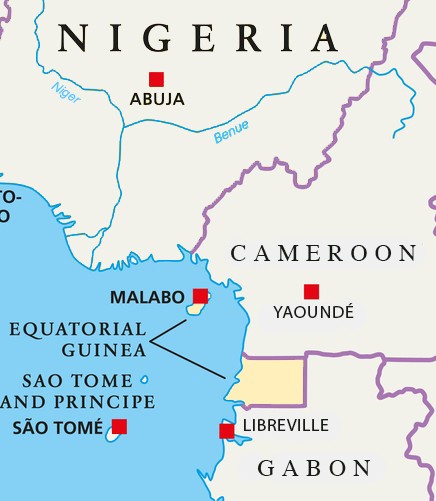
Equatorial Guinea, on the west coast of Central Africa, serves as a transit for commercial shipping between Africa and markets in Europe.
The economy is primarily driven by its hydrocarbon sector. Petroleum and natural gas make up approximately 97% of the country’s exports, with the nation being the third-largest oil producer in Sub-Saharan Africa. While oil production reached over 360,000 barrels per day in the early 2000s, recent years have seen a decline due to under-investment and a lack of new discoveries. Agriculture, once a major contributor, now makes up only 2.9% of GDP, focusing on subsistence farming. Key agricultural products include cassava, sweet potatoes, oil palm fruit, plantains, bananas, coconuts, coffee, and cocoa. Despite its smaller economic footprint, agriculture remains a critical source of employment, particularly in rural areas. The fishing industry and timber sector also contribute to the economy, though less prominently in recent years.
As a member of several regional and global organizations, Equatorial Guinea is part of the Economic Community of Central African States (ECCAS) and the Central African Economic and Monetary Community (CEMAC), which foster economic integration within Central Africa. The country is also a member of the World Trade Organization (WTO), providing access to global trade agreements. Additionally, Equatorial Guinea is a signatory to the African Continental Free Trade Area (AfCFTA), which aims to create a unified market for goods and services across Africa.
With a population of approximately 1.8 million, Equatorial Guinea has a GDP (PPP) of around US$33 billion, a GDP per capita (PPP) of US$20,500, and a projected GDP contraction of 1.7% for 2026, due to a decline in the energy sector, following several years of high growth. It has a medium ranked Human Development Index.
Russia, Equatorial Guinea Trade & Investment
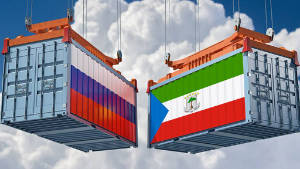
The Russian President, Vladimir Putin, held previous discussions with President Mbasogo in late 2024, when Equatorial Guinea held the rotating Presidency of the Economic Community of Central African States (ECCAS). This is a free trade area and includes Equatorial Guinea in addition to Angola, Burundi, Cameroon, the Central African Republic, Chad, the Democratic Republic of the Congo, Gabon, the Republic of Congo, Rwanda, and São Tomé and Príncipe.
Putin stated at that time that Russian companies have significant interest in working in Africa in general and in Equatorial Guinea in particular. In his opinion, the African country has “great potential investment opportunities,” especially in the context of natural resource extraction.
Equatorial Guinea took part in the ‘Great African Expedition’ to assess fish stocks in the West African Atlantic Ocean, while Russia is also interested in establishing port facilities. Russia is looking to replace European supplies and is also looking to invest in African ports and processing factories. The two sides are also exploring the possibility of Russian companies investing in Equatorial Guinea’s hydrocarbon industry.
Russia and Equatorial Guinea also signed a nuclear energy cooperation agreement in May 2026.
Russia currently exports pharmaceutical products, as well as mineral and chemical fertilizers, to Equatorial Guinea, while the latter exports some frozen fish to Russia. While bilateral trade is currently small at US$1.8 million in 2025, this could change quickly should the two sides engage in larger energy and maritime development projects.