
 Русский




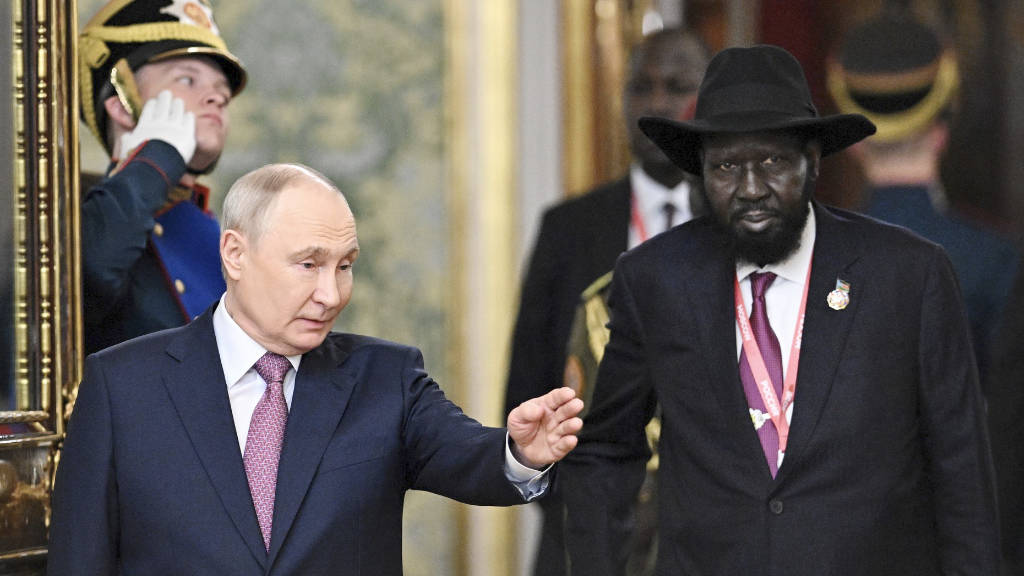

President Vladimir Putin met with President of the Republic of South Sudan Salva Kiir on the sidelines of the 2026 Russia-Africa Summit.
On the Russian side, attending the meeting were Deputy Prime Minister Alexander Novak, Deputy Chief of Staff of the Presidential Executive Office Maxim Oreshkin, Deputy Chief of Staff of the Presidential Executive Office – Presidential Press Secretary Dmitry Peskov, Presidential Aide Yury Ushakov, and Ambassador Extraordinary and Plenipotentiary of the Russian Federation to the Republic of South Sudan. Alexander Kosmodemyansky, Minister of Economic Development Maxim Reshetnikov, Deputy Foreign Minister Georgy Borisenko, Deputy Defence Minister Vasily Osmakov, Chief of the Main Directorate of the General Staff of the Russian Armed Forces-Deputy Chief of the General Staff of the Russian Armed Forces Igor Kostyukov, Deputy Chief of the Main Directorate of the General Staff of the Russian Armed Forces; Andrei Averyanov; and General Director of Zarubezhneft Sergei Kudryashov.
This is what they had to say:
Vladimir Putin: “Mr President, friends, We are delighted to welcome you all to Moscow and grateful to you for making the journey to take part in the third Russia-Africa Summit. You attended the first summit in Sochi in 2019, and I recall that the Vice President took part in the second summit in 2023. Yesterday, at the plenary session, we saw once again the mutual determination of our states to deepen bilateral relations and cooperation.
Our ties with South Sudan are friendly ones. This year we marked the 15th anniversary of the establishment of diplomatic relations. During your 2023 visit to Moscow, we held most substantive talks. On that occasion, we were able to discuss the bilateral and regional agenda in detail, and we agreed to open a Russian embassy in Juba-a step that will undoubtedly benefit interstate ties. I understand that in January, the Russian ambassador presented his credentials to you.
Together we are exploring ways to strengthen bilateral trade and economic engagement. Plainly, our potential is not yet fully realised.
We shall continue to assist in training personnel for South Sudan. For 2026/2027, we have raised the quota to 40 people.
We are pleased with our cooperation in international affairs and at the United Nations, which rests on the close alignment of Russia’s and South Sudan’s positions on key issues. Today offers a good opportunity to compare notes on the key aspects of our cooperation.”
Salva Kiir: “Your Excellency, I am very pleased to be here, and I thank you for finding time to meet me with my delegation, represented by ministers and senior officials from various sectors.”
Most of the bilateral talks involved South Sudan’s Caretaker Foreign Affairs and International Cooperation Minister Cecilia Adut Manyok, who said that the Russia-Africa summit provided a platform for African leaders and Russia to strengthen engagement and explore cooperation in economic development, security and other areas of mutual interest.
She stated that South Sudan’s priorities included cooperation in agriculture, security, agro-processing, infrastructure development, foreign direct investment, education, technical trade, healthcare, science and technology, local capacity building and peacebuilding.
According to the South Sudan Broadcasting Corporation (SSBC), the South Sudan government approved closer cooperation with Moscow in several sectors, including agriculture and education, with an economic partnership also covering petroleum, mining, healthcare, infrastructure, and information technology, according to the Office of the President.
Russian-South Sudanese Joint Intergovernmental Commission
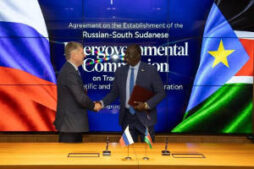
A major event that occurred as a result of the meeting was the Agreement on the Establishment of the Russian-South Sudanese Joint Intergovernmental Commission. That was signed by Maxim Reshetnikov, the Russian Minister of Economic Development, and Awow Daniel Chuang Deng, the Caretaker Minister of Petroleum of South Sudan.
This agreement is of fundamental importance for the further development of bilateral relations. The work of the intergovernmental commission makes it possible to bring Russian-South Sudanese cooperation to a new level, ensure systematic coordination of joint efforts, and open up additional opportunities for launching a number of key projects in South Sudan, in line with the expansion of Russia’s presence in the country’s economy and the strengthening of mutually beneficial partnerships in priority sectors.
The signing of the Agreement confirms the mutual interest of Moscow and Juba in further strengthening friendly relations and building a solid institutional foundation for long-term cooperation.
South Sudan Economy & Development
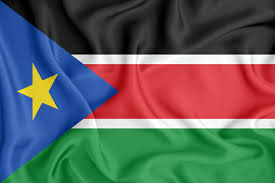
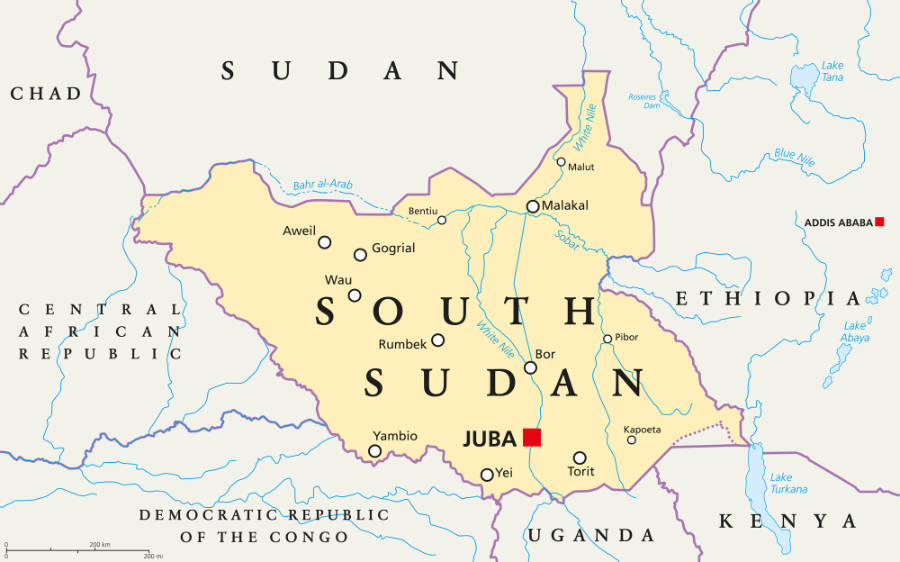
South Sudan is landlocked and one of the least developed countries in the world, ranking second to last in the Human Development Index, and also one of the poorest countries by GDP per capita. The country has been badly affected by a five-year civil war that ended in 2018 and is still recovering.
South Sudan’s population is approximately 12 million. According to the IMF, its GDP in PPP terms is US$19.16 billion, while GDP per capita is US$1,540. The GDP growth forecast for 2026 is 4.1%, a significant improvement after years of decline.
South Sudan’s economy is largely dependent on its oil and gas industry, with crude petroleum accounting for about 90% of the country’s foreign exchange earnings. However, the sector has faced significant challenges, including geopolitical issues and infrastructure constraints. The government is working to repair and resume oil pipeline operations, which are essential to the nation’s economic stability. Agriculture also plays an important role, employing a large portion of the population and contributing significantly to GDP. Key agricultural products include cotton, peanuts, gum arabic (with South Sudan being one of the world’s largest producers, accounting for 750% of global supply), sesame seeds, and livestock.
Additionally, South Sudan is rich in mineral resources, especially gold, and is the third-largest producer of gold in Africa, with annual production nearing 30 tonnes. The country’s manufacturing sector includes oil refining, cement production, and the production of goods like shoes and chemical fertilizers, although many factories are underutilized.
South Sudan is a member of several regional and continental free trade agreements. These include the Greater Arab Free Trade Area (GAFTA), Tripartite Free Trade Area (TFTA), and the African Continental Free Trade Area (AfCFTA), aimed at enhancing trade across Africa. The country is also part of COMESA (Common Market for Eastern and Southern Africa), the League of Arab States (LAS), the East African Community, and the Intergovernmental Authority on Development (IGAD). South Sudan has bilateral trade agreements with neighboring countries, such as Egypt, Ethiopia, and Sudan, covering agriculture, oil, and livestock.
Additionally, the country has strong economic ties with China, particularly in energy and infrastructure projects, where Beijing has invested about US$5 billion into the energy sector as well as constructing roads and Juba airports air traffic control system. Bilateral trade between China and South Sudan however remains relatively small at about US$420 million. There have been reported problems with Chinese traders exporting to South Sudan and using middlemen in Kenya and Uganda instead to take the financial risk.
The oilfields in South Sudan have been significant to the economy since the latter part of the 20th century. In 2023, oil constitutes more than 90% of state revenues, with the third-largest oil reserves in Sub-Saharan Africa. However, after South Sudan became an independent nation in July 2011, southern and northern negotiators have not been able to reach an agreement on how to split the revenue from these oilfields. However, with Sudan also being close to Russia, agreements may be revived, and with this, oil production increased.
South Sudan also contains many natural resources such as petroleum, iron ore, copper, chromium ore, zinc, tungsten, mica, silver, gold, diamonds, hardwoods, limestone, and hydropower. The country’s economy, as in many other developing countries, is heavily dependent on agriculture.
Russia, South Sudan Bilateral Trade & Investment
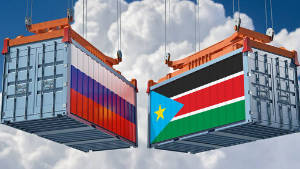
Russia-South Sudan bilateral trade is currently small, running at about US$10 million. However, this has received a boost with the signing of the Joint Commission, which signifies that Moscow is looking to become involved in South Sudan’s energy and minerals sectors. Additional intent, as mentioned by Putin, is that Russia opened an Embassy in Juba in 2024.
The next development stage will be Russian economic evaluation of South Sudanese mineral assets.
