 Русский




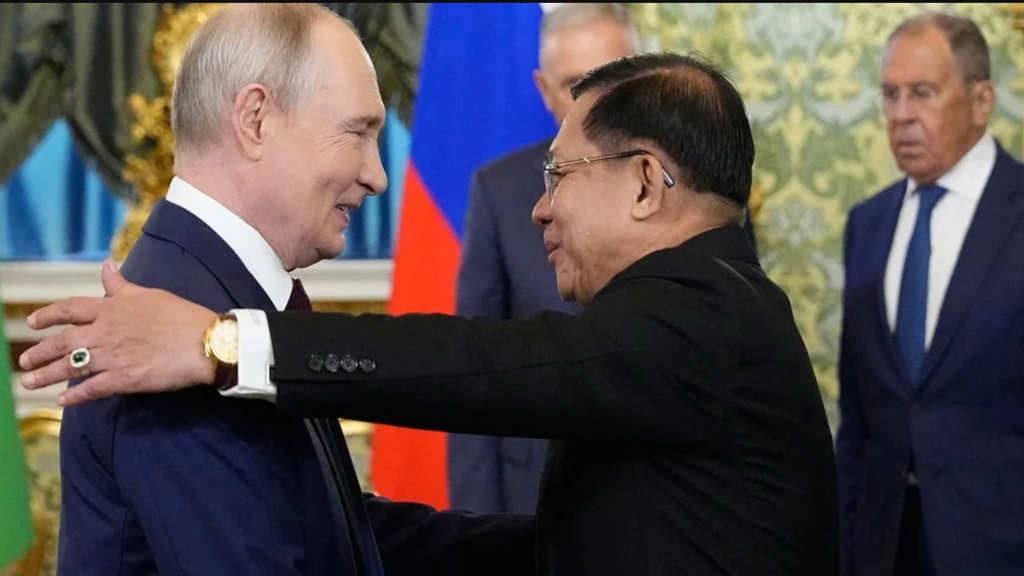

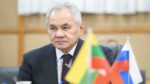
Myanmar President Min Aung Hlaing’s official visit to Moscow on August 17-19, 2026, where he also met with Russian President Putin, marks a significant transition in Russia-Myanmar relations. Russia’s support for Myanmar after the 2021 military takeover laid the political foundation for a relationship that is now expanding beyond defense cooperation. Moscow maintained close political and military-technical ties with Naypyidaw despite growing Western pressure, while Myanmar remains an important partner for Russia and broadly supportive of Moscow amid the Ukraine conflict. Moscow was among the first countries willing to maintain high-level engagement with Naypyidaw when Western governments imposed sanctions and diplomatic pressure. Defense cooperation remained particularly important, and a five-year military cooperation agreement was concluded in February 2026.
The partnership is now acquiring a stronger economic dimension. Trade, investment, energy, infrastructure, connectivity, financial settlements, tourism, agriculture, digital technologies and regional cooperation are increasingly entering the bilateral agenda. Russia and Myanmar are therefore moving from a primarily security-oriented relationship towards a broader strategic partnership with an expanding economic component.
It is worth noting that Russia and Myanmar have already expanded cooperation in space and defence, including a Roscosmos-Myanmar Space Agency agreement on human spaceflight, training Myanmar’s first cosmonaut, GLONASS stations and near-Earth object tracking, alongside a military cooperation pact running until 2030.
In April 2026, Myanmar’s Ministry of Electricity and Energy signed a cooperation agreement with Russia’s RC-Investments Fund covering energy cooperation, crude oil, petroleum products, LNG and related projects, with discussions also involving Inter RAO on Dawei infrastructure. During June 2026, Myanmar and Russia signed an economic and investment MoU with the RC-Investments Fund, followed by an Inter RAO-Launglon Economic Development Company MoU for a power plant at the Dawei Deep Sea Port Special Economic Zone, deepening strategic energy and infrastructure cooperation.
Hlaing’s visits to Russia in 2025, first as acting president and later in 2026 as president, have accelerated this process. His latest visit should be understood not as an isolated diplomatic event, but as part of efforts by both countries to institutionalize their long-term partnership. Myanmar’s diplomacy since the 2026 election also reflects this broader strategy. Engagement with India, China and now, Russia highlights the importance Naypyidaw attaches to major BRICS countries, while visits to Thailand and Laos demonstrate the continuing importance of ASEAN. This suggests a growing rejection of the West in Myanmar’s foreign policy, with BRICS particularly Russia, China and India and ASEAN becoming increasingly important pillars of its external relations.
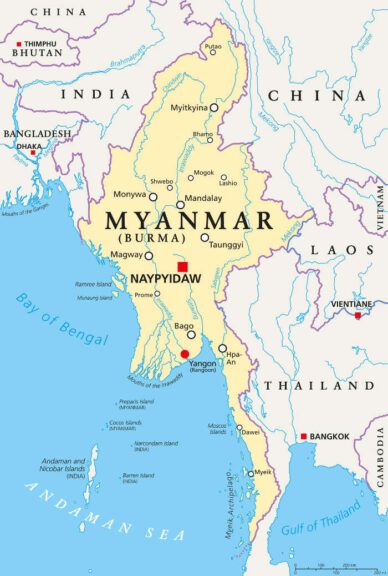
For Moscow, Myanmar offers a strategically significant partner in Southeast Asia. Located between China, India, Thailand and Bangladesh and facing the Bay of Bengal, Myanmar can provide opportunities for Russia to expand its economic and political presence in the region while strengthening its engagement with ASEAN. The next stage of the relationship could therefore extend beyond bilateral cooperation. Russia and Myanmar can develop trade and investment while exploring links between Russian interests, ASEAN markets and broader BRICS-ASEAN cooperation. Putin said during the August 18 talks that Russia was grateful for Myanmar’s assistance in promoting Russia’s relations with ASEAN.
The central issue is consequently no longer whether Russia and Myanmar will preserve their strategic partnership, but whether they can convert it into a functioning economic architecture covering trade, investment, energy, finance, infrastructure, technology and regional connectivity. That transformation is visible in the extraordinary breadth of this August’s package. The two sides signed total 12 intergovernmental documents, depending on whether individual protocols and related memoranda are counted separately. The package covered electricity and oil and gas, electronics and digital technologies, ICT, culture, satellite navigation, human spaceflight, search-and-rescue systems, competition policy and long-term LNG supplies. The implication is clear: Moscow and Naypyidaw are set on creating a large scale trade relationship.
The Political Meaning: From Post-Coup Support to Institutional Recognition

Myanmar’s parliament elected Hlaing president on April 3 following elections held in December 2025 and January 2026. Western governments and critics rejected the electoral process as lacking credibility, while Myanmar’s own institutions treated the process as the constitutional transition to a new government. Russia’s decision to receive Hlaing in Moscow as president is therefore politically important. It represents institutional recognition in bilateral practice: Moscow is dealing with the post-election government as the government with which it intends to conduct state-to-state relations. This distinction matters. Legitimacy is contested internationally, but governments conduct economic policy through institutions, contracts and sovereign counterparts. By receiving Hlaing in the Kremlin, signing intergovernmental agreements and opening new channels for investment and finance, Russia is helping Naypyidaw demonstrate that Western isolation does not prevent it from maintaining functioning international relationships. That is precisely why the visit matters more than an ordinary presidential trip.
Putin’s Meeting: Economics Has Moved to the Centre
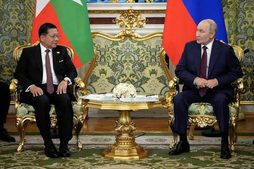
The August 18 Kremlin meeting lasted more than three hours, in both narrow and expanded formats. Putin emphasised that the relationship had moved beyond traditional political and security cooperation toward concrete economic projects. The Russian president specifically identified economic ties as a priority and said that two-thirds of commercial transactions between Russia and Myanmar are already conducted in Russian rubles. That is the most economically consequential statement of the summit. For two countries operating under different forms of Western financial pressure, settlement currency is not a technical detail. It is infrastructure. If bilateral transactions can increasingly be settled in rubles, supplemented by direct correspondent banking and the newer payment channel involving the Indian rupee, companies can reduce their exposure to dollar-based settlement channels and Western financial intermediaries. Russian Economic Development Minister Maxim Reshetnikov said at the August 19 Russia-Myanmar business forum that direct correspondent accounts already existed and that a new payment channel involving the Indian rupee had been launched in the previous month. Hlaing also highlighted the linkage of Russia’s Mir payment system with Myanmar’s MPU network and the introduction of direct kyat-ruble payments. This is the financial foundation of the relationship’s next stage. A bilateral trade target is meaningless if companies cannot reliably pay each other. Russia and Myanmar are therefore building payment capacity before attempting to build much larger trade flows.
The Mishustin Meeting: From Political Partnership to Project Pipeline
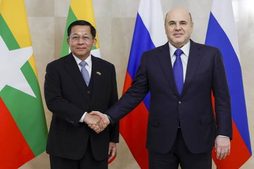
The meeting between Prime Minister Mikhail Mishustin and Hlaing on August 18 provided the clearest evidence that Moscow wants to turn political goodwill into an industrial project pipeline. Mishustin described Myanmar as a major Russian partner in Southeast Asia and the Asia-Pacific region. He identified manufacturing, energy, transport infrastructure and agricultural production as priority areas, while proposing deeper cooperation in digital economics, autonomous electronic systems and artificial intelligence.
Hlaing said during his meeting with Mishustin that “Coordination is actively underway between the competent authorities of both sides for the effective implementation of major projects, such as the construction of a small nuclear power plant, the creation of a deep-sea port in Dawei and a special economic zone, the construction of an oil refinery and a coal-fired power station, the establishment of a metallurgical plant in Pang Pet, and the construction of an organic fertiliser plant. Considering the strategic location of the port in Dawei within the region, Russia has been invited to express its interest in the project. Should these initiatives be successfully realised, they will generate employment opportunities for a significant number of people and contribute to the economic advancement of both nations. I wish to inform you that a delegation led by Vice-President Nyo Saw will participate in the 11th Eastern Economic Forum, which will be held in Vladivostok. To facilitate trade and economic collaboration between our countries, we have proposed the establishment of a Myanmar-Russia trade house in Moscow. Similarly, the Roscongress Foundation has proposed the opening of a trade house and energy infrastructure within the special economic zone in Yangon, as well as the establishment of a branch in Mandalay. The prompt, reciprocal establishment of such trade representations would facilitate even closer cooperation within the trade sector.”
The meeting was particularly significant because it brought together the sectors that determine whether bilateral trade can escape its current low base of about US$2 billion. Myanmar’s delegation included U Khin Maung Yi, U Tin Maung Swe, Dr Chaw Chaw Sein, Dr Thet Khaing Win, U Ko Ko Lwin and Dr Charlie Than, alongside Myanmar Space Agency chief executive Dr Soe Myint Maung, Tanintharyi Region Chief Minister U Zaw Naing Oo, senior Tatmadaw officers, the Myanmar ambassador to Russia and other officials. Russian cabinet ministers, its ambassador to Myanmar and officials accompanied Mishustin.
The composition is economically revealing as this was not simply a diplomatic delegation. It included energy, industry, health, technology, regional governments, space and security officials. The presence of the Tanintharyi chief minister was particularly important because the southern region contains the Dawei project, one of the most strategically ambitious components of the emerging Russia-Myanmar economic relationship.
Dawei: The Project That Could Change the Geography of Trade
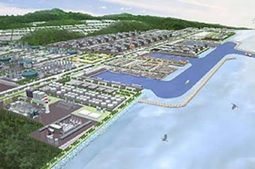
Dawei is the strongest example of why Russia-Myanmar relations should be analysed as a connectivity strategy rather than merely bilateral commerce. The Dawei Special Economic Zone covers about 196 square kilometres on Myanmar’s Andaman Sea coast. The project envisages industrial zones, transport infrastructure, information technology facilities and export-processing activities. Mishustin explicitly said Russian companies intend to participate in the zone. The associated deep-water port has been discussed with a projected handling capacity of 15 million tonnes.
In February 2025, Russia and Myanmar agreed on parameters involving the port, a power plant of up to 660 MW and an oil refinery. The geographical argument is even more compelling. Tanintharyi Chief Minister U Zaw Naing Oo told the August 19 Russia-Myanmar business forum that Dawei could allow vessels to bypass the Strait of Malacca and reduce transit times by four to six days. He also highlighted its connection to Thailand and Vietnam through the Southern Economic Corridor and its proximity, about 45 kilometres, to major offshore natural-gas fields.
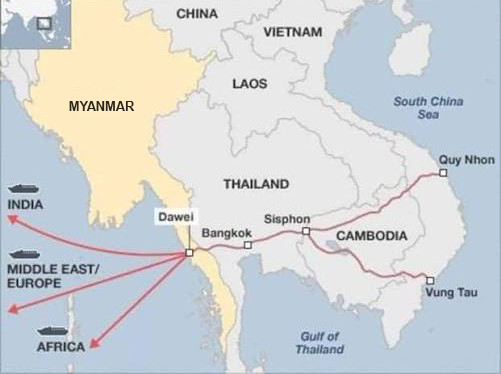
That gives Dawei a potential three-layer function. First, it can become an industrial platform for Myanmar. Second, it can become a maritime gateway linking the Andaman Sea with Thailand, Vietnam and the broader Mekong region. We also discuss here how cooperation among Thailand, Myanmar, and Russia on the Dawei Port could boost regional integration and connectivity by strengthening trade, transport networks, and economic links across the region. Third, it can become a future energy logistics point for Russian supplies entering Southeast Asia. For Russia, this is strategically attractive because the country’s Far Eastern ports can serve Asian markets while Myanmar offers an Indian Ocean-facing platform. For Myanmar, it means Russian capital and technology can complement Chinese infrastructure and Indian connectivity rather than necessarily replacing them.
The relevant negotiations are currently underway between Russia and Myanmar to ensure that Russian companies participating in investment projects in the latter country receive majority stakes during the payback period as one of the conditions, Russian Economic Development Minister Maxim Reshetnikov said. “Russian businesses have set another objective for us that we are negotiating, which is to enable our businesses to invest and maintain a majority stake in any given project during the payback period. This is necessary for Russian banks to finance projects in Myanmar and, accordingly, attract their own capital, as well as debt financing. I am confident that we will find a mutually acceptable solution to the matter,” Reshetnikov said at the Russia-Myanmar business forum. The decision is important within Russia’s plans to participate in the project to develop the Dawei Special Economic Zone (SEZ) that envisages constructing a deep-water port, a coal-fired power plant, and an oil refinery, Reshetnikov said. Hlaing is particularly seeking greater Russian investment in Myanmar, viewing it as strategically significant. Putin ratified the Russia-Myanmar Agreement on the Promotion and Protection of Investments, originally signed in June 2025, providing a legal framework and protections for investors from both countries.
Energy Is the Commercial Core
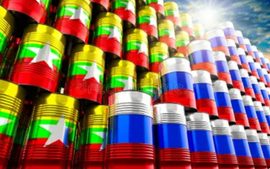
Energy is the strongest economic pillar of the new relationship. Over 90% of oil on the Myanmar market originated from Russia in 2024. Putin said Russia is ready to participate in Myanmar’s oil and gas exploration and production, including offshore projects. Moscow is also considering an oil refinery and power plant in southern Myanmar and sees prospects for LNG exports to Myanmar, including transit supplies to neighbouring countries.
The April 16, 2026 memorandum between Myanmar’s Ministry of Electricity and Energy and Russia’s RC-Investments Fund provides an important bridge. It covers crude oil, petroleum products, LNG and related energy projects. Protocols implementing this memorandum were subsequently included in the August 18 document package.
This commercial opportunity extends beyond Myanmar’s domestic market. Myanmar is strategically positioned between China, Thailand, Bangladesh, India and the rest of mainland Southeast Asia. If Russian LNG enters Myanmar and future infrastructure permits redistribution, the market could eventually include Thailand, China and potentially Bangladesh. Thailand’s Deputy Prime Minister and Foreign Minister Sihasak Phuangketkeow specifically asked that Thailand be included in the Dawei Port project in meetings held in Moscow on August 12-15.
This is where Myanmar’s geography becomes economically valuable to Russia. Moscow does not necessarily need Myanmar to become a major final consumer. It could become a transit and processing node. The proposed refinery addresses another structural weakness. Myanmar’s existing refining capacity covers only around 2-3% of domestic demand. That creates a natural commercial logic for Russian participation: crude supply, refining, petroleum distribution, power generation and potentially petrochemicals can be developed as one integrated value chain rather than separate projects.
Russia-Myanmar Nuclear Power
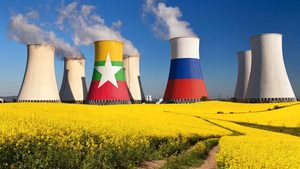
A small modular nuclear project is potentially the most important long-term technology project in the relationship. Russia and Myanmar signed the relevant intergovernmental agreement in March 2025. The initial planned capacity is 110 MW, with potential expansion to 330 MW. Rosatom has indicated that construction could begin in 2027, using modular RITM-200 technology with two 55 MW reactors per module. The economic significance goes far beyond electricity generation. A nuclear project creates demand for engineering, construction, scientific research, specialist training, safety systems, digital control equipment, logistics and long-term maintenance. Mishustin explicitly described the project as a catalyst for fundamental and applied research. For Myanmar, the attraction is access to stable baseload electricity and advanced technology. For Russia, it provides a foothold in a Southeast Asian civilian nuclear market and creates the possibility of a much longer technological relationship. The proposed 110 MW project is therefore small in generation terms but potentially large in strategic economic consequences.
Fertilizers: The Fastest Existing Trade Opportunity
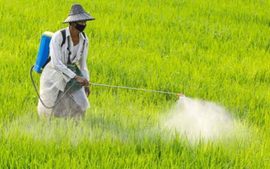
If nuclear power is the long-term strategic project, fertilizers are the fastest-growing commercial category. Myanmar imports up to 95% of its chemical fertilizers, targeting roughly 1.6 million tonnes annually to support staple crops like rice. This is important because Myanmar is a net rice exporter, with a target a total of 3 million tonnes in shipments for the 2026/27 fiscal year. Top buyers include the Philippines, China, and European nations including Belgium, Spain, and Poland. It is also lucrative: strong demand for varieties like GW-11 has pushed export prices to record highs around US$580 per tonne.
Russian mineral-fertilizer deliveries to Myanmar increased elevenfold during the first half of 2026. This matters because Myanmar has a structurally large agricultural sector and significant fertilizer-import requirements. Myanmar approved over150,000 tonnes of fertilizer import licences during the nine-month period in the 2025-26 fiscal year, alongside nearly 27,500 tonnes of pesticides.
Estimates place Myanmar’s broader fertilizer demand at more than 2 million tonnes annually. Russia therefore has an opportunity to move from supplying fertilizer to participating in local fertilizer production. The organic-fertilizer plant highlighted at the August 19 forum is particularly important. Roscongress said construction was progressing and that initial output was expected at the beginning of 2027. That is a better model than simple commodity exports because it embeds Russian technology and capital inside Myanmar’s agricultural value chain.
Trade Diversification Must Work Both Ways
During Hlaing’s meeting with Putin in 2025, Putin stated that by the end of the previous year, trade had increased by approximately 40%, reaching nearly US$2 billion. He added that Russia was ready to work on expanding mutually beneficial trade. Through this 2026 visit, both countries aim to expand and diversify their trade base, with bilateral trade potentially reaching approximately US$5 billion, reflecting the size of both economies and the strategic ambition of their relationship.
Myanmar’s exports to Russia remain concentrated in garments, textiles, footwear and a limited number of agricultural products. Reshetnikov said Russian businesses are prepared to expand supplies of energy, vehicles, grain, animal-feed products, medical devices and pharmaceuticals, while simultaneously purchasing more Myanmar products. Myanmar has already begun supplying Russia with beans, transformers, furniture and utensils. Hlaing identified rice, pulses, maize, sesame and fishery products as areas where Myanmar could expand exports. He specifically highlighted Pawsan rice as a premium product with market potential in Russia. Myanmar has also been exporting mango paste, value-added food products and garments. This is crucial because a sustainable bilateral trade relationship cannot be based only on Russian exports. Myanmar needs foreign-exchange earnings from Russia, while Russia needs reliable new Asian markets. The objective should therefore be a two-way supply chain: Russian energy, fertilizer, machinery, vehicles, pharmaceuticals and technology flowing into Myanmar, while Myanmar supplies Russia with food, agricultural commodities, garments, seafood and selected manufactured goods. Russia has already undertaken investment projects worth US$97.359 million in Myanmar’s oil, natural gas and industrial sectors.
A bilateral investment treaty between Russia and Myanmar was signed on June 20, 2025, in Saint Petersburg, to provide a legal framework for the promotion, protection, and mutual encouragement of long-term commercial investments between both nations. This also provides some tax concessions as well as reducing rates in the services sector. This document is why Russian investment is now starting to take note of opportunities in Myanmar. Looking ahead, there is confidence that Myanmar and Russia can further deepen cooperation in agriculture, energy, infrastructure, industry, science and technology, education and human resource development.
The Sanctions Mitigation Declaration As An Economic Instrument

The joint declaration on countering, mitigating and compensating for the negative consequences of unilateral coercive measures is arguably the most politically significant of the August 18 documents. Its importance is not rhetorical. Sanctions affect trade through banking, insurance, shipping, correspondent accounts, technology access and investment risk. By signing a dedicated declaration, Moscow and Naypyidaw are effectively acknowledging that their economic relationship must be designed around sanctions resilience. That explains why payment mechanisms appeared alongside energy and investment agreements. Two-thirds of transactions already being conducted in rubles provides a measurable starting point. Direct correspondent accounts, kyat-ruble settlement and the Indian-rupee payment channel provide additional layers. Mir’s connection with Myanmar’s MPU network adds a retail-payment dimension. The strategic objective is not complete de-dollarisation. It is transaction diversification: reducing the number of points at which bilateral trade can be disrupted.
The Russia-Myanmar Twelve Signed Documents: Details
- The first document, the joint declaration on unilateral coercive measures, creates the political framework for sanctions-resistant economic cooperation. Its value lies in institutionalising coordination rather than treating sanctions as an obstacle to individual transactions.
- The second memorandum, covering electricity and the oil-and-gas industry, provides the sectoral framework for power generation, petroleum, LNG and upstream cooperation. It directly supports the energy projects discussed by Putin and Mishustin.
- The third memorandum on radio-electronic industry and digital technologies is important because it moves the relationship beyond natural resources. It opens potential cooperation in electronics, industrial digitalisation and technology supply chains.
- The fourth memorandum between the Federal Antimonopoly Service and Myanmar’s Competition Commission is less visible but economically important. Cross-border investment requires regulatory predictability. Competition-policy cooperation can reduce uncertainty for companies entering new markets.
- The fifth memorandum on culture and art strengthens the people-to-people component of the relationship. It is economically relevant because cultural exchanges can support tourism, education and longer-term public familiarity.
- The sixth ICT memorandum is potentially more commercially significant. Digital infrastructure, telecommunications and data systems can become enabling infrastructure for trade, banking, logistics and government services.
- The seventh Roscosmos-Myanmar Space Agency memorandum covers satellite navigation and human spaceflight. It also incorporates Cospas-Sarsat search-and-rescue cooperation and the ASPOS near-Earth hazard warning system.
- The eighth education-related memorandum involving Plekhanov University creates an institutional channel for economic and managerial training. Russia already has educated more than 7,000 Myanmar citizens, with roughly 400 currently studying in Russian universities according to Putin’s remarks.
- The ninth memorandum involving Bauman Moscow State Technical University and Myanmar’s space institutions extends the technological relationship into advanced engineering and aerospace education.
- The tenth RC-Investments memorandum creates a business and technical cooperation mechanism linking Russian investment capabilities with Myanmar’s energy sector.
- The eleventh protocol implements the April 16 agreement concerning long-term LNG supplies. This is especially important because it turns the earlier energy memorandum into a more concrete implementation track.
- The twelfth protocol further implements the RC-Investments cooperation framework and reinforces the movement from broad political declarations toward project execution. Actually, it is the protocol on the implementation of the Memorandum of Cooperation between RC-Investments Fund of the Russian Federation and the Ministry of Electricity and Energy of the Republic of the Union of Myanmar of April 16, 2026 (regarding long-term supplies of liquefied natural gas (LNG)).
The complete package is therefore best understood as a layered system: sanctions resilience, energy, finance, technology, regulation, education, space and implementation mechanisms.
Russian-Myanmar Business Forum 2026
The Russian-Myanmar Business Forum 2026, held on 19 August 2026 at the Plekhanov Russian University of Economics in Moscow, served as the commercial counterpart to the 18 August Kremlin summit between Russia and Myanmar.
Organised by the Embassy of Myanmar in Russia and the Roscongress Foundation, the forum brought together more than 80 Russian companies and over 130 Russian representatives, alongside Myanmar government officials and business representatives. The programme focused on strengthening bilateral economic relations through investment, trade, economic zones, financial cooperation, tourism, and new products and solutions. The forum opened with welcome addresses by Ivan Vasilyevich Lobanov, Rector of Plekhanov Russian University of Economics; Aye Win, President of the Union of Myanmar Federation of Chambers of Commerce and Industry (UMFCCI); and Maxim Gennadyevich Reshetnikov, Minister of Economic Development of the Russian Federation. A special keynote address was delivered by U Min Aung Hlaing, President of the Republic of the Union of Myanmar.
The session highlighted the sectors and areas in which both sides see potential for expanding commercial cooperation. Under “Investment Opportunities in Myanmar,” presentations were delivered by U Thant Sin Lwin, Deputy Minister of the Ministry of National Planning, Investment and Foreign Economic Relations; Alexander Sergeyevich Shatirov, Director of the Investment Fund of the Roscongress Foundation; and U Ye Yint Aung, Chairman of the Board of Myanmar AnBang Investment Group Co., Ltd.
The session on “Trade Opportunities and Special Focus on Economic Zones in Myanmar” featured U Min Min, Deputy Minister of Commerce; Artur Valeryevich Ibatullin, Russian representative nominated for the Port and Power Plant; and U Zaw Naing Oo, Chief Minister of Tanintharyi Region. This discussion was particularly relevant to the broader effort to develop trade, infrastructure and investment opportunities in Myanmar, including projects connected with the country’s strategic economic zones.
A further session on the current economic situation in Myanmar brought together Daw Khin Khin Nwe, Secretary-General of UMFCCI; Thanay K., Director of Myanmar Airways International (MAI), as listed in the programme; and M. A. Minchenkov, Member of the Project Council of the State Corporation Rostec and Adviser to the President and Chairman of the Management Board of JSC Eurofinance Mosnarbank.
The financial and technological dimensions of bilateral cooperation were also highlighted. Vladimir Vyacheslavovich Sitnov, Senior Vice President of PJSC Sberbank, presented “Sberbank-A Financial Bridge Between Myanmar and Russia: Strategic Partnership and New Opportunities.” Andrey Viktorovich Bakumenko, Deputy General Director of LLC Telematic Solutions, also presented the company’s perspective on potential cooperation.
All this showcases the serious level of intent in developing bilateral relations: participants were senior level government and corporate officials.
B2B Meetings: Moving from Government-to-Government to Business-to-Business

The most important practical component of the forum was the B2B Meetings between Russian and Myanmar companies. Conducted in English, Russian and Burmese, these meetings provided a direct platform for companies from both countries to explore commercial partnerships, investment opportunities, market access, technology cooperation and potential joint projects.
The B2B component was significant because it represented the forum’s effort to translate high-level political and governmental commitments into company-to-company engagement. While the major formal agreements had already been concluded at the presidential level on 18 August, the business meetings provided an opportunity for Russian and Myanmar enterprises to discuss how such commitments could be implemented through concrete commercial relationships. The overall structure of the forum therefore points to a deliberate progression from government-to-government diplomacy toward business-to-business cooperation. Rather than functioning primarily as a signing ceremony, the forum served as a matchmaking and market-building platform, bringing together policymakers, financial institutions, infrastructure and technology companies, investors and private-sector representatives.
The closing theme, “The Business Forum: From Government-to-Government to Business-to-Business,” captured this objective. The emphasis on investment opportunities, trade and economic zones, financial connectivity, technology, and direct B2B engagement suggests that Russia and Myanmar are seeking to deepen bilateral economic relations by moving beyond political dialogue and toward practical, company-level implementation. In this context, the B2B Meetings between Russian and Myanmar companies were a key bridge between the political agreements reached at the leadership level and the commercial activities required to turn those agreements into actual investment, trade and joint-venture opportunities.
Tourism, Aviation and Humanities Infrastructure

Tourism is another small sector with considerable growth potential. Current Russian tourist arrivals in Myanmar are only around 3,000-4,000 annually, while the 2019 pre-pandemic figure exceeded 5,000. The 2025 flow grew by around 10%. Direct flights between Russia and Myanmar are scheduled to resume in October 2026, according to Russian Economic Development Minister Maxim Reshetnikov, who highlighted strong prospects for tourism cooperation. The two countries had resumed flights in September 2023 after a 30-year gap, but services were suspended in 2025 because of low demand. However, the subsequent January 2026 introduction of visa-free travel for stays of up to 30 days significantly reduces one barrier to tourism and business travel. The Myanmar Tourism Federation and ITE Russia also discussed a tourism cooperation memorandum, with ITE’s Connect Digital B2B platform reporting more than 260,000 active users.
Tourism matters economically because it creates a low-cost mechanism for increasing human contacts, airline demand, retail payments and small-business activity. It can also support the broader investment relationship by making business travel easier.
There is also growing interest of Myanmar citizens in learning Russian. The language is currently taught at the prestigious universities of Yangon and Mandalay, as well as at the Defence Services Academy. The possibility of Myanmar schools and universities joining the Russian Teacher Abroad programme is also being explored. At present, approximately 400 Myanmar students are studying at Russian universities. In total, over 7,000 Myanmar citizens have received their education in Russia.
Russia’s Far East Gives Myanmar A Second Geography

The planned opening of a Myanmar Consulate General in Vladivostok is more significant than it might initially appear. Vladivostok is Russia’s gateway to the Pacific and the administrative and commercial centre of the country’s Far Eastern orientation. A Myanmar diplomatic presence there can support trade, investment, shipping, education and regional business links. This also suggests that Russia’s FESCO Transportation Group could facilitate container shipping and cargo transit direct to Myanmar – the Russia-Myanmar route is currently served by using regional transshipment hubs in Vietnam and China. If trade builds, the need for direct service will develop.
The relationship is also becoming increasingly regional rather than purely central-government-to-central-government. Min Aung Hlaing noted that Tatarstan, Buryatia, Kalmykia, St Petersburg and Novosibirsk have developed contacts with Myanmar. Novosibirsk and Mandalay have formalised sister-city relations and adopted cooperation plans for 2026-2028. This regionalisation is important because many economic projects are not controlled exclusively by Moscow. Myanmar can work directly with Russian regions that have strengths in agriculture, engineering, energy, logistics, education and technology.
Space, Digital Technology and the Search for a New Technology Relationship
The space agreements demonstrate that Russia is trying to make the relationship technologically deeper. Partnerships in high-tech sectors are also developing. Russian companies are ready to introduce their unique cutting-edge digitalisation, cybersecurity, and data storage technologies in Myanmar. Cooperation is also being developed under the Intergovernmental Agreement on Cooperation in the Exploration and Use of Outer Space for Peaceful Purposes and Manned Spaceflight, signed in 2025. Roscosmos plans to select and train Myanmar’s first national cosmonaut according to Russian standards. Cooperation also covers satellite navigation, including GLONASS-related infrastructure, Cospas-Sarsat search and rescue and monitoring of near-Earth hazards. For Myanmar, the economic significance is practical. Satellite technologies can support agriculture, disaster management, environmental monitoring and maritime surveillance. For Russia, the opportunity is to create an integrated technology relationship in a market where Western technology access is constrained. Mishustin’s proposal to cooperate in artificial intelligence, autonomous electronic systems and digital economics takes the same logic further. The emerging relationship therefore has three technology layers: civilian nuclear technology, aerospace and digital systems.
Defence Remains the Foundation, But No Longer the Whole Relationship
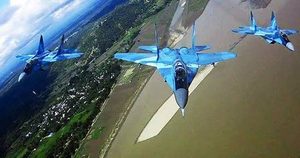
Military-technical cooperation remains substantial. Russia is reported to account for approximately 38% of Myanmar’s arms supplies, including MiG-29 aircraft, Mi-24, Mi-38T and Mi-35P helicopters, Pechora-2M air-defence systems, radar, armoured vehicles and artillery. Russia also maintains aircraft support and sees potential for naval-equipment cooperation because of Myanmar’s maritime position. Putin confirmed that naval exercises are regularly conducted off Myanmar’s coast and that Russian Navy ships make port calls there. Myanmar and Russia have established close military and military-technical cooperation. Bilateral naval exercises are regularly held off the coast of Myanmar, and Russian Navy ships also make port calls there. This security relationship gives Moscow an established strategic channel in Southeast Asia. But the economic evolution of the relationship is more important for its future sustainability. Defence creates trust and institutional familiarity. Energy, payments, infrastructure, agriculture and technology create economic interdependence. The strategic transformation is therefore from a defence-heavy relationship to a defence-backed comprehensive partnership.
Cultural and Religious Cooperation

Myanmar-Russia ties are also expanding in cultural and religious cooperation. Myanmar cultural and religious centres already operate in Altai Territory, Kaluga Region and Moscow, while an agreement has also been reached to build a Russian Orthodox church in Yangon. On 11 August 2026, Myanmar’s Sitagu International Buddhist Academy (SIBA) and Russia’s Foundation for the Promotion of Buddhist Education and Research signed a five-year cooperation agreement in Moscow. It covers Buddhist literature, research, education and culture, including conferences, seminars, training programmes, exchanges of scholars and research on Buddhist scriptures, historical sites and contemporary teachings. The agreement was signed by Sitagu Sayadaw and Alexey Maslov, strengthening people-to-people, academic and religious links between the two countries.
The Bangladesh Question: An Underappreciated Future Opportunity

Myanmar’s position also creates a potential link with Bangladesh. Bangladesh is already looking at ways to secure additional gas supplies from Myanmar, while Myanmar’s western geography provides the possibility of future energy and infrastructure connections toward Bangladesh. The Russia-Myanmar LNG framework could eventually become relevant to such regional energy flows if infrastructure, commercial feasibility and political conditions permit. The strategic logic would be a chain extending from Russian energy suppliers through Myanmar’s energy infrastructure toward Bangladesh, Thailand and potentially other neighbouring markets.
Myanmar’s existing China-linked oil and gas infrastructure also demonstrates that the country can function as a transit territory between major Asian markets. The China-Myanmar pipelines connect Kyaukphyu on the Bay of Bengal with Kunming in Yunnan, demonstrating the strategic value of Myanmar’s west-east corridor. Russia’s interest in LNG, Myanmar’s offshore gas resources, Dawei’s maritime location and Bangladesh’s energy demand could eventually create a broader Bay of Bengal energy network. There is not yet a signed Russia-Myanmar-Bangladesh project, and regional security problems persist. But it is precisely the kind of second-order economic opportunity that makes this years agreements strategically significant.
Myanmar’s Natural Resources and Russia’s Mining and Engineering Capacity

Myanmar possesses oil and gas, minerals, agricultural land, forests, fisheries and significant coastal resources. Russia, meanwhile, has large engineering, mining, metallurgy, energy and geological-exploration capabilities. The August 18 energy memorandum provides an institutional basis for Russian participation in hydrocarbon exploration, including offshore operations. Putin specifically mentioned Russian readiness to participate in exploration and production. This could eventually extend into geological services, drilling, engineering equipment, processing and logistics. The same logic applies to metallurgy. Myanmar and Russia are already discussing a metallurgical plant at Pang Pet, alongside the organic-fertilizer plant. If these projects progress simultaneously, Russia would no longer simply be an exporter to Myanmar. Russian firms would increasingly become producers and technology providers inside Myanmar.
Can Russia-Myanmar Bilateral Trade Reach US$5 Billion by 2030?

The current base makes aggressive trade growth mathematically possible. If bilateral trade, according to Russian President Putin had reached about US$2 billion in 2024, reaching US$5 billion by 2030 would require an average annual compound growth rate of roughly 30%. That is ambitious, but not impossible if energy, fertilizer, machinery, agricultural products, LNG and infrastructure begin generating actual transactions. The critical variable is not political declarations. It is project execution. If fertilizer supplies continue expanding, if the refinery and power projects move from feasibility studies into construction, if LNG contracts become operational, if Dawei attracts Russian companies, if payment channels scale up and if agricultural exports from Myanmar enter the Russian market, bilateral trade could grow several times over its current level. But without those developments, the relationship will remain politically strategic while economically modest.
The Seven Measurable Steps To Growth

The August 18 documents are not evidence that a US$5 billion economic relationship has suddenly appeared. They are evidence that Russia and Myanmar are constructing the institutional machinery required to create one. The most important immediate indicators will be measurable. First will be the implementation of the 110 MW nuclear project from 2027. Second will be progress on Dawei’s port, power and industrial-zone components. Third will be the execution of the April LNG memorandum. Fourth will be the growth of fertilizer shipments beyond the elevenfold increase recorded in the first half of 2026. Fifth will be the scale of ruble-kyat and rupee-linked settlement. Sixth will be the restoration and sustainability of direct air links. Seventh will be the expansion of Myanmar agricultural exports to Russia. These indicators will determine whether Moscow and Naypyidaw have built a real economic corridor or simply produced another package of diplomatic documents.
Summary: A New Russia-Myanmar Model Is Taking Shape
The most important change in Russia-Myanmar relations is conceptual. After 2021, the relationship was largely understood through the lens of political solidarity and military cooperation. In 2025, nuclear energy and investment began expanding the agenda. By 2026, the relationship is being organised around trade, payments, energy, infrastructure, technology, tourism and investment.
The August 18 meetings demonstrate this transformation with some clarity. The MoU agreed and signed cover energy, oil and gas, electricity, electronics, ICT, space, competition policy, sanctions resilience and culture. The August 19 business forum added companies, investment discussions, tourism, B2B meetings and Dawei-focused opportunities.
The bilateral relationship has therefore moved from strategic protection to economic architecture. That architecture is still incomplete. Bilateral trade remains far below the potential implied by the two countries’ ambitions. Many projects remain at feasibility, planning or memorandum stage. Private-sector participation is still less developed than state-led cooperation. The political and security situation inside Myanmar continues to create substantial commercial risk.
Yet the direction is unmistakable. Russia and Myanmar are building the foundations for a sanctions-resilient, non-dollar, energy-intensive and infrastructure-linked economic partnership that connects the Russian Far East with mainland Southeast Asia and the Bay of Bengal. If Dawei develops, if LNG moves, if the nuclear project begins construction, if fertilizer and agricultural trade expands, and if payment systems become sufficiently deep to support private businesses, the relationship could change from a politically durable partnership into an economically consequential one.
This is why Min Aung Hlaing’s August 2026 Moscow visit should not be judged simply by how many agreements were signed. The real significance lies in what those agreements are designed to connect: energy to infrastructure, infrastructure to trade, trade to alternative finance, finance to investment, investment to technology, and all of them to Myanmar’s strategic geography between India, China and ASEAN.
The decisive question for the period to 2030 is consequently no longer whether Russia and Myanmar will remain partners. The evidence from 2026 strongly suggests that they will. The real question is whether they can convert that political certainty into economic scale. If they do, Myanmar could become more than a recipient of Russian energy, defence equipment and technology. It could emerge as a southern gateway through which Russian capital, commodities and technology reach the wider Indo-Pacific while Russian markets give Myanmar an additional outlet for its agricultural, industrial and resource potential. That would represent a fundamentally different relationship from the one created after 2021: not merely an alliance of governments under pressure, but an emerging economic corridor designed to function under pressure.
This article was written by PC Majumdar, a geostrategic and geo-economics analyst based in South Asia whose work has been widely published by prestigious international news organizations and publications. He may be reached at info@russiaspivottoasia.com