Русский






A Pakistan-Russia IT Collaboration Webinar, titled ‘Building Technology Partnerships, Market Access and Joint Solutions’, took place on November 5, 2026, at the Ministry of Planning, Development and Special Initiatives in Islamabad, and has produced a solid, institutionalized structure for further developments that could lead to some significant Joint Venture investments. We examine what took place.
Russia and Pakistan are moving to establish a commercial technology partnership built around artificial intelligence, cybersecurity, enterprise software, cloud computing and digital infrastructure, with an initial programme of B2B meetings involving the creation of a pipeline for joint development and market expansion.
The November 5 engagement in Islamabad brought together technology companies, industry associations and digital-sector specialists from both countries. Its commercial priorities extend beyond conventional IT outsourcing to joint product development, cybersecurity solutions, financial technology, cloud infrastructure and technology delivery in third-country markets.
Six areas of cooperation were identified, providing a framework for matching Russian scientific and engineering capabilities with Pakistan’s expanding IT workforce and international services-export experience. The immediate significance lies in the shift towards company-level implementation. Rather than relying exclusively on bilateral discussions, the two sides are developing a sequence involving identified business counterparts, specific project opportunities, pilot implementation and subsequent commercial contracts. The programme also creates an opportunity to diversify a bilateral trading relationship that has remained concentrated in agricultural commodities, textiles and energy-related transactions.
The Six Russia-Pakistan Technology Sectors

The Pakistan-Russia IT Collaboration Webinar, titled ‘Building Technology Partnerships, Market Access and Joint Solutions’, took place on Thursday, November 5, 2026, at the Ministry of Planning, Development and Special Initiatives in Islamabad, with Russian participants joining remotely from Moscow.
The programme was organised by the Pakistan Software Export Board (PSEB), operating under Pakistan’s Ministry of IT and Telecommunication, in collaboration with the University of World Civilizations Moscow (UWCM). It was the third event in the Pakistan-Russia Webinar Series and followed earlier business-to-business engagement facilitated by PSEB and the Pakistan Software Houses Association (P@SHA).
The six cooperation areas are:
- Artificial Intelligence and Cloud Computing;
- Cybersecurity and Critical Infrastructure Protection;
- Digital Governance and Digital Public Infrastructure;
- IT and IT-Enabled Services ;
- Digital Skills and Workforce Exchange;
- Quantum Computing.
These priorities establish several possible commercial models. Russian companies can contribute specialised software, scientific research, cybersecurity products and advanced engineering, while Pakistani companies can provide software development, systems integration, international client delivery, technical personnel and access to South Asian markets. Joint delivery in Russia, Pakistan and third-country markets was specifically discussed. The resulting discussions produced a shortlist of prospective projects in cybersecurity, enterprise software, artificial intelligence and cloud computing.
Ebryx, Positive Technologies and TMC Lead Possible Russia-Pakistan JV Discussions
The cybersecurity discussions produced one of the clearest prospective commercial partnerships between Pakistan’s Ebryx and Russia’s Positive Technologies. Ebryx was represented by Chief Executive Officer Ahrar Naqvi, while Positive Technologies participated through Regional CEO Yegor Rykov. The companies explored the co-development of enterprise-grade cybersecurity products, threat-detection systems and security architectures for businesses and critical infrastructure. The proposed cooperation could combine Ebryx’s managed security services, vulnerability assessment, penetration testing, cloud security and incident-response capabilities with Positive Technologies’ cybersecurity products and threat-research expertise.
Founded in 2008, Ebryx is headquartered in Lahore’s Arfa Software Technology Park, with additional operations in Islamabad and Karachi. Its activities include security monitoring, zero-trust architecture, ransomware protection, threat intelligence and custom security engineering. The company serves large international clients, including Fortune 500 businesses, as well as government organisations and smaller enterprises. Its stated certifications include CMMI Level 3 and ISO 27001. Positive Technologies is one of Russia’s established cybersecurity developers and is listed on the Moscow Exchange. Its business encompasses information-security products, enterprise protection systems, vulnerability research and incident response. The potential partnership therefore has a complementary commercial structure: Pakistani engineering and international service delivery combined with Russian-developed security technologies.
A second engagement involved Pakistan’s TMC Group, represented by Group Chief Executive Officer and Managing Director Abdul Haseeb. Discussions covered enterprise software, financial technology, scalable business platforms and cloud infrastructure. The objective is to develop solutions that can be integrated into business operations in both countries and potentially supplied to customers in other international markets. The Russian Quantum Center, represented by Director Dr Alexey Akimov, introduced another dimension to the programme. Its participation extended the discussions beyond immediate software services into quantum computing, advanced research, secure computing and next-generation analytical technologies. Cooperation in this field is likely to require longer research and development cycles than cybersecurity or enterprise software pilots, but it offers opportunities for university-industry collaboration and specialised technical training.
The industry associations also played an important coordinating role. RUSSOFT President Valentin Makarov and Pakistan Software Houses Association (P@SHA) Chairman Dr Shoab Ahmed Khan discussed structured partnerships between the Russian and Pakistani software industries, including joint delivery and market access. Dr Irina Serenko examined the digital economy as an area for sustained cooperation. Two industry sessions provided the principal discussion platforms. The first was moderated by Dr Roxolana Zigon of UWCM, bringing together Makarov, Khan and Serenko. The second was moderated by Shahbaz Hameed of PSEB, with Ahrar Naqvi, Yegor Rykov, Abdul Haseeb and Dr Alexey Akimov examining practical company-level opportunities. This structure is important because it connects industry associations, which can coordinate larger business networks, with individual companies capable of developing and delivering commercial products.
Pakistan’s US$4.6 Billion IT Industry Creates A Larger Export Platform
The technology initiative comes as Pakistan’s IT and telecommunications industry expands its international business. Exports reached a reported record of US$4.6 billion in FY2025-26, approximately 20% above the previous year’s US$3.814 billion. The increase represents approximately US$786 million in additional annual export earnings.
This also provides a substantial commercial foundation for Pakistani companies seeking new customers in Russia and other markets. Pakistan produces more than 75,000 IT graduates annually. Its national ambition is to develop one million AI professionals by 2030, supported by seven new AI centres intended to connect research, skills development, startups and industrial applications.
Planning Minister Ahsan Iqbal placed the technology initiative within URAAN Pakistan, the country’s national economic transformation programme. E-Pakistan is one of its five strategic pillars, with an overall ambition of developing a US$1 trillion economy by 2035.
The workforce programme has implications for bilateral industrial cooperation. Pakistani software developers and engineers could participate in Russian-led product development, while Russian companies could obtain additional engineering capacity and access to a larger pool of technology professionals.
Joint development would also provide a route for Pakistani businesses to move from contract-based services towards proprietary software and digital products. Russia has its own substantial technology-export base. RUSSOFT President Valentin Makarov stated in an October 8, 2026, interview published by the association that Russian IT companies generated nearly US$6.5 billion in foreign sales during 2025. He described international cooperation based on technology transfer, source-code access, partner training and joint development rather than simply exporting finished products. That approach is particularly relevant to Pakistan. Joint ownership or participation in product development could allow Pakistani companies to retain intellectual property, develop local expertise and build recurring export revenue rather than relying exclusively on project-based outsourcing.
Digital Governance, Payments & Workforce Development
Digital public infrastructure represents another potential area of cooperation. Pakistan’s National Database and Registration Authority (NADRA) has developed a large-scale digital identity system, while the Raast instant payment platform provides a domestic model for digital financial transactions. Raast processed 646 million transactions in a single quarter, according to Ahsan Iqbal’s November 5 remarks. The scale of these transactions makes financial technology, identity verification, secure authentication and interoperable digital services relevant areas for joint technical development. Possible applications include secure digital trade systems, electronic identity verification, business payment infrastructure, financial technology integration and digital supply-chain management. Russian software developers could contribute enterprise platforms and cybersecurity architecture, while Pakistani firms could bring experience in large-scale digital service delivery.
Artificial intelligence and digital governance were particularly emphasised because both countries operate digital systems serving large populations. Industrial automation, enterprise software and digital agricultural supply chains were also identified as potential workstreams. Workforce exchange is equally important. Pakistan’s existing IT graduate pipeline and AI training ambitions provide a foundation for joint technical teams, while Russian engineering expertise offers opportunities for specialised training and research collaboration.
A language-development initiative is intended to support this process. A Russian-language centre at Allama Iqbal Open University, working with Pakistan’s Higher Education Commission, is expanding Russian-language learning among Pakistani academics and researchers. Russian-language programmes are also being incorporated into existing language education initiatives. The practical objective is to increase the number of Pakistani specialists capable of reading Russian technical material, participating in research programmes and negotiating directly with Russian companies. This is particularly relevant to advanced engineering, cybersecurity and scientific cooperation, where technical documentation and specialist communication are essential.
Pakistan-Russia Bilateral Trade
The technology initiative is taking place against a background of relatively limited merchandise trade. According to Pakistan’s official figures, bilateral trade with Russia stood at US$243.412 million in FY2024-25, substantially below the approximately US$963 million reported for FY2023-24. Calendar-year figures from UN Comtrade, meanwhile, show merchandise trade of approximately US$215.1 million in 2025, comprising US$65.98 million in Pakistani exports and US$149.12 million in imports from Russia. This produced a Pakistani trade deficit of approximately US$83.14 million. (The fiscal-year and calendar-year figures cover different reporting periods).
The composition of trade illustrates the diversification challenge. Pakistan’s principal exports to Russia in 2025 included leather products worth US$21.49 million, non-knitted apparel worth US$18.53 million, vegetables worth US$6.19 million, optical and medical instruments worth US$5.5 million, knitted apparel worth US$4.12 million and cotton worth US$3.32 million. Russian exports to Pakistan were concentrated in agricultural products. Edible vegetables and roots accounted for US$142.62 million, followed by pharmaceutical products at US$3.34 million and coffee, tea and spices at US$1.45 million. Mineral fuels and petroleum products represented only approximately US$38,760 in the UN Comtrade classification for 2025.
The contrast is significant. Bilateral merchandise trade remains concentrated in relatively traditional product categories, whereas the technology programme targets higher-value services, intellectual property, specialised software and digital infrastructure. The opportunity is therefore not simply to increase the number of Pakistani IT companies selling services in Russia. It is to establish a new category of bilateral trade involving software licensing, cybersecurity products, cloud services, AI applications, technology transfer and jointly developed digital platforms.
Expanding The Bilateral Economic & Institutional Framework
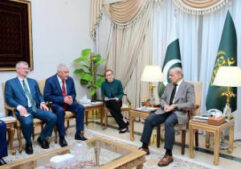
The November technology initiative followed a series of high-level engagements in Islamabad in October 2026. Russian Interior Minister Vladimir Kolokoltsev arrived in Pakistan on October 12 for a four-day visit, the first visit to Pakistan by a Russian interior minister. On October 14, he met Prime Minister Shehbaz Sharif, Interior Minister Mohsin Naqvi, Deputy Prime Minister and Foreign Minister Ishaq Dar, and Chief of Defence Forces Field Marshal Asim Munir in Islamabad and Rawalpindi.
During these discussions, Shehbaz Sharif and Kolokoltsev addressed the expansion of bilateral trade, investment, energy and economic development. President Asif Ali Zardari also discussed stronger cooperation in oil and gas, industrial development and regional connectivity with the Russian minister. A memorandum of understanding on strengthening cooperation in combating organised crime was witnessed by the prime minister.
Further discussions covered information exchange, extradition arrangements, readmission, anti-narcotics cooperation and cybersecurity. The two interior ministries also discussed cooperation between Pakistan’s National Police Academy and the Russian Police Academy, alongside the exchange of skilled Pakistani manpower and easier visa procedures for businesspeople and tourists. Kolokoltsev referred to a 33% reduction in cybercrime achieved through Russian measures.
Pakistan also highlighted that approximately 1,300 Pakistani students were studying in Russia. These engagements provide a broader institutional environment for the technology partnership, particularly in cybersecurity, secure information exchange and professional training. Energy and transport connectivity remain important components of the wider relationship. Russian crude oil purchases, agricultural supplies and potential industrial cooperation have featured in earlier bilateral economic discussions.
Pakistan has also expressed interest in stronger links through the International North-South Transport Corridor (INSTC), rail and road connections through Central Asia, direct flights and improved cargo connectivity. For technology companies, better connectivity and commercial arrangements could facilitate personnel movement, project implementation and access to customers in additional regional markets.
Payments & Settlement Mechanisms
One of the practical issues raised during the November 5 discussions was the difficulty of establishing efficient payment and settlement arrangements between Pakistani and Russian businesses. Ahsan Iqbal acknowledged that relevant institutions were working on the issue. The challenge has implications for software licensing, recurring service subscriptions, technology procurement, cross-border investment and the payment of engineering teams.
The two countries have previously explored financial cooperation, including a 2018 memorandum between their central banks. However, banking procedures, international compliance requirements and settlement arrangements have remained important considerations in bilateral commercial activity. The technology initiative therefore needs to develop alongside workable banking channels and transparent commercial arrangements.
Without predictable payment mechanisms, even technically successful pilot projects could face difficulties when moving towards regular service contracts and larger transactions. PSEB’s proposed follow-up mechanism is intended to address another operational problem: the gap between initial business discussions and commercial implementation. Chief Executive Faisal Jeddy outlined four stages: defining the opportunity, matching suitable companies, agreeing on a pilot project and assigning named focal persons on both sides. PSEB intends to remain involved in the process and review progress with its Russian counterparts. This approach places responsibility on participating businesses to identify specific deliverables rather than treating the webinar as an isolated networking exercise.
Summary
The November 5 initiative has established an initial commercial framework involving several Russian and Pakistani businesses, under a recognized bilateral institutional structure. Its six priority areas provide a wider platform for cooperation, while the company discussions have concentrated on cybersecurity, enterprise software, FinTech, AI, cloud computing and quantum technologies.
The most immediately identifiable prospective partnership is between Ebryx and Positive Technologies, where existing cybersecurity products and service capabilities provide a basis for joint development.
TMC’s engagement creates opportunities in enterprise software and financial technology, while the Russian Quantum Center opens a longer-term research dimension. The institutional network includes PSEB, P@SHA, RUSSOFT and the University of World Civilizations Moscow, with Faisal Jeddy, Shoab Ahmed Khan and Valentin Makarov providing industry-level coordination.
The next stage is the conversion of shortlisted opportunities into pilot projects, followed by commercial agreements, joint product development and access to additional markets. For Pakistan, the initiative offers a route to diversify its US$4.6 billion IT export industry, increase higher-value technology exports and expand the commercial role of its 75,000-plus annual IT graduate pipeline.
For Russia, it creates an additional South Asian partnership channel for cybersecurity, software, cloud and advanced engineering products. The broader economic significance lies in the possibility of changing the structure of bilateral trade.
With merchandise exchange still relatively modest and heavily concentrated in agricultural and traditional manufactured goods, technology cooperation provides a potential new source of services exports, investment, intellectual property development and skilled employment.
The measurable indicators of progress will be the number of pilot projects launched, contracts concluded, joint products developed, companies entering each other’s markets, specialists trained and recurring technology exports generated. The November programme has established the initial company-to-company network and identified the priority sectors. Its economic importance will ultimately depend on how effectively that network develops into a sustained commercial partnership.