Русский




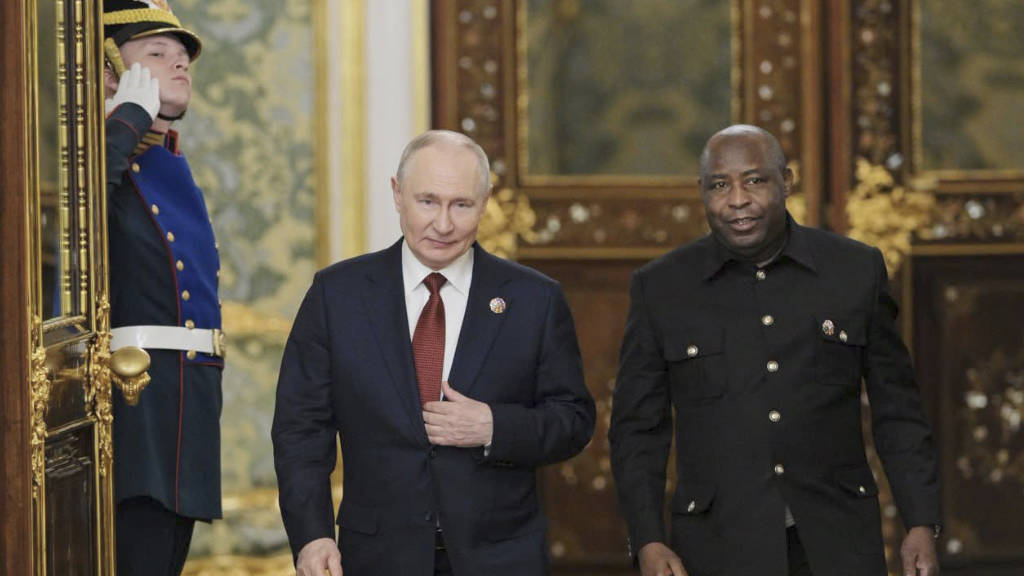

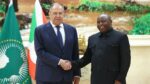
The Russian President, Vladimir Putin met with the President of Burundi, Evariste Ndayishimiye, on the sidelines of the 2026 Russia–Africa Summit in Moscow.
Taking part in the meeting on the Russian side were Deputy Prime Minister Alexander Novak, Deputy Chief of Staff of the Presidential Executive Office Maxim Oreshkin, Deputy Chief of Staff of the Presidential Executive Office – Presidential Press Secretary Dmitry Peskov, Presidential Aide Yury Ushakov, Russian Ambassador Extraordinary and Plenipotentiary to Burundi Sergei Chernenko, Minister of Economic Development Maxim Reshetnikov, and Head of the Federal Service for the Oversight of Consumer Protection and Welfare Anna Popova, Deputy Foreign Minister Georgy Borisenko, Deputy Defence Minister Vasily Osmakov, and Director General of the State Space Corporation Roscosmos Dmitry Bakanov.
Ndayishimiye is the current Chair of the African Union and spent a considerable amount of time with Putin as part of this role. We covered their joint press conference regarding the 2026 Russia-Africa Summit here. However, bilateral ties are also increasing. In this article we examine their mutual trade and investment relations. This is what they had to say on the subject:
Vladimir Putin: “I would like to thank you for your substantial contribution to the success of our summit. We are developing relations with the African Union, which you currently chair, on a solid, long-term basis. As you know, we supported the African Union’s aspiration to become a full member of the G20.
Our bilateral relations are developing well, and our ties continue to grow stronger. We can discuss what further steps might be taken to ensure that our economic cooperation, alongside our political engagement, helps advance our shared plans for strengthening these long-standing bilateral ties. Next year, we will mark the 65th anniversary of diplomatic relations between our countries.
I am also aware that a ceremony was held yesterday to confer upon you the title of Honorary Doctor of the Patrice Lumumba Peoples’ Friendship University of Russia. Please accept my warmest congratulations on this occasion.”
Ndayishimiye: “Thank you very much, dear friend, for this opportunity. This meeting has confirmed that Russia wants to move forward together with Africa. As I have said, you have stood with us since the beginning of our struggle for decolonisation, supporting us in our quest for independence. Today we are in a different era – an era of development, and we are very grateful to Russia for its support.
Thank you for supporting us in this new phase – the phase of liberation, the pursuit for economic autonomy for African countries. All African countries understand that we have opportunities, but we lack the capital to get everything started. Because we need a solid framework for this.
What is that framework? It is an international plan. We would like to thank Russia once again for supporting our bid to become a full member of the UN Security Council and our aspiration to join the G20. We will continue in this spirit, hoping that Africa will achieve a strong position on the international stage, enabling us to advance our social and economic spheres.
Burundi has opportunities, we have natural resources and capital, we have a very dynamic young population and, in principle, we have the finances. What we lack is finance and technology to create basic infrastructure – in transport, in energy, in digital systems. We do not have all this at present. But I believe that together we can move forward. Russia has such capital, and we hope that at this new stage, we will be able to cooperate and to see how we can invest more and build a mutually beneficial partnership.
We have a great wealth of natural resources, and we need capital to process them and create value chains. The last time we met, I told you about our projects – socioeconomic projects in particular. Yes, we faced some difficulties: at that time the West imposed sanctions against us – there was Western interference. We continue to suffer from this.
We have budgetary problems and we cannot, receive funding from the World Bank and the International Monetary Fund. That is why I asked for assistance with chemical fertilisers, and I would like to repeat that request once again.
We have also asked for help in protecting our institutions. We are in close proximity to the Democratic Republic of the Congo and you know that there is a conflict underway in its eastern regions.”
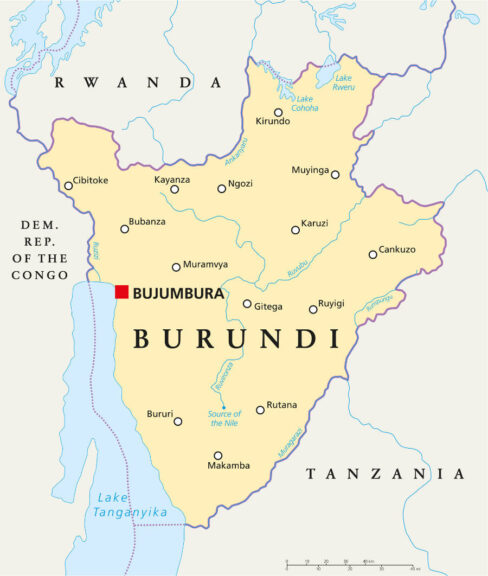
Burundi is a landlocked, resource-poor country with an underdeveloped manufacturing sector. The economy is predominantly agricultural, accounting for about 50% of GDP, while employing more than 90% of the population. Subsistence agriculture accounts for 90% of agriculture. Burundi’s primary exports are coffee and tea, which account for 90% of foreign exchange earnings, though exports are a relatively small share of GDP. Other agricultural products include cotton, tea, maize, sorghum, sweet potatoes, bananas, manioc (tapioca), beef, milk and cow hides.
Burundi is one of the world’s poorest nations, owing in part to its landlocked geography, a lack of education and the proliferation of HIV/AIDS. Famines and food shortages have occurred throughout Burundi, and according to the World Food Programme, 56.8% of children under age five suffer from chronic malnutrition. Burundi’s export earnings – and its ability to pay for imports – rests primarily on weather conditions and international coffee and tea prices. Apart from agriculture, other industries include the assembly of imported components; public works construction; food processing; and light consumer goods such as blankets, shoes, and soap.
Burundi does have some natural resources; however, investment will be needed to extract these. They include uranium, nickel, cobalt, copper and platinum.
Burundi joined the East African Community (EAC) in 2009 and is also a member of the African Continental Free Trade Agreement.
With a mainly Christian population of just over 14 million and covering an area of 27,834 km², Burundi’s GDP (PPP) is estimated at US$14 billion, with a GDP per capita (PPP) of just US$1,020. It has a low Human Development Index, although there is some sign of progress – 2026 GDP growth is estimated to reach 4.7%.
Russia, Burundi Bilateral Trade & Investment
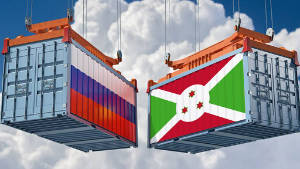
Burundi and Russia have a small, but growing trade relationship that includes services, and cooperation in industry, mining, and agriculture. Russia exports wheat, potassic fertilizers, iron, steel and vehicles to Burundi; with bulgar wheat in particular used in traditional Burundian dishes such as Boko Boko Harees.
Burundi exports small amounts of coffee to Russia. Current bilateral trade however is small at about US$10 million.
Russian Foreign Minister Sergei Lavrov announced in 2024 that an inter-governmental agreement on nuclear energy was being discussed. In addition, the two sides have discussed hydropower projects, saying that Russian companies were prepared to invest in the country. If these materialise, they will probably be financed at least in part-exchange from Burundi’s mineral assets.
Burundi is keen on constructing small modular nuclear power stations, with Lavrov saying in July this year that during a visit to Burundi that “We discussed a whole host of specific projects that Russian companies are ready to implement in Burundi, primarily in the hydropower and nuclear power sectors.” On nuclear power, work is already underway; staff are being trained. Burundi is keen on small modular nuclear power stations, and Rosatom and Burundi’s counterparts have already signed a fundamental document that forms the basis for such interaction.” That appears feasible, as Burundi has significant uranium and nickel reserves.
Education is another cooperation sector, with Lavrov adding that “Our African colleagues are increasingly interested in educational exchanges. We are ready, at our friends’ request, to increase the number of annual stipends allocated to Burundi.”
Russia also resumed flour exports to Burundi this year after a hiatus beginning in November 2024. Over 815 tonnes of wheat or rye-wheat flour worth around US$600,000 were shipped in 8M 2026, according to the Russian Agroexport Federal Center.
There may additionally be manufacturing opportunities, depending upon regional overland supply chains to neighbouring countries, to develop Burundi as a light industrial assembly hub for export to EAS members due to the lower wages and its central-eastern location.