Русский








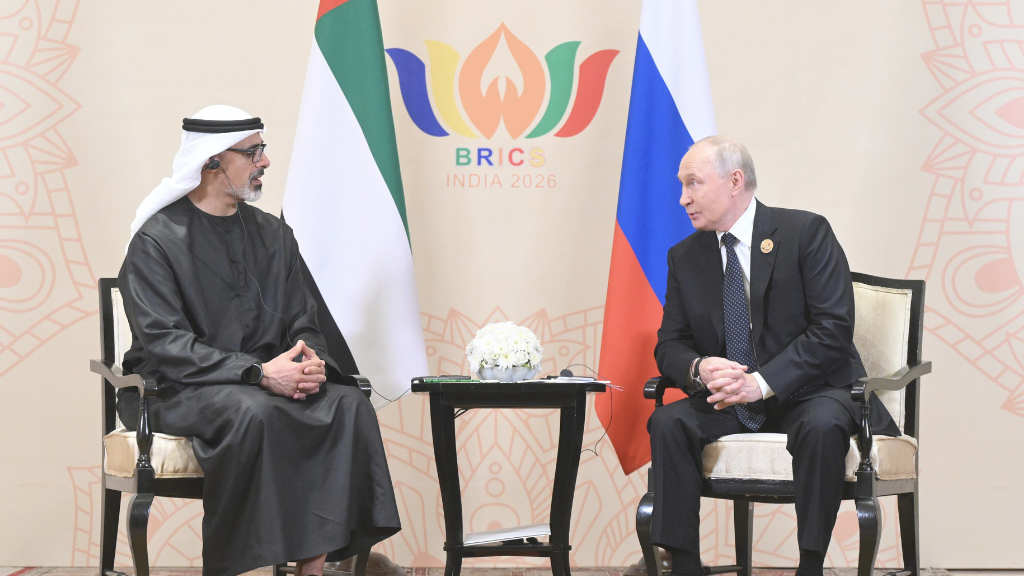

The Russian President, Vladimir Putin, met with Khaled bin Mohamed bin Zayed Al Nahyan, the Crown Prince of Abu Dhabi and Chairman of the Abu Dhabi Executive Council, on the sidelines of the BRICS Summit.
Both sides brought substantial delegations. Taking part in the talks on the Russian side, amongst others, were Foreign Minister Sergei Lavrov, Deputy Prime Minister Alexei Overchuk, Aide to the President Yury Ushakov, Minister of Economic Development Maxim Reshetnikov, First Deputy Minister of Energy Pavel Sorokin, Chief Executive Officer of the Russian Direct Investment Fund Kirill Dmitriev, President of the Russian Fertiliser Producers Association, member of the Board of the Russian Union of Industrialists and Entrepreneurs and Head of the Russian Part of the BRICS Business Council Andrei Guryev, and Director General of Rosatom State Atomic Energy Corporation Alexei Likhachev.
This is what Putin had to say:
“Your Highness, I am very pleased to see you again and to have this opportunity to speak with you. At the outset, I would like to note that this December, if I am not mistaken, our countries will mark the 55th anniversary of the establishment of diplomatic relations.
Much has changed over these years, both in the world and in our bilateral ties. The United Arab Emirates has become one of our closest partners in the region. Our cooperation extends well beyond the economic sphere, although our economic ties are developing successfully, with trade reaching substantial levels and continuing to grow. We also maintain close cooperation on political and security matters.
Of course, the region is currently going through a very difficult period. Nevertheless, we remain in close and constant contact with the UAE leadership, including your father, the President of the United Arab Emirates, Mohamed bin Zayed Al Nahyan. Please convey my warmest regards to him. We maintain regular contact. Our officials exchange visits, meet frequently and discuss a wide range of issues. I am confident that, despite the current difficulties, the situation will stabilise and our relations will remain strong and continue to develop. I have no doubt about that.
I would like to say once again how pleased I am to see you and to have this opportunity to discuss our bilateral relations. And, of course, it is very important for us to hear your assessment of the developments currently unfolding in the region and your outlook for the future.”
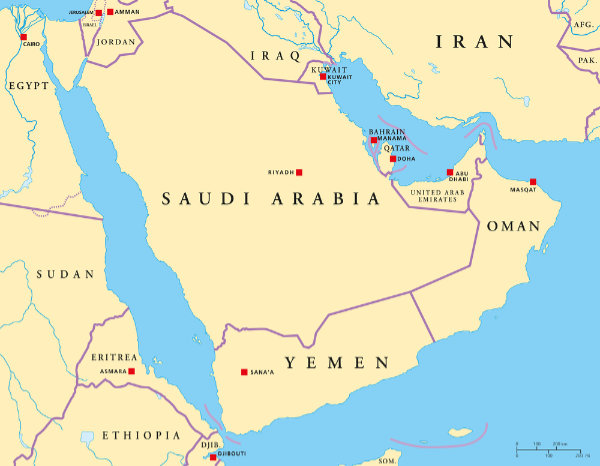
Abu Dhabi is the capital of the United Arab Emirates and differs somewhat from the UAE’s second largest city, Dubai, both by being the Emirati capital and by being the centre of the UAE’s energy industry. Dubai, in contrast, focuses more on finance, manufacturing and trade.
Currently, the region is undergoing considerable turmoil both as a result of the ongoing United States conflict with neighbouring Iran and Houthi rebels attacking Saudi Arabia from Yemen. This has significantly disrupted oil flows, while many of the UAE’s large expatriate population have left, placing the economy under both some financial and human capital strains.
However, the UAE has leveraged its natural resources and innovative policies to develop a highly diversified economy. The latter is driven by several major industries. The oil and gas industry continues to be a foundational element with Abu Dhabi National Oil Company (ADNOC) playing a pivotal role in global energy markets. While hydrocarbons contribute significantly to the economy, the UAE has made substantial progress in diversification. Tourism and hospitality are vital, with cities like Dubai and Abu Dhabi – under normal circumstances – drawing millions annually. The aviation and logistics sectors further boost the economy, with world-class airlines like Emirates and Etihad Airways operating from major international airports.
Financial services are another key sector, supported by global hubs such as the Dubai International Financial Centre (DIFC). Construction and real estate have contributed, with iconic projects like Palm Jumeirah showcasing innovation. In technology, the UAE is fostering growth through initiatives like Dubai Internet City and Abu Dhabi’s Hub71, focusing on artificial intelligence and renewable energy. The healthcare and pharmaceuticals sectors are also expanding.
As a member of the Gulf Cooperation Council (GCC), the UAE benefits from regional free trade agreements, including the GCC’s customs union and the GCC-Singapore Free Trade Agreement. It is also a member of the World Trade Organization (WTO) and the Greater Arab Free Trade Area (GAFTA). The UAE has recently signed significant agreements, including the UAE-India Comprehensive Economic Partnership Agreement (CEPA). These agreements enhance trade across a range of goods and services. Negotiations are ongoing with countries such as the UK, Türkiye, and South Korea to establish additional agreements.
The UAE’s population is about 11.5 million, GDP (PPP) is approximately USD$1 trillion (IMF estimate for 2026), and GDP per capita (PPP) is around USD$87,800, reflecting a high level of economic development. Projected GDP growth for 2026 is about 3–5% depending on the source (IMF — 3.1%, Standard Chartered and the World Bank — about 5%).
Russia-UAE Trade & Investment
The UAE is one of Russia’s leading trade and economic partners in the Arab world. According to Russian authorities, total trade turnover between the two countries in 2025 grew 1.5-fold and reached a historic high of USD$14 billion. At the same time, non-oil trade, calculated using the methodology of the UAE Ministry of Economy (including re-export), reached USD$20.4 billion (+77.7% compared to 2024). The discrepancy is explained by different statistical approaches: the UAE, as a major re-export hub, accounts for transit flows differently than the Russian side.
The main products Russia exports to the UAE are gold, diamonds, and refined petroleum. Dubai is a major international jewellery trading hub.
Russian capital invested in the UAE has exceeded US$30 billion, while the volume of Emirati investments in Russia was US$17 billion. In late 2024, the UAE sovereign wealth fund purchased 6.86% of the Moscow Stock Exchange. About 4,000 Russian companies are registered in the UAE.
New Trade Agreements
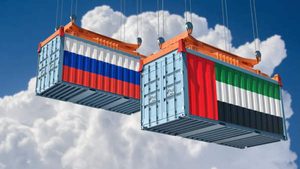
There have been efforts to further boost trade and diversify trade sectors. Last month, Russia and the UAE commenced their Trade in Services and Investment Agreement (TISIA), which is designed to expand market access for services, strengthen protections for investors and create new opportunities for businesses in both countries. It covers high-growth sectors, including fintech, healthcare, transport, logistics and professional services, and aims to reduce barriers to market entry and facilitate the movement of professionals.
A Free Trade Agreement between the UAE and the Eurasian Economic Union is also due to come into effect from October 6.
Nuclear Energy
Alexei Likhachev, Rosatom’s CEO, was present at the meeting and has previously stated that Rosatom has offered the UAE its designs for both large and small nuclear power plants (NPP). He has previously said that “Our partners in the United Arab Emirates are willing to broaden the nuclear agenda. We have submitted our proposals to them for large and small NPPs, land-based and floating options. These issues are now under consideration.”
Rosatom overseas director Ilya Vergizayev previously said at the 2025 Russian Energy Week, when speaking about prospects in the Arab region, that the UAE is considering developing the second stage of the Barakah Nuclear Power Plant and research reactors. That NPP was built by South Korea.
However, Rosatom is already collaborating with the UAE in the transport sector. In particular, the company is engaged in a joint project with Arab port operator DP World (DPW) to advance container shipping along the Northern Sea Route, as Rosatom provides the nuclear-powered icebreakers.
The UAE is also apparently interested in helping finance other NPPs in third countries, and especially in Central Asia, and possibly at Türkiye’s Akkuyu nuclear power plant. The UAE’s role would be as an investor and to make a return on such investments.
Russia has been making steps to facilitate this. Rosatom’s Supervisory Board has approved attracting foreign financing and includes issuing Atomenergoprom bonds in Chinese RMB yuan, as well as Islamic bonds (Sukuk). The Russia-Turkey intergovernmental agreement on implementing the Akkuyu NPP project also allows for the possibility of selling a 49% stake in the project.
Ports
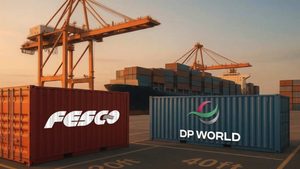
Rosatom Director General Alexey Likhachev also announced that the state corporation has formed an alliance with DP World, the UAE’s largest port operator. “By creating an alliance with DP World, we are establishing a win-win principle. They get the opportunity to participate in the development of the Northern Sea Route and now also the trans-Arctic transport corridor. This is a solid addition to their business. We get not only investments but also port technologies and efficient stevedoring operations, which will take us to a new level.” he noted.
Rosatom and DP World agreed to establish a new joint venture in March 2026. The parties to the deal are Global Logistics LLC (a Rosatom subsidiary), DP World Russia FZE, and PAO Far Eastern Shipping Company (FESCO)—the parent company of the FESCO transport group. The Russian side holds 51% in the joint venture. Rosatom’s contribution is FESCO: the state corporation owns 92.5% of the shares in the group’s parent company, FESCO. DP World’s contribution is cash. In April 2026, the deal was approved by the Federal Antimonopoly Service (FAS) and in August — by the Government Commission on Foreign Investment Control.
The agreement sees the Russian side holding a 51% stake. Rosatom’s contribution will be FESCO – the state corporation owns 92.5% of the shares of the group’s parent company, PJSC FESCO – while DP World’s contribution will be in cash. The Russian government commission overseeing foreign investment approved the deal in April.
The FESCO-DP World alliance creates an Asia-Eurasian behemoth dwarfing any other global operator. The new JV will focus heavily on both the Middle East, Iran, and the Russian Far East, leveraging its position to facilitate trade between Russia and Asia.
Key port assets that FESCO brings to the deal include Vladivostok Port, with an annual cargo throughput of 13 million tonnes and over 878,000 TEU of containerised cargo.
DP World is one of the world’s largest port operators, managing 78 terminals in more than 40 countries. The company operates ports, terminals, industrial parks, and logistics hubs with a total throughput capacity exceeding 100 million TEU. For comparison, Danish Maersk, one of the world’s largest shipping companies, has a fleet with a capacity of about 4.3 million TEU.
Summary
The main feature of the Russia-UAE relationship is how it is diversifying away from energy and more towards global logistics. The Rosatom-DP World venture underpins the International North-South Transport Corridor – which sees freight travel between Russia, Iran and India, with DP World’s existing capacity helping develop that further to East Africa. Russia’s Eastern Sea Route already connects countries such as India, Vietnam and China to Vladivostok and further across the Northern Sea Route – an essential maritime supply chain with access to Russia’s massive gas fields. DP World want to insert themselves into that and generate sustainable, longer-term cash flow revenues. This fundamentally changes the economy of the UAE and shifts its attention further east towards Asia.