
 Русский







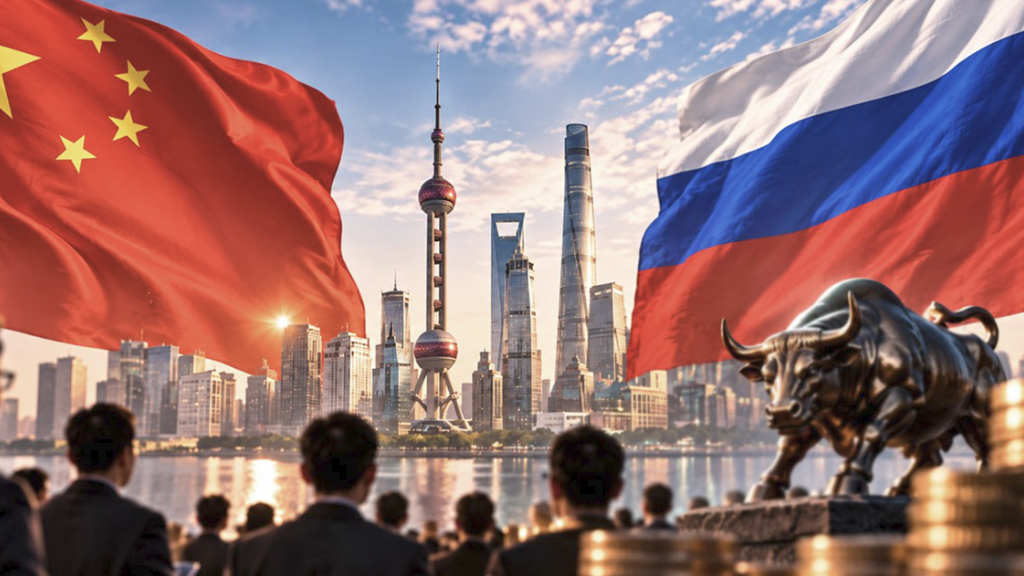

Yesterday we looked at why China’s massive new US$54 billion stimulus can be expected to filter down into Chinese companies that have invested into Russian infrastructure. With Russia and China sitting on a planned and identified US$240 billion investment portfolio – of which just about 5% has been realised – we look at where savvy investors, interested in which Chinese stocks are likely to be involved – can conduct research and uncover where some of this investment capital money is likely to be directed.
What Are The Chinese Investor Stock Market Trends?
China’s 2026 IPO market has raised over US$54 billion across Hong Kong and Shanghai, heavily driven by artificial intelligence, robotics, and semiconductor demand. Hong Kong’s IPO market has boomed this year, with 108 listings so far in 2026, while Shanghai has seen 19 IPOs and Shenzhen 16.
Major 2026 IPO offerings have included
- ChangXin Memory Technologies (CXMT) a semi-conductor manufacturer, launched a massive US$8.6 billion offering in Shanghai. It is now China & Hong Kong’s largest company by market value, worth about US$531 billion.
- Enflame a Shanghai semi-conductor manufacturer, saw their stock soar over 200% after raising US$912 million in Shanghai;
- Unitree a humanoid robot maker listed in Shanghai raising US$904 million and becoming China’s first listed humanoid robot manufacturer. First-day shares surged 460%, delivering massive retail windfalls.
In addition, high-profile AI companies like Moonshot AI and DeepSeek have initiated preparations and confidential filings for domestic and cross-border listings.
What this means is that AI, semi-conductors and related digital related businesses are hot in China (and Asia) right now. But there appears to be a disconnect with Russia, for the following reasons:
- These IPOs are concentrating on developing the Chinese local market;
- This technology is strictly controlled due to the risk of incurring secondary sanctions from the United States and European Union and are not keen to directly exposure themselves to the Russian market.
Yet all may not quite be as it seems.
Identifying The Russian Shadow As An Investment Opportunity
While China is currently experiencing a historic share sale boom driven by AI and mainland Chinese tech firms, strict adherence to global compliance and geopolitical sanctions has effectively frozen new listings with major Russian business exposure.
But this doesn’t mean that the Russia opportunity is wholly excluded – it has instead been somewhat hidden – as Xiaomi’s case illustrates.
Xiaomi’s Russia Strategy

To recap, Xiaomi have the largest share of Russia’s smartphone market, taking about 25% of the total sales volume, outperforming Apple. While they have been under pressure from the threat of secondary sanctions, Xiaomi’s strategy concerning Russia has been interesting. Amid secondary sanctions risks from the United States and European Union, Xiaomi shifted regional assembly and logistics planning toward neighbouring countries like Kazakhstan, while discussions for local CKD (Complete Knock-Down) facilities have also surfaced in alternative regional locations such as Georgia. This means that while direct sales to Russia no longer appear on Xiaomi’s books, in reality they continue to supply the market, although production and unit sales are registered in non-Russian markets.
Xiaomi’s primary high-volume manufacturing remains centered in China, such as its fully automated “dark factories” in Beijing and smart appliance facilities in Wuhan. Despite scaling back direct operational footprints and local production ties in Russia, Xiaomi products remain widely available in the Russian market through authorized parallel import channels and third-party distributors.
In 2025, Xiaomi shipped a total of 165.2 million smartphones globally, generating ¥186.4 billion (US$27.7 billion) in smartphone revenue according to the company’s 2025 annual results. With Russia’s total 2025 smartphone sales at about 25 million units, and total sales revenues of about ₽585 billion (US$7 billion) an estimated value to Xiaomi of the Russian parallel imports market is roughly US$2.8 billion.
Xiaomi’s Central Asia strategy as part of its Russian strategy is also worth noting as Central Asian e-commerce surged to US$14.7 billion, last year – heavily supercharged by mobile app usage and digital wallets accounting for 60% to 70% of transactions.
Xiaomi are listed in Hong Kong.
The Eurasian Route to Russia

To gain access to the forbidden fruits of the Russian market – the world’s fourth largest economy in PPP GDP terms – Hong Kong and Chinese capital forums are aggressively pivoting to alternative Eurasian routes. For instance, discussions at major 2026 forums have focused on building capital bridges to Central Asian countries such as Kazakhstan and the Middle East to diversify their international pipeline – while still keeping parallel sales development exposure benefits to Russia as part of the strategic portfolio.
For example, while sales of semi-conductors and related equipment to Russia is officially curtailed due to sanctions, in reality, according to China’s General Administration of Customs, China’s exports of integrated circuits between January to August 2026 reached US$256.75 billion, a 103.9% increase over the same period last year. In August alone, exports totalled US$40.731 billion. Where are those growth markets?
Nearly half were exported to Hong Kong, and about 10% to Vietnam. That alone is significant.
Joining the dots, and following the asset trails, Russia, with the world’s largest gold deposits, has stated it will produce about 500 tonnes of gold during 2026, while interestingly, Hong Kong has imported about 100 tonnes of Russian gold in the period January-July 2026, worth about US$5.6 billion. Russia and Vietnam meanwhile also have a Free Trade Agreement via the Eurasian Economic Union, settling their trade in their respective currencies.
But Hong Kong doesn’t need so much gold for its jewellery industry, suggesting that the bullion is being exchanged for products. Guess where the newly listed Chinese semi-conductor manufacturers have significant sales presence? Hong Kong. All this is subjective of course and may not necessarily be true or indicate that any of these businesses are selling semiconductors to Russia in return for gold bullion. But these routes do also point to the deliberately grey supply chains that undoubtedly exist. Want to make money? Speculate.
It is also worth looking at other markets between China and Russia. Kazakhstan’s semi-conductor imports from China are worth over US$1 billion and increased by 23% in 2026 to date. Kyrgyzstan’s grew by 130% in 7m 2026. Tajikistan doesn’t break down its import data in the same way but does say that semi-conductor imports from China are currently its third largest imported product. Pakistan’s imports of semi-conductors from China are up over 100% in 2026.
Clearly all these are growth markets with their own domestic needs. But the huge jumps suggest another market is behind the scenes. This is where looking for value in Chinese stocks supplying Russia’s growth potential requires some detective work – and a certain amount of market sleuthing. For Chinese investors, this is all part of the portfolio fun – ‘smart gambling’ – but there are serious returns to be made when the stock investment pays off.
Cross-Border Clues
It is also worth looking at the Russia-China border for clues. That extends for 4,209km and runs across China’s Heilongjiang, Jilin, Inner Mongolia and Xinjiang Provinces. There are slightly over 300 Chinese companies from these regions listed in Hong Kong, Shenzhen, and Shanghai, or about 8% of the Chinese stock market quoted total. These will almost certainly have Russian trade influences in their corporate profile.
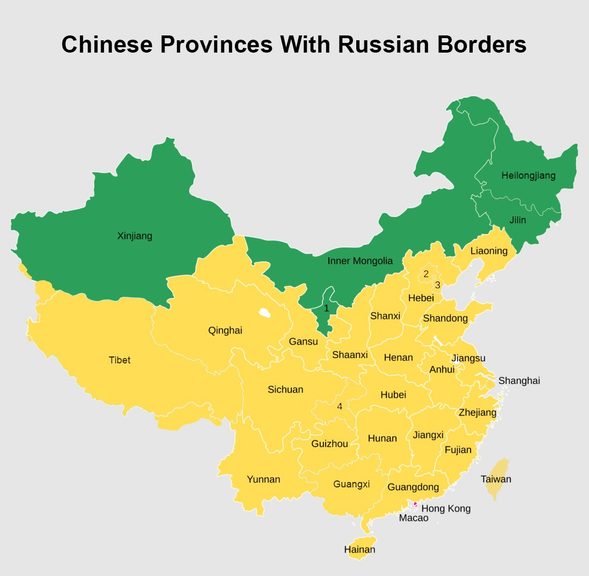
Heilongjiang

Due to convenient border-crossing transportation, the total trade value between Heilongjiang Province and Russia reached US$234.12 billion in 2025, according to the Chinese State Council Information Office. The Province shares borders with five Russian regions: Amur Oblast, the Jewish Autonomous Oblast, Khabarovsk Krai, Primorsky Krai and Zabaykalsky Krai, making it a major tade conduit with Russia. The Heilongjiang capital, Harbin, is directly connected to the Trans-Siberian railway via the Eurasian Land Bridge.
Russia is both Heilongjiang’s top importer and its top export market. Heilongjiang’s main international imports are crude oil, petroleum gas, soybeans, iron ore, and coal, briquettes and similar manufactured solid fuels. Its main exports are vehicles, oxygen amino compounds, rubber footwear, luggage, and other smaller volumes of various commodities. There are seventeen different border crossings between Heilongjiang and Russia, with the most important being Tongjiang, Suifenhe, Heihe, and Jiamuxi.
Heilongjiang businesses include three listed in Hong Kong, another 27 in Shanghai and 13 in Shenzhen.
Jilin

According to the OEC, Jilin Province conducts about US$2 billion worth of annual trade with Russia, which is also its largest export market and second largest supplier.
Jilin’s main international imports are vehicles, parts and accessories, navigation equipment, copper Ore, and integrated circuits. It exports nitrogen heterocyclic compounds, electric batteries, amine compounds and lower value commodities. The main border crossing is at Hunchun. Jilin has 27 companies are listed in Shanghai, 20 in Shenzhen and 11 in Hong Kong.
Inner Mongolia

According to the OEC, the Chinese Province of Inner Mongolia conducts about US$400 million worth of trade with Russia, with Russia being its largest export market. Its largest import market is Mongolia itself – which has just agreed a free trade deal with the Eurasian Economic Union, which includes Russia. This will have some impact on Inner Mongolian trade with Russia.
Inner Mongolia’s main international imports include copper ore, coal, briquettes and similar manufactured solid fuels, Iron ore, gold, and potassic fertilizers. It exports oxygen amino compounds, sunflower seeds, and automotive vehicles. The main border crossing points are at Manzhouli, Mohe and Ergun.
Inner Mongolia has 32 listed companies, with 15 in Shanghai, 12 in Shenzhen and 6 in Hong Kong.
Xinjiang

Apart from a small (55km) border with Russia, Xinjiang is a major gateway through to Kazakhstan and the rest of Central Asia, where Russian invested companies are among the region’s largest investors and account for about 40% of all Kazakhstan’s foreign investment. The inland port at Khorgos, between China and Kazakhstan is the largest in the world. This is where Chinese and Russian companies collaborate on Central Asian joint Ventures. Xinjiang’s capital city, Urumqi, is the largest and most prosperous city in Central Asia. Xinjiang has about 40 listed companies, with 17 each amongst the Shanghai and Shenzhen bourses and 5 in Hong Kong. However the onus here is on Central Asia rather than Russia itself.
If investors are looking for Chinese company stocks because they are specifically involved in the China-Russia trade space – which is expanding at rates of 25% plus this year – as well as Central Asia – then these regions would be a good place to look at.
Five Key Regional Developments
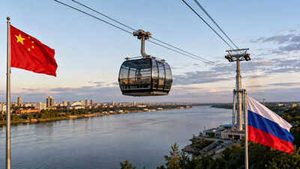
- The Blagoveshchensk-Heihe Cross Border Cable Car
The world’s first border crossing by cable car, crossing the Amur River with customs and immigration at each end. It can transport 110 passengers per carriage to a total of 6,800 passengers per day in each direction, or 2.5 million people per year. The journey takes 2.5 minutes. It will open in 2027. - Existing Rail Freight Capacity Is Doubling
The main rail line between China and Russia is having its freight capacity doubled, with work underway. The work should be completed by 2030. - Another Border Rail Crossing
China and Russia are seeking to build a fifth rail border crossing in the Far East. The new railway would help Beijing secure additional energy and resource imports. The Heilongjiang Government issued the construction tender in July this year with plans to have the route completed by 2030. - Bolshoy Ussuriysky Island Border To Open In 2027
A new border and freight crossing is set to open next year at Bolshoy Ussuriysky Island across the Heilongjiang (Amur) River. The crossing’s capacity will be 400 vehicles, 2,500 people and 3,600 tonnes of cargo per day. Warehousing and production facilities with a total area of 16,500 square meters are currently being completed. - Massive Free Trade Zone & Data Centre Opens In Inner Mongolia
The Inner Mongolia Pilot Free Trade Zone spans 119.74 square km including Manzhouli on the Russian border, with the Inner Mongolia Data Exchange Center facilitating the global expansion of the computing power industry as well as bioresearch materials which are already being exported to Russia. The Data Exchange Centre will support the massive Bytedance five and six gigawatts’ worth of compute in Ulanqab, which is 1,000 times more powerful than Elon Musk’s Colossus data center in Memphis, which he has described as the world’s largest AI supercomputer. Not anymore.
New Tech Industries: The Suifenhe Case Study

The next stage of China-Russia economic cooperation is increasingly taking place on smartphones. Alongside energy, machinery, automobiles and other physical goods, a different form of economic relationship is expanding rapidly: Chinese companies are selling directly to Russian consumers through e-commerce marketplaces, while Chinese game publishers are monetizing Russian users through domestic digital distribution.
These two sectors may appear unrelated. One involves parcels, warehouses, customs declarations, trucks, ports, rail terminals and industrial sites, while the other involves software, advertising algorithms, app stores and virtual goods.
Despite these physical differences, economically, however, they are increasingly based on the same model. Chinese companies are moving closer to the Russian end consumer, using local digital platforms, targeted advertising, domestic payment mechanisms, logistics infrastructure and data analytics to reduce their dependence on traditional intermediaries. The development of Suifenhe in Heilongjiang as a China-Russia e-commerce gateway coupled with the explosive growth of Chinese mobile games on RuStore are therefore best understood as two components of the same structural transformation in bilateral trade.
The effect is significant: the processing speed for transit goods has increased by more than 50%, while the logistics costs for small and medium-sized foreign-trade companies have fallen.
This matters because the economics of cross-border e-commerce are fundamentally different from those of conventional bulk trade. A large manufacturer can absorb customs and transportation costs into a container shipment; a small online seller shipping hundreds of individual orders cannot. Consolidated warehousing and border processing therefore determine whether smaller Chinese companies can profitably serve Russian customers. China’s border cities next to Russia are consequently evolving from a traditional border crossing into a digital fulfilment node. Chinese merchants from Heilongjiang and other provinces can concentrate inventories close to the Russian border, consolidate orders, complete customs procedures and then distribute products through Russian marketplaces. The border itself becomes part of an integrated e-commerce supply chain.
Suifenhe is not the only example. North China has an astonishing 160 border crossings with Russia. Chinese stock market analysts need to understand this, get out there and research where the emerging stars are. This extensive cross-border development means that there are low-hanging fruit ripening here. Some of China’s coming IPOs will emerge from China’s border regions with Russia.
China and the Russian E-Commerce Marketplace
The significance of Suifenhe becomes clearer against the scale of Russian online retail. Estimates vary according to methodology, but all show a very large and rapidly expanding market. One industry assessment put Russian e-commerce turnover at ₽11.2 trillion in 2024, equivalent to about US$121 billion, with online purchases representing 20.3% of total retail sales. Other Russian market estimates are higher for 2025. Data Insight has estimated B2C online commerce at approximately ₽13.4 trillion (US$159 billion) with 8.3 billion orders, while other industry assessments put the market value at over ₽15 trillion (US$178 billion).
The differences largely reflect definitions of e-commerce, marketplace turnover and included categories rather than a contradiction over the underlying direction – the increases are explained by Russian consumers having moved a substantial share of their purchasing activity online.
The cross-border segment is particularly important for China. Estimates for 2025 put Russian online imports at approximately ₽366.8 billion (US$4.4 billion), based on 274.6 million orders. The number of cross-border orders increased by approximately 64% year on year, while China accounted for an extraordinary 96.8% of those orders and approximately 90.9% of their value.
If those estimates are used as a benchmark, China’s position in Russian online imports is not merely strong but it is overwhelmingly dominant. A market in which roughly nine out of every ten cross-border online-ruble transactions are associated with Chinese goods gives Chinese sellers an enormous network effect. The more Chinese merchants enter the Russian market, the more attractive the associated logistics, fulfilment and marketplace infrastructure becomes.
This is also a knock on, multiplier – the better the infrastructure becomes, the easier it becomes for another Chinese merchant to enter. The market is also expected to keep expanding. Estimates cited for Russian online imports put the value at approximately ₽487.5 billion (US$5.8 billion) in 2026, potentially exceeding ₽512 billion (US$6 billion) in 2027. Even if actual growth differs from forecasts, the direction is unmistakable: cross-border e-commerce is becoming a significant component of Russia’s consumer import economy.
Russia’s Developed Online Market Provides A Strong Platform For Chinese Digital Sales

The rise of Russian marketplaces is central to this transformation. In 2026, Russia’s internet penetration rate has reached nearly 90%. More than half of the country’s 128 million internet users now shop online, and the e-commerce sector continues to grow rapidly. Wildberries, Ozon and Yandex Market together accounted for approximately 68.9% of Russian online sales in one 2025 market assessment. Combined sales across the major platforms were estimated at roughly ₽8.59 trillion (US$102 billion) in 2025, representing growth of more than 30% year on year.
This creates a highly efficient entry mechanism for Chinese manufacturers. A Chinese company does not necessarily need to establish a large Russian retail subsidiary, construct a chain of shops or negotiate with dozens of regional wholesalers. It can manufacture in China, consolidate inventory through a border logistics hub such as Suifenhe, complete the necessary customs procedures, place inventory in Russian fulfilment centres and sell through an established marketplace.
Russia has remained a very attractive e-commerce market in 2026, with Chinese sellers particularly well positioned: Russia’s has over 200,000 active Chinese sellers, with their Gross Market Value (GMV) rising over 2.5× in 2025. Wildberries opened to Chinese merchants in April 2025, while Yandex Market plans to recruit 50,000 more Chinese sellers. Strong opportunities exist in apparel, footwear, home goods, personal care, small appliances, smart-home products and consumer-electronics accessories, where Chinese supply chains offer competitive pricing and potentially strong margins.
The economic consequence is a fragmentation of exporters and concentration of distribution. Thousands of Chinese SMEs can collectively generate enormous trade volumes without any individual company becoming a major bilateral trader. This is a major structural difference from the traditional China-Russia trade model. Large energy companies, automobile manufacturers and industrial groups dominate conventional trade statistics. E-commerce creates a much broader base of smaller enterprises. The bilateral trade relationship is therefore becoming more consumer-facing and more decentralized.
China’s Dominance In Russia’s Gaming Industry

If e-commerce represents the physical movement of Chinese products into Russia, mobile gaming represents the movement of Chinese intellectual property and digital services. The acceleration is remarkable. In the six months January-June 2026, foreign mobile-game publishers invested more than ₽400 million (US$4.7 million) for advertising on RuStore, three times the amount spent in the same period in 2025. China’s share was approximately 76%, meaning Chinese companies accounted for more than ₽300 million (US$3.6 million) of foreign game advertising expenditure in only six months.
Singapore and the United Arab Emirates followed China, but together their contribution was only about 10 percentage points, illustrating the extraordinary concentration of foreign investment around Chinese publishers. The significance becomes clearer when compared with 2025. Chinese companies accounted for around 70% of foreign promotional budgets over the preceding two years. Chinese developers reached the same scale of advertising expenditure in the first half of 2026 that the entire non-Chinese foreign publisher community recorded during the whole of 2025. This is not a marginal increase. It represents a fundamental change in the economics of Russian market entry.
Russia’s market attraction cannot be explained solely by the availability of RuStore. The underlying consumer market is large. One recent industry estimate valued Russia’s overall gaming market at between US$2.1 to US$2.4 billion, with mobile gaming accounting for roughly US$1 billion under some market definitions. Other Russian estimates put its total domestic gaming market at around ₽200 billion in 2025, (US$2.4 billion) compared with approximately ₽173 billion (US$2 billion) in 2024.
According to the baseline forecast of Russia’s Strategy Partners analysts, the Russian domestic video game industry will grow by 5% annually and will reach ₽257 billion (over US$3 billion) by 2030. Drivers of the Russian market include:
The development of information technologies that simplify and accelerate the creation of games, making them more interesting and visually appealing;
Industry support at the state level;
The growing popularity of esports and streaming;
Changes in the field of entertainment and recreation: video games have become an affordable and interesting way to spend leisure time against the background of difficulties with travel arrangements; this has brought many new users to the industry.
A separate industry estimate put Russia’s mobile-gaming market at US$247.2 million in 2024, reflecting the fact that different studies measure different portions of consumer spending and use different exchange-rate and market-definition assumptions.
The figures should therefore not be mechanically combined. What they collectively establish is that Russia has a substantial mobile-gaming economy with a very large user base and meaningful monetization potential. Recent industry data estimates approximately 76 million mobile gamers in Russia, with players spending an average of roughly 42.5 hours per month gaming. Approximately 45% of mobile players make in-game purchases. That combination, scale, engagement and willingness to pay, is precisely what attracts Chinese publishers. The Russian market also ranks among the world’s leading mobile-game markets by downloads, with Russia frequently appearing within the global top five to seven depending on the measurement period.
RuStore Has Become the Critical Domestic Gateway

The most important infrastructure change is the rise of RuStore. The platform’s monthly audience reached approximately 65.5 million users in 2025, and its audience subsequently approached 67-68 million. Its catalogue has expanded into tens of thousands of applications and games, while cumulative downloads have passed the 2-billion threshold.
For Chinese publishers, the platform provides something increasingly valuable: a domestic Russian distribution and payment environment. This matters because international app distribution has become more fragmented. Chinese developers can no longer assume that a title launched globally through the same Western channels will encounter identical distribution, payment and marketing conditions in every country. RuStore reduces that uncertainty. It provides developer onboarding, Russian-language market access, advertising opportunities, payment infrastructure and internal featuring. Its developer environment has also become more accessible to Chinese companies. The platform is evolving into something more important than an app store: it is a commercial gateway between foreign digital suppliers and Russian consumers.
China’s Own Gaming Industry Provides the Export Capacity

The Russian opportunity is also connected to China’s enormous gaming-production base. China’s domestic game market generated about ¥188.45 billion (US$28 billion) in actual sales revenue in H1 2026, an increase of 12.17% year on year, while the country’s game-user base reached approximately 684 million users. More importantly for Russia, revenue from Chinese-developed games in overseas markets reached approximately US$12.37 billion in the first half of 2026, up 30.22% year on year.
Russia is therefore entering an export strategy that already has substantial scale. Chinese publishers possess the financial resources, development capacity, marketing technology and experience necessary to localize successful games for multiple foreign markets. The Russian market does not need to be China’s largest overseas destination to be strategically important. Its value lies in the combination of audience size, relatively low distribution barriers, high engagement and the availability of a domestic platform.
E-Commerce and Gaming Are Two Versions of the Same Business Model

The most important analytical conclusion is that e-commerce and gaming should not be treated as separate stories. In e-commerce, a Chinese manufacturer acquires a Russian consumer through a marketplace. The product is manufactured in China, consolidated through a logistics hub, cleared through customs and delivered through a Russian fulfilment network.
In gaming, a Chinese developer acquires a Russian player through advertising. The game is developed in China, localized for Russia, distributed through RuStore and monetized through in-game transactions. The infrastructure is different, but the commercial logic is identical: Chinese production to digital customer acquisition to Russian platform to direct consumer transaction to recurring revenue.
That is a profound change from the traditional China-Russia trading model. Previously, a Chinese manufacturer might sell to a Russian importer, who then distributed the product through wholesalers and retailers. The manufacturer had limited information about the final consumer. Now the Chinese company can increasingly see the entire customer journey: what the consumer searches for, what advertisement attracted them, what price converted them, how often they return and what they purchase. This data-driven model increases the economic value of the Russian consumer.
The Border and the Smartphone Are Becoming Connected

The Suifenhe example shows how this transformation is physically developing. With over ¥2 billion (US$297 million) in cross-border e-commerce turnover in six months, up 40%, this is being supported by warehouses, customs integration and logistics systems that cut processing time by more than half.
RuStore shows the same process digitally. More than ₽400 million of foreign game advertising in six months, with China responsible for 76%, is being supported by a domestic app ecosystem with approximately 68 million monthly users. One system moves parcels. The other moves software, but both are reducing the distance between Chinese suppliers and Russian consumers. This is why the development has implications beyond gaming and retail. It creates demand for advertising services, logistics, warehousing, payment processing, data analytics, cloud services, localisation, customer support and digital marketing. As Chinese companies increase their Russian-market presence, they create an ecosystem around the original transaction.
Summary
China-Russia trade is expanding beyond traditional energy and industrial goods into digital consumer markets, particularly e-commerce and gaming. Bilateral trade reached US$134.2 billion in the first half of 2026, while Suifenhe recorded nearly US$300 million in first-half 2026 cross-border e-commerce turnover, up over 40%, Hunchun recorded US$1.3 billion in cross-border e-commerce trade during January-October 2025.
Chinese companies accounted for approximately 97% of Russian cross-border e-commerce orders, highlighting China’s growing consumer-market presence. Gaming shows a similar trend. Russia’s RuStore has around 67-68 million monthly users, while the foreign gaming advertising market exceeded US$4.8 million in H1 2026, with Chinese companies holding 76% of this volume. Chinese developer revenue on RuStore increased 18-fold, while the average Russian purchases of Chinese games were about US$7.
The next stage is deeper localisation: Russian warehouses, fulfilment, customer service, payments, Russian-language content, advertising and local promotions. Border cities such as Suifenhe and Hunchun will become key logistics hubs. Overall, China-Russia integration is increasingly connecting Chinese producers directly with Russian consumers through platforms, creating a new trade corridor for parcels, software, intellectual property, advertising, data and digital services alongside traditional goods.
While the steel cathedrals and established capital markets in Hong Kong, Shenzhen and Shanghai might be somewhat removed from North China and Russia, savvy investors should be keeping an eye on the emergence of a gigantic new commercial region that is already starting to produce excellent returns. The future emergence of significant Chinese businesses servicing the Russian market from China’s border regions is starting to move and there will be substantial sums of money to be made.