 Русский




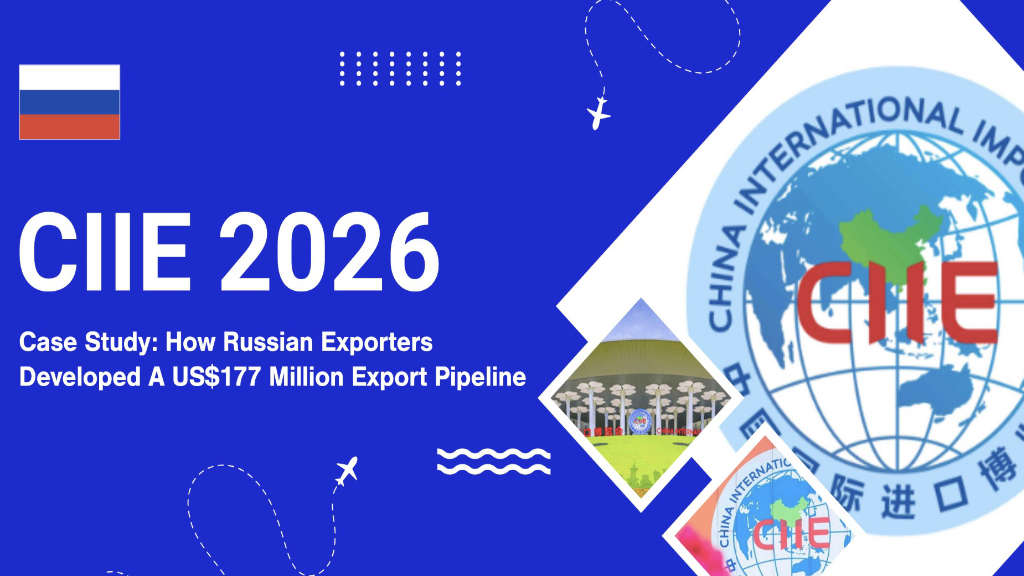
Russia’s newly assertive methods in gaining access to and developing the China export market were shown off to the fullest at the ninth China International Import Expo (CIIE), held in Shanghai from November 5-10, 2026. They developed an export pipeline exceeding ₽14.5 billion (US$177 million), conducted more than 530 business-to-business negotiations and secure cooperation agreements covering rapeseed oil, other food oils, flax seeds and buckwheat. How this happened provides a case study into todays’ Russian commercial strategies when developing new markets and will be of interest to anyone assessing how Russian companies develop their export strategies.
The Russian commercial presence brought together 63 manufacturers and suppliers, including 40 small and medium-sized enterprises, across a 1,425-square-metre collective exhibition. The results indicate a widening of Russian commercial activity in China beyond traditional energy and bulk commodities, with processed foods, cosmetics, dietary supplements, industrial materials, jewellery and creative-industry products gaining access to Chinese buyers and distribution networks.
From Exhibition Contacts To Commercial Agreements

The ninth CIIE marked Russia’s ninth consecutive participation in the Shanghai exhibition since its establishment in 2018. Organised through the Russian Export Center (REC), part of VEB.RF, the 2026 collective exhibition operated under the Made in Russia brand.
Of the 63 participating Russian companies, 34 carried the Made in Russia certification mark, while 40 were small and medium-sized businesses. The participating enterprises represented food and agricultural production, consumer goods, healthcare products, technical equipment and service-related solutions. The principal commercial result was the conversion of exhibition contacts into negotiations on actual purchasing requirements.
More than 530 B2B meetings took place during the six-day programme, generating an export potential of over ₽14.5 billion. Russian exporters concluded cooperation agreements for supplies of rapeseed oil, food oils, flax seeds and buckwheat between November 6 and 10. More than half of the business meetings advanced to discussions of specific purchasing volumes, delivery schedules and logistics, indicating that Chinese procurement is moving beyond introductory product assessments towards supplier selection and procurement planning.
Agricultural Agreements & Krasnodar’s Export Programme

Agriculture and food processing formed the largest component of the Russian presence. Forty companies participated in the food and agricultural section, covering vegetable oils, grains, seeds, confectionery, meat products, beverages and processed foods. The agreements involving rapeseed oil, food oils, flax seeds and buckwheat were particularly significant because they extended Russian export opportunities into products that can be supplied through recurring commercial orders rather than one-off commodity transactions.
Russia’s Krasnodar Territory, also known as ‘Kuban’, established a separate regional presence with an approximately 90-square-metre collective stand. Eleven regional enterprises participated in the Shanghai exhibition, presenting confectionery, frozen foods, wheat flour, cereals, pulses, oilseeds, vegetable oils, quinoa, tea, herbal collections, fruit and vegetable preserves, juices and pet food.
Their negotiations resulted in preliminary supply arrangements worth approximately US$1.7 million, covering confectionery, vegetable preserves, juices and juice-containing products, grains and oilseeds. Vice-Governor Alexander Ruppel highlighted China’s importance to the regional export economy, noting that Krasnodar exports to China increased by 12.5% in the first half of 2026 compared with the corresponding period of 2025.
Yulia Prikhodko, representing the regional export promotion effort, reported that six manufacturers submitted product samples to the Russian Export Center’s China office for further commercial promotion. This is an important operational outcome: the process moved beyond exhibition presentations to product assessment and follow-up with potential Chinese importers.
Roman Vorotnikov, director of the Krasnodar Territory Export Support Center, linked the Shanghai participation to earlier commercial activity at the Canton Fair in Guangzhou. Previous negotiations had produced arrangements involving wheat and corn supplies to China, India, Pakistan, Saudi Arabia and Egypt, as well as wheat and corn flour and vegetable oils for China, Middle Eastern markets and Africa. The CIIE participation therefore forms part of a global Russian export-development programme instead of an isolated regional exhibition.
Major Russian Companies & Consumer Brands

The participation of established manufacturers alongside smaller exporters gave the Russian pavilion a broad commercial profile. Miratorg Agricultural Group presented meat and food products, reinforcing its position in the processed-food segment. Its associated product portfolio included nuggets, baked goods, dumplings and beverages. United Confectioners showcased chocolates and sweets, using established brand recognition to attract Chinese distributors and retail buyers.
SIBPRIBOR LLC presented natural dietary supplements, including products based on raw materials associated with Lake Baikal and its Baikal Legend brand. Its participation introduced a health and wellness category alongside conventional food exports. Arnest UniRus made its CIIE debut, exhibiting personal-care products under the Silky Hands, Clean Line and Forest Balsam brands. The debut was commercially important because it placed Russian mass-market cosmetics before Chinese buyers and beauty-sector distributors.
Trading company LEADER offered sugar, flour, canned goods and juices to prospective importers. Russian chocolate brands Aileen and Big Head Doll, together with Sfladella ice cream, also appeared in the exhibition.
These products complemented the established presence of Russian confectionery and dairy-related goods in Chinese retail channels. The consumer response was not confined to food. Chinese beauty-sector representatives expressed interest in Russian hand creams, body lotions, facial masks and hyaluronic-acid formulations. A beauty-agency operator identified a reliable supply channel through the exhibition. Chen Bo, purchasing manager at Ningbo Shangge Import and Export Co., Ltd., described established demand for Russian flour, sunflower oil and honey and indicated interest in introducing additional Russian products into Chinese retail assortments. These buyer discussions demonstrate how the exhibition connected individual manufacturers with importers already serving local consumer markets.
Volgograd’s Industrial Technology: NPO Bronya Develops An Established Chinese Market

The industrial segment provided an important counterweight to the food-heavy Russian exhibition. Volgograd-based NPO Bronya, a developer and manufacturer of high-technology thermal-insulation coatings, demonstrated materials designed for high-temperature applications, condensation control and fire safety in industrial structures. Its participation in Shanghai was its seventh appearance at exhibitions in China and its third Chinese exhibition in 2026. The company has operated in China since 2017 and had already completed several container shipments during 2026. One shipment followed its participation in a Made in Russia trade festival in Tianjin, demonstrating that regional promotional events can generate immediate commercial orders.
At CIIE, Bronya worked alongside personnel from its exclusive Chinese distributor, Bronya China. Demonstrations involving heating objects coated with its materials attracted technical visitors, who could assess the product’s performance and safety through practical experiments. The company also planned approximately 500 B2B negotiations with prospective partners under its exhibition programme. Its commercial proposition extends beyond selling insulation materials: it offers solutions for industrial facilities requiring temperature management, condensation prevention and improved structural fire protection. This gives Russian exports an entry into China’s industrial construction, manufacturing and infrastructure markets, where technical performance, distributor relationships and after-sales support are important purchasing considerations.
Moscow: Regional Manufacturers & Distribution Opportunities

The Moscow Region presented three identifiable companies through its agricultural and food-processing representation. May Company, based in Fryazino, exhibited tea and coffee. TK Miratorg, operating from Domodedovo, presented nuggets, baked goods, dumplings and beverages. Trust Production Company (PK Trust) from Klin displayed gingerbread and oatmeal biscuits. Their participation expanded the Russian offering from agricultural ingredients into branded, processed products suitable for supermarkets and specialist food retailers.
This combination of tea, coffee, frozen and prepared foods, beverages and confectionery also gives Chinese importers opportunities to assemble complementary Russian product ranges rather than purchase isolated commodities. The broader exhibitor roster also included Top Grain LLC, an agricultural trading and export company established in 2005. Its international business covers peas, durum wheat, oilseeds and chickpeas, while its container-export activity connects agricultural supply with international logistics. Its presence on the official CIIE exhibitor platform illustrates the importance of combining agricultural sourcing with shipment capacity when developing Chinese procurement relationships.
The Krasnodar and Moscow regional presentations were supported by export-promotion structures, including the Krasnodar Territory Export Support Center, the Volgograd Region Export Support Center and the Russian Export Center. The Krasnodar delegation’s programme also included business contacts with the Russian Trade Representation in China, REC and the Russian Ministry of Agriculture’s representation in China. These engagements connected manufacturers with trade-promotion, market-entry and sectoral support institutions.
Creative Industries: Amber, Jewellery, Lace and Russian Design
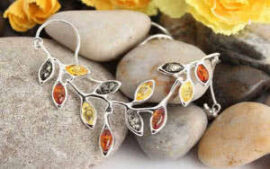
One of the most important developments at the 2026 exhibition was the expansion of Russian participation into creative industries. Companies and producers from Kaliningrad, Sverdlovsk and Tver regions presented amber jewellery, artistic products, folk crafts and design-related goods. The objective was to develop commercial opportunities for Russian-made products whose value derives from design, craftsmanship, cultural identity and specialised production rather than mass manufacturing.
On November 6, Yevgeny Bazhov, general representative of the Russian Export Center in China, discussed the commercial potential of these industries with TASS. He identified jewellery, original designer products, interior items, folk crafts and digital products as areas with prospects in China. His assessment was that Russian producers needed to communicate the distinctive characteristics and value of their products to Chinese consumers rather than depend exclusively on their Russian origin as a selling point.
The cultural presentation included Mikhailovsky lace produced by CJSC Truzhenica in the Ryazan area, alongside Vyatka lace, traditional fur ornaments of northern peoples, Khokhloma painting, porcelain and decorative products. Truzhenica’s participation also built on its earlier promotional activities: Mikhailovsky lace appeared at the 2024 Russia exhibition-forum and decorated the National Centre Russia department store in 2025.
That year, the enterprise also received recognition through the Golden Mercury national entrepreneurship award, with its chief artist Tatiana Presnova recognised for contributions to preserving and developing folk-art crafts. These presentations created opportunities to position Russian creative goods in China’s jewellery, gift, interior-design and premium consumer-product markets. They also introduced potential commercial links involving design licensing, intellectual property and digital creative products, areas that can generate longer-term relationships beyond individual shipments.
The Russian Export Centre Infrastructure: E-commerce, Retail & Livestream Sales
The Russian Export Center’s programme extended beyond the physical exhibition. The Russian National Pavilion continued operating on Chinese e-commerce platforms, while Made in Russia retail stores and themed promotional festivals provided additional routes to consumers. These activities included promotional events in Shenyang, Dalian, Harbin, Chengdu and Beijing. The programme also incorporated livestream commerce, product demonstrations and food tastings. During the three principal days of the relevant promotional programme, Russian chefs prepared dishes using participating companies’ products. A dedicated livestream studio enabled Chinese bloggers, some with audiences exceeding one million subscribers, to introduce Russian products, conduct tastings and communicate directly with prospective buyers. The participation of Ningbo Shangge Import and Export Co. illustrated the importance of these distribution channels. Its purchasing manager, Chen Bo, identified continuing demand for Russian flour, sunflower oil and honey while looking for additional products to expand the company’s Chinese retail assortment. Similarly, a Chinese beauty-sector representative identified stable supply channels for Russian hand creams, body lotions and facial masks through the exhibition.
REC’s wider institutional structure supported this work through the Export Credit and Investment Insurance Agency (EXIAR), Roseximbank and the REC Export School. The assistance included product adaptation, importer identification, export financing and insurance, market promotion and logistics support. This integrated approach is intended to reduce the interval between initial buyer interest, contract negotiation and the first commercial shipment.
China’s Procurement Market and CIIE’s Global Scale

The Russian results need to be considered against the scale of the Chinese exhibition. The ninth CIIE brought together 4,142 exhibitors from 162 countries, regions and international organisations. Its overall exhibition area exceeded 440,000 square metres, including 370,000 square metres devoted to the business exhibition. More than 300 Fortune Global 500 companies and major industry leaders participated. The exhibition generated US$85.45 billion in intended one-year deals, an increase of 2.3% year-on-year. A total of 485 exhibits made their global, Asian or Chinese debuts. More than 470,000 visitors registered for the event, while 51 trade delegations and 80 supporting activities contributed to its business programme.
The accompanying Hongqiao International Economic Forum hosted 23 sub-forums and seven closed-door meetings. Discussions addressed multilateral trade, technological innovation, green globalisation, international economic cooperation and supply-chain development. The wider programme provided a commercial environment in which Russian exporters could connect with international procurement companies, distributors and industry representatives. The importance of Chinese distribution networks is also reflected in Shanghai’s own procurement activity. The city’s trading delegation generated US$11.2 billion in intended one-year deals, bringing together nearly 15,000 companies and 122,000 buyers. This concentration of procurement capacity provides a substantial commercial opportunity for Russian exporters seeking access to large-scale retail, food-processing and industrial purchasing networks.
Summary: A Shift Towards Recurring Exports
Three developments distinguish Russia’s 2026 participation in the CIIE. First, agricultural exporters moved towards concrete procurement negotiations and cooperation agreements covering rapeseed oil, food oils, flax seeds and buckwheat. Second, consumer manufacturers expanded the Russian offer into cosmetics, personal care, dietary supplements, confectionery and prepared foods.
Third, industrial and creative-industry companies demonstrated that Russian participation can extend into specialised technical materials, jewellery, design and cultural products. The regional results reinforce this diversification. Krasnodar’s US$1.7 million in preliminary supply agreements, NPO Bronya’s established container shipments to China, and the Moscow Region’s participation by Mai Company, TK Miratorg and PK Trust illustrate different routes into the Chinese market. One model is based on agricultural volume, another on specialised industrial technology and a third on branded consumer products.
The quantitative results are equally significant. The 63-company Russian exhibition generated more than 530 B2B meetings and an export potential exceeding US$177 million. Five percent of exhibitors had already reached agreements to sign cooperation documents with Chinese partners, while another 76% expected to reach similar arrangements in the near term. These percentages distinguish completed agreement commitments from the wider pipeline of prospective agreements.
Tatiana An, REC vice-president, emphasised that Chinese buyers were increasingly interested in direct cooperation with Russian manufacturers, specific delivery volumes, schedules, guaranteed logistics and finished products with added value. Her assessment reflects the central commercial development at Shanghai: Russian suppliers were increasingly being evaluated as regular manufacturers and delivery partners rather than simply as exhibitors offering unfamiliar foreign products.
The 2026 CIIE therefore strengthened the infrastructure connecting Russian production regions with Chinese procurement, retail and industrial markets. Its most important result was not simply the presentation of 63 companies but the creation of a measurable commercial pipeline linking agricultural contracts, regional export arrangements, industrial distribution, online retail and repeat purchasing. The next stage will depend on converting the export potential into executed contracts, scheduled shipments and continuing orders. The combination of direct manufacturer negotiations, regional export programmes and established Chinese distribution channels provides the basis for that transition from product display to deeper penetration of the Chinese market.
This article was provided by M. Jahan, an analytical reporter for Russia’s Pivot To Asia. Contact: info@russiaspivottoasia.com