Русский








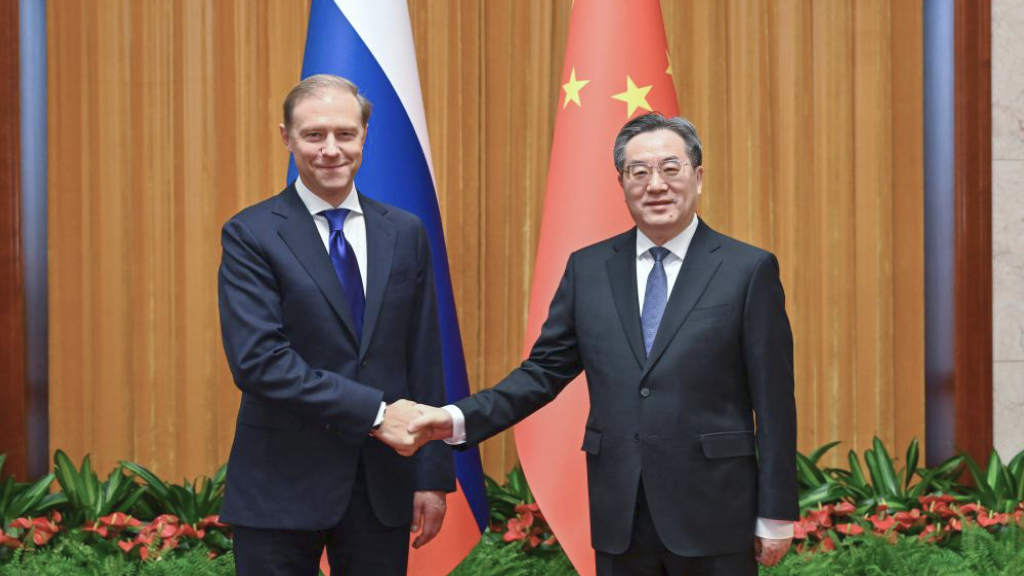

On September 3, Chinese Vice Premier Ding Xuexiang and Russian First Deputy Prime Minister Denis Manturov chaired the 13th Meeting of the Intergovernmental Russia-China Commission on Investment Cooperation in Vladivostok. While the commission did not produce a headline number of dozens of new commercial contracts. Its significance was portfolio management: identifying which projects were advancing, which needed support and which new projects should enter the pipeline.
The portfolio is substantial: 65 current projects plus 26 prospective projects, worth about US$240 billion. More than half are already being implemented. Six more projects were added. These range from steel and chemicals to forestry, engineering, agriculture, transport, trade and logistics.
New additions include refractory-material production, food additives, components, chemical complexes and iron-ore extraction and processing. The deeper significance is geographical. The commission is increasingly connecting China’s Northeast revitalisation with the Russian Far East rather than treating the two regions as separate development programmes.
China’s Belt and Road Initiative and Eurasian Economic Union cooperation has therefore acquired a physical regional expression: industrial projects in Russia can use Chinese equipment and financing, Chinese logistics networks are connecting Russian commodities and manufactured products to Chinese markets, and border infrastructure is reducing the cost of moving both goods and people. That is also why the Far East matters disproportionately.
Around 100 joint Russia-China projects are currently under way in the Russian Far East with investment approaching ₽1 trillion (US$11.7 billion), while Chinese investors account for more than 80% of foreign investment in regional preferential-regime projects. The wider, Russian state-supported Far Eastern investment portfolio now exceeds ₽16 trillion (US$187 billion), with about ₽6.8 trillion (US$79 billion) already invested. Trade between the Russian Far East and China has increased by 250% in the past five years.
The RusHydro-Beijing Taiji Example

A classic example of China serving as Russia’s core economic partner is the RusHydro-Beijing Taiji cooperation agreement, which involves an unlikely commodity: peat.
RusHydro and Beijing Taiji Technology signed a strategic cooperation agreement aimed at developing Russia’s peat industry. It is worth noting – the commercial model is more important than the product itself. The concept envisages peat extraction and production in Russia, Chinese investment, transport and logistics, processing and ultimately sales into China.
Russian peat reserves are estimated at more than 200 billion tonnes, while Chinese annual import requirements could reach as much as 100 million tonnes. Negotiations were already under way for a Chinese processing centre and logistics hub, while discussions with Chinese equipment manufacturers included localisation of machinery.
Research contracts also covered the use of peat for contaminated-soil restoration and improving land fertility. This is a small project compared with oil and gas, but strategically it is more representative of where the relationship is going. The old model was Russian resource, Chinese buyer. The emerging model is Russian resource plus Russian technology plus Chinese capital plus Chinese equipment plus Chinese logistics plus Chinese market access. That is a production chain rather than a commodity transaction and provides a strong example of how Russian resources are now moving up the added-value chain – in Russia – to service a demanding Chinese domestic consumer market right on its doorstep.
The China Factor In Far Eastern investment: Dominant But Not Exclusive
An investment survey carried out at the Eastern Economic Forum presented a useful measure of Chinese economic weight. 73% of respondents identified China as the most promising Asia-Pacific investment partner, compared with 26% for South Korea, 25% for India and 23% for Japan. At the same time, 93% stated that foreign investment was necessary for breakthrough development in the Russian Far East.
This should not be interpreted as a desire for Chinese dominance. Rather, it reflects geography and existing infrastructure. China is the largest neighbouring market, has enormous industrial capacity and already possesses logistics networks, capital and manufacturing capabilities that can complement Russia’s Far East. The policy challenge for Russia will be to convert Chinese capital into competitive regional development while maintaining a diversified Asian investment environment involving India, South Korea, Japan and ASEAN economies. In some sense, this means that China is also a gateway to the rest of Asia as concerns Russian trade development.
Where Governments Lead, Investors Follow
Ding, who is also a member of the Standing Committee of the Political Bureau of the Communist Party of China Central Committee, said China is willing to work with Russia to continuously enhance the quality and efficiency of bilateral investment cooperation, constantly enrich the connotation of the China-Russia comprehensive strategic partnership of coordination, and better enhance the well-being of the people of both countries. He described the cooperation as ‘a new era’.
Ding spoke of the progress and achievements in China-Russia investment cooperation and put forward a four-point proposal to deepen bilateral cooperation.
First, the two sides should focus on key areas, strengthen exemplary leadership, and strive to deliver more practical results. Second, they should enhance communication and coordination, leverage their complementary strengths, and deepen and substantiate investment cooperation. Third, they should strengthen supply-demand alignment, tap into cooperation potential, and actively explore new areas for investment. Fourth, they should continue to broaden openness, improve the business environment, and steadily boost enterprises’ confidence in cooperation.
Manturov said that Russia is ready to give full play to the steering and coordinating role of the Russia-China Investment Cooperation Committee, develop a fair and transparent business environment, steadily advance key projects, actively cultivate new growth drivers, and take Russia-China relations to new heights.
Following the meeting, Ding and Manturov both witnessed the signing of numerous cooperation documents.