 Русский





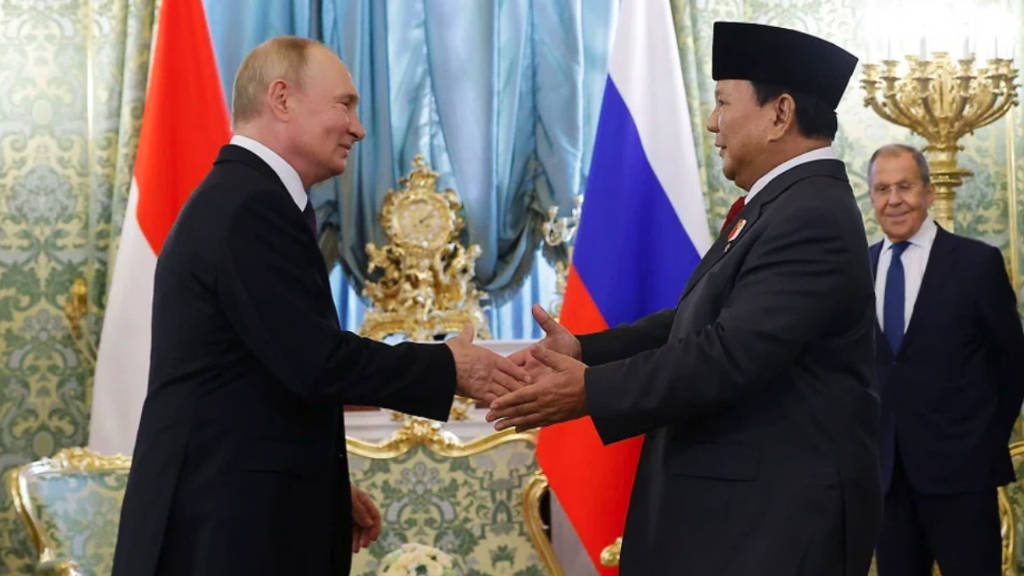

President Vladimir Putin held official talks at the Kremlin with the Indonesian President Prabowo Subianto, who arrived in Moscow on a working visit on April 13. The discussions confirmed the strategic nature of Russian-Indonesian relations and their steady development across a broad range of sectors. Indonesian Foreign Minister Sugiono, Energy and Mineral Resources (ESDM) Minister Bahlil Lahadalia, and Cabinet Secretary Teddy Indra Wijaya also attended the meeting, as did Russian Foreign Minister Sergey Lavrov, First Deputy Prime Minister Denis Manturov, Rosatom head Alexey Likhachev, and Central Bank Governor Elvira Nabiullina.
Putin noted that bilateral trade turnover grew by 12.5% during 2025, expressing confidence that Russia and Indonesia will be able to find solutions to maintain stable trade dynamics. According to Putin, energy, space, agriculture and pharmaceuticals are among the most promising areas of bilateral cooperation. Indonesia has become a full member of BRICS, which represents yet another opportunity for cooperation, similar to cooperation between Indonesia and the Eurasian Economic Union. He expressed confidence that ongoing work within the intergovernmental commission would ensure continued growth and stability in trade and investment. The Russian side reaffirmed its readiness to deepen engagement with Indonesia in both traditional and high-tech industries.
Special attention was given to expanding cooperation in the energy sector, as well as advancing joint industrial and technological projects. According to Russian Energy Minister Sergei Tsivilyov, Russia has received a request from Indonesia for the supply of petroleum products, and the parties have already started working on long-term contracts. Indonesia’s Minister of Energy and Mineral Resources Bahlil Lahadalia said on April 14 that both countries agreed to pursue concrete energy cooperation, covering refinery development, strengthening oil trade and supply, and expanded use of energy technology.
President Subianto expressed appreciation for Russia’s consistent support of Indonesia on the international stage, including its accession to BRICS. He underscored the importance of closer coordination in the face of global geopolitical uncertainty and confirmed Indonesia’s commitment to enhancing economic and financial cooperation with Russia, saying, “We should continue to strengthen bilateral cooperation, particularly in the economic and energy sectors.”
The Indonesian president also emphasised the need to accelerate joint initiatives, particularly bilateral financial transactions, noting his intention to personally oversee progress in this area. Both sides highlighted the growing role of Indonesia within BRICS as opening new opportunities for expanded cooperation, including engagement with the Eurasian Economic Union. The leaders also stressed the importance of strengthening humanitarian ties, including cultural and educational exchanges. The talks also included an exchange of views on current international and regional issues, with both sides reaffirming their commitment to continued dialogue and coordination on the global stage.
Russia-Indonesia Bilateral Analysis
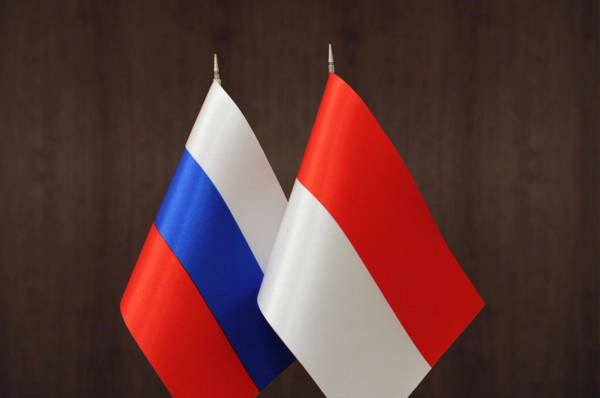
The latest Putin-Prabowo meeting marks a decisive moment in the evolution of Russia-Indonesia relations, transforming what had long been a cordial partnership into a strategic alignment shaped by energy security imperatives and shifting global geopolitics. Far from a routine diplomatic exchange, Prabowo’s third visit to Russia in less than a year underscored the urgency of Indonesia’s current energy predicament and its determination to secure long-term, reliable supply channels outside traditional Western and Middle Eastern frameworks.
Against the backdrop of escalating conflict in the Middle East, disruptions in the Strait of Hormuz, and oil prices exceeding US$100 per barrel, Indonesia’s outreach to Russia reflects a broader recalibration toward Eurasian energy integration. Indonesian Cabinet Secretary Teddy Indra Wijaya said that the meeting lasted around five hours, and both sides agreed on long-term cooperation in energy and mineral resources, including oil and gas energy security and downstream development, adding that “cooperation will also be expanded into education, technological research, agriculture, and investment, particularly in industrial development in Indonesia.”
Energy
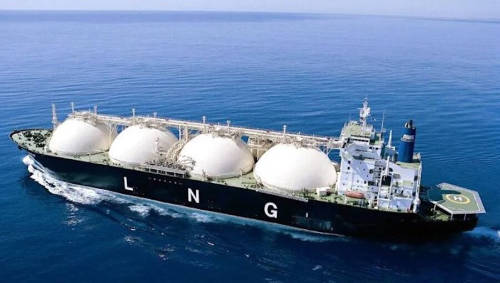
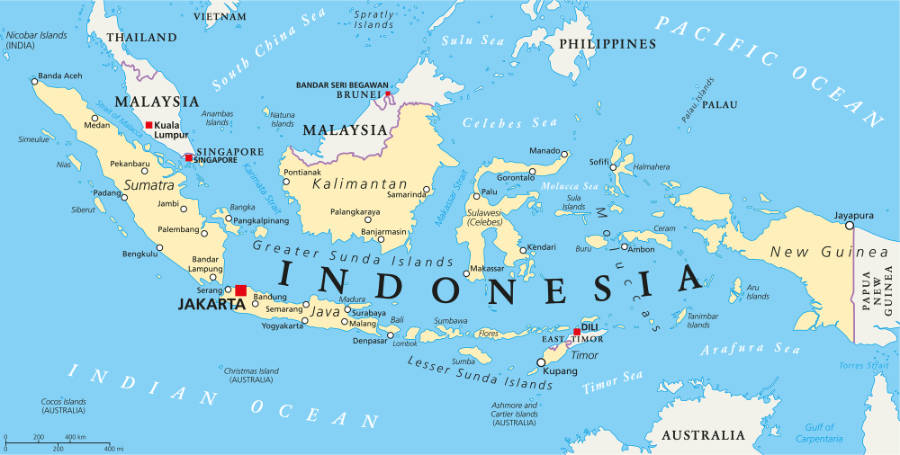
Indonesia’s current energy crisis is structural rather than cyclical. The country – with a population nearly double that of Russia’s, with 280 million people – has been a net oil importer since 2003, and its economy remains heavily dependent on fossil fuels to power transport, industry and electricity. That dependence is now translating into rising fiscal pressure, currency risks and broader economic vulnerability.
OIl
Despite being an oil-producing nation, Indonesia has become a net importer, with domestic production hovering around 600,000-700,000 barrels per day against demand exceeding 1.5 million barrels per day.
Roughly a quarter of Indonesia’s crude imports had come from the Middle East. It has previously inked a commitment to facilitate US$4.5 billion worth of US crude as part of a tariff deal. Its refining capacity remains insufficient, forcing reliance on imported refined fuels even as domestic refineries operate at maximum capacity.
The situation has been exacerbated by recent Mid-East geopolitical shocks, prompting the government and its state energy company, Pertamina, to impose fuel rationing, mandate remote work policies to reduce consumption, and enforce minimum reserve requirements. According to Kpler, in March, Indonesia’s crude oil imports from Saudi Arabia dropped from 104,000 barrels per day to 23,000 barrels per day, a decrease of nearly 78%.
In late March, Jakarta announced fuel rationing and mandated one telework day per week for civil servants to preserve national stocks. The government also pledged to keep fuel prices stable in the near term. Prabowo recently said that he would travel “everywhere” to guarantee his country’s energy supply. The U.S. military began a blockade of ships leaving Iran’s ports on Monday (April 13), President Donald Trump said, while Tehran threatened to retaliate against its Gulf neighbours’ ports after weekend talks in Islamabad on ending the war broke down. These highlight the vulnerability of Indonesia’s energy system and the necessity of diversifying supply sources beyond the volatile Gulf region.
In this context, Russia emerges as a uniquely positioned partner. As one of the world’s largest producers of oil and gas, with output levels potentially exceeding 10.3 million barrels per day in 2026, Russia offers not only scale but also a political proposition: reliability without conditionality. Russia expects oil production to reach 515 million metric tons this year, up from 512 million tons in 2025, Deputy Prime Minister Alexander Novak said on Friday.
Indonesia has already begun exploring and increasing imports of Russian oil products to meet high demand, with 2024 imports including approximately 58,200 tons of naphtha and 100,000 tons of fuel oil. According to shipping data, around 500,000 metric tons of fuel oil were exported from the Russian Baltic port of Ust-Luga to Indonesia between January and March in 2025. In addition to the 2024 figures, 33,000 tons of diesel were delivered in March 2025, with an additional 60,000 tons of diesel potentially delivered recently.
As of March 2026, Indonesia is exploring purchasing Russian crude oil and LPG due to a 30-day US waiver and high global fuel prices. While major imports historically came from the Middle East, Indonesia is actively seeking to buy more Russian oil and explore LPG imports. Russian Energy Minister Sergei Tsivilyov said that Indonesian officials have formally requested petroleum product supplies from Moscow, and negotiations are underway to establish long-term contracts at ‘mutually beneficial’ prices – a nod to Indonesia being both a fellow BRICS member and a ‘friendly nation’. However, Tsivilyov offered little detail on the arrangement, including how large an order Indonesia was looking to place. However, this shift is significant, given Indonesia’s historical reliance on suppliers such as the Gulf partners, the United States, and Australia. The recalibration is driven not by optional choice but by national imperatives and pragmatic considerations of supply security in an increasingly fragmented global energy market.
A critical dimension of this evolving partnership is the potential entry and expansion of major Russian energy companies into Indonesia’s domestic sector. Firms such as Rosneft, Lukoil, Gazprom, Gazprom Neft, Novatek, Tatneft, and Surgutneftegas are well positioned to participate in upstream, downstream, and LNG projects. In the petrochemical and infrastructure domains, companies like Sibur and Transneft could play a pivotal role, while the nuclear sector is dominated by Rosatom, which is actively promoting nuclear power solutions as part of Indonesia’s long-term energy diversification strategy.
Gas
Indonesian Energy Minister Lahadalia recently noted that Indonesia imports 7 million tons of LPG annually and that Russia could become one of the suppliers, provided its LPG prices are competitive. Regarding the reactivation of idle wells, the minister said that the government needs to learn the technology and collaborate with Russia. As Indonesia aims to build oil refineries across several of its islands, including Kalimantan and Sulawesi, with a total capacity of 1 million barrels per day, Russian technology transfer could help support this effort.
The flagship project symbolizing this cooperation is the Tuban oil refinery and petrochemical facility in East Java, a joint venture between Rosneft and Pertamina. Designed with a capacity of approximately 300,000 barrels per day, the refinery is intended to reduce Indonesia’s dependence on imported fuels and strengthen its downstream capabilities. Indonesia and Russia are reviewing the energy project. after costs rose significantly from about US$13.5 billion to around US$23-24 billion, prompting a reassessment of project economics and design. Although the project has faced delays, Moscow has reaffirmed its commitment to accelerating its implementation, recognizing its strategic importance. If Indonesia and Russia are able to immediately resume and complete the project, it would not only strengthen Indonesia’s energy security by increasing domestic refining capacity and reducing import dependence, but also significantly boost the domestic job market through large-scale employment generation during both construction and operational phases, alongside wider multiplier effects in related industries.
Nuclear
Beyond refining, discussions during Prabowo’s visit also touched on the potential construction of nuclear power plants, reflecting Indonesia’s ambition to incorporate stable, low-carbon energy sources into its national mix. Both countries agreed to develop new and renewable energy while opening opportunities for peaceful nuclear technology. In this regard, Rosatom’s expertise in both large-scale reactors and small modular reactors positions it as a key partner in shaping Indonesia’s future energy architecture. Indonesia is preparing to launch its first nuclear power program, targeting initial operation by 2032 with a phased expansion toward 35 GW by 2060 as part of its net-zero strategy. Russia, led by Rosatom, has proposed a staged cooperation model starting with floating nuclear power plants (like the Akademik Lomonosov) and later moving to large-scale land-based reactors with full technology transfer and training. The plan highlights nuclear energy as a core pillar of Indonesia’s energy security, aiming to diversify away from fossil fuels and provide stable baseload power across its archipelago, while Russia positions itself as a leading partner offering proven operational technology in competition with other global nuclear suppliers.
Agriculture
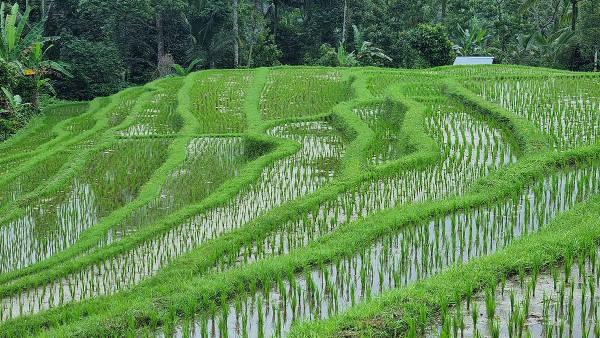
Equally important, though often overlooked, is the role of fertilizer trade in bilateral relations. Indonesia’s agricultural sector depends heavily on imported inputs such as potash and phosphates, and Russia is among the world’s leading exporters of these materials. Companies like Uralkali, PhosAgro, EuroChem, and Acron Group are central to this supply chain. Indonesia’s interest in securing fertilizer raw materials from Russia reflects a broader concern with food security, especially in an environment of rising global prices and supply disruptions. The integration of energy and fertilizer cooperation creates a multidimensional partnership that extends beyond hydrocarbons into the foundations of economic stability. Indonesia’s fertilizer market, valued at US$2.2 billion in 2024, is projected to reach US$2.8 billion by 2033, registering a CAGR of 2.5%, driven by crop diversification, modern agricultural technology adoption, and rapid rural infrastructure development. Amid this growth, Russia has emerged as Indonesia’s leading fertilizer supplier, exporting US$276.8 million in the first five months of 2025, a 70% increase over the same period last year, overtaking last year’s Canada. During a recent official visit to Moscow, Indonesian Agriculture Minister Andi Amran Sulaiman and Russian Agriculture Minister Oksana Nikolaevna Lut discussed establishing a joint fertilizer manufacturing venture.
Bilateral Trade
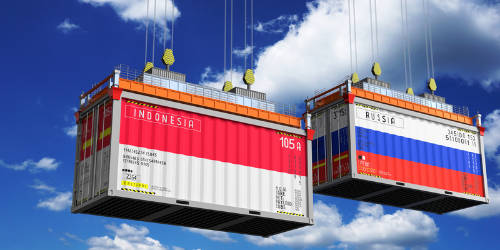
Bilateral trade between the two countries has shown robust growth, increasing by 18% in the first ten months of 2025, reaching approximately US$5 billion by the year-end, according to Trading Economics data. Indonesia’s exports to Russia reached around US$1.88 billion in 2025, while mineral fuels, oils, and distillation products’ imports from Russia stood at US$1.76 billion. Indonesia imports energy and strategic raw materials from Russia, including mineral fuels, fertilisers and wheat. In return, Indonesia exports commodities such as crude palm oil (CPO), rubber, and manufactured products.
Over a five-year horizon, bilateral trade has expanded by more than 30%, with further acceleration expected following the signing of the Eurasian Economic Union-Indonesia Free Trade Agreement in December 2025. This agreement, which reduces tariffs from an average of 10.2% to around 2% and grants preferential access for 90% of all traded goods, is expected to double trade volumes within three to five years. That implies a 20% growth in Russia-Indonesia trade per annum between 2026 and 2030.
Crucially, this facilitates not only the exchange of commodities but also deeper industrial cooperation, including machinery, petrochemicals, and agricultural products.
Logistics
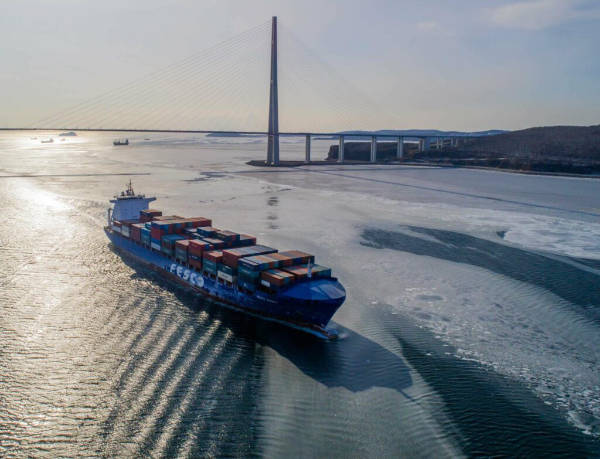
Logistics remains a key challenge but also an area of opportunity. Traditional shipping routes through the Middle East are increasingly vulnerable to geopolitical disruptions, prompting interest in alternative corridors. The Northern Sea Route, enabled by Russia’s Arctic infrastructure, offers a shorter pathway between Europe and Asia, while the Vladivostok-Southeast Asia corridor provides a direct link between the Russian Far East and Indonesian markets. These routes, alongside broader Eurasian connectivity initiatives, could redefine global trade patterns and reduce dependence on chokepoints such as the Strait of Hormuz. For Indonesia, participation in these emerging networks aligns with its identity as a maritime nation and enhances its strategic autonomy. Clearly, new supply chains are being built that will better connect Eurasia with Southeast Asia.
Geopolitical Balancing

The geopolitical context of Prabowo’s visit is further complicated by Indonesia’s simultaneous engagement with other major powers. On the same day as the Kremlin meeting, Jakarta announced a new defense partnership with the United States, highlighting its commitment to a non-aligned foreign policy. This dual-track approach allows Indonesia to balance relationships with competing global actors while maximizing its strategic options. At the same time, historical defense cooperation with Russia, including the acquisition of military hardware, provides an additional layer of depth to the bilateral relationship. Three Russian Pacific Fleet warships, like the corvette Gromky, a submarine (Petropavlovsk-Kamchatsky), an improved KIlo II version, and the tugboat Andrey Stepanov docked at Tanjung Priok Port in Jakarta on March 29, 2026. The visit focuses on strengthening maritime security, including joint exercises with the Indonesian Navy focusing on manoeuvring and communications.
Indonesia maintains strong relations with the Donald Trump administration, which has recently eased certain sanctions affecting Russian oil trade and could potentially leverage this policy flexibility to sustain or expand energy cooperation with Russia while navigating existing restrictions. At the same time, as a BRICS member, Indonesia may explore greater use of local-currency settlement between the rupiah and ruble in bilateral trade, while Russia also signals interest in expanding such mechanisms, even as timelines for implementation remain undefined.
An intriguing dimension of Prabowo’s diplomacy is his potential role as a mediator between Russia and France, particularly as European tensions with Moscow intensify. With Emmanuel Macron adopting a more assertive stance toward Russia, Indonesia’s neutral positioning and Prabowo’s personal rapport with both leaders could create opportunities for dialogue. Such a role would elevate Indonesia’s global standing and reinforce its identity as a bridge between geopolitical blocs.
Ultimately, the significance of the April 13 meeting lies in its demonstration of how middle powers like Indonesia are navigating an increasingly complex international environment. Faced with energy shortages, supply chain disruptions, and geopolitical uncertainty, Jakarta is pursuing a strategy of diversification and resilience. Russia, for its part, is expanding its presence in the Indo-Pacific, seeking new markets and partnerships in response to Western sanctions and shifting global demand. The convergence of these interests has given rise to a partnership that is both pragmatic and strategic, rooted in mutual benefit and long-term vision.
In this emerging framework, energy is not merely a commodity but a foundation of sovereignty. By engaging with Russia across oil, gas, nuclear energy, and fertilizers, Indonesia is laying the groundwork for a more self-reliant and resilient economy. For Russia, the partnership offers access to one of the world’s most dynamic regions and an opportunity to shape the future of global energy flows. As the international system continues to evolve, the Russia-Indonesia axis may well become a defining feature of a new, multipolar energy order.
This article was written by KP Majumdar, a geostrategic and geo-economics analyst whose work has been widely published by prestigious international news organizations and publications. He may be reached at info@russiaspivottoasia.com