 Русский







Russian President Vladimir Putin has approved a new strategy for developing Russia’s Arctic zone and safeguarding national security in the region. It discusses the resumption of dialogue with the Arctic Council, describes the Trans-Arctic Transport Corridor for the first time – and in some detail – discusses Arctic transport and logistics developments and security issues concerning NATO. We examine the content and provide analysis. This article will be of interest to anyone involved or interested in Arctic development.
The decree gives the Russian government six months to draw up a comprehensive plan for developing the Arctic zone as well as the Trans-Arctic Transport Corridor (TATC) and submit it to the Presidential Council for Strategic Development and National Projects for review.
The 2026 Arctic Development Strategy
The new strategy covers the period up to 2035, with a longer-term outlook to 2050. It reveals that Russia remains committed to the Arctic as a zone of peace and stability but has recalibrated its approach to international cooperation in light of NATO’s expansion, the deterioration of Arctic governance mechanisms, and what Moscow perceives as the militarization and politicization of the region by other states.
As with previous strategies, the 2026 Strategy affirms that “the Russian Federation advocates for equal, mutually beneficial international cooperation, strengthening international peace, stability, and security in the Arctic, settlement of disputes by peaceful means on the basis of international law, principles of sovereign equality of states, non-interference in internal affairs of other states, and indivisible and undivided security of Arctic states.” This language closely mirrors the 2020 Strategy’s commitments to international law and conflict resolution, demonstrating continuity in Russia’s normative framework.
What has changed is the framing of cooperation as conditional. The strategy states that “Russia is ready to develop good-neighborly relations with Arctic states, cooperation with other states on issues of Arctic development subject to the respect for the national interests of the Russian Federation by its partners.” While the 2023 Foreign Policy Concept had already shifted toward a more utilitarian approach to international cooperation, the 2026 Strategy builds on this by making that conditionality much more explicit.
The strategy document states that the plan will be implemented in stages. The first stage will run from 2026 to 2030 and the second from 2031 to 2035. Subsequent stages will take place every six years, implying that it can be modified – as and when political relations improve. Currently the strategy is geared towards Asia and ‘friendly countries’ as beneficiaries, but it is cautious when it comes to dealing with the European Union.
Relations With The Arctic Council
The Strategy’s section on “Strategic Stability and Mutually Beneficial International Cooperation” contains 24 statements, many of which signal openness to engagement. These include “developing multilateral cooperation within the framework of Arctic Council, forming relations of good neighborliness with Arctic states,” “increasing predictability of international relations, preventing militarization of the Arctic, preventing unintended armed incidents in the Arctic,” and “equal, mutually beneficial cooperation with constructively disposed (towards Russia) Arctic and other states.” This is despite Russia being suspended from the Arctic Council by its other members – Canada, Denmark, Finland, Iceland, Norway, Sweden, and the United States since 2022 and it being the largest Arctic nation.
Following the 2022 suspension, and Russia’s subsequent withdrawal from the Barents Euro-Arctic Council, handling Arctic governance and Russia’s role in these institutions have been widely discussed. Russia’s 2023 Foreign Policy Concept notably removed all mentions of the Arctic Council from its text.
However, the 2026 Strategy confirms that Russia is not walking away from the Arctic Council. The document calls for “Developing multilateral cooperation within the framework of the Arctic Council, proceeding from the national interests of the Russian Federation on an equal and mutually beneficial basis, for the purpose of preserving peace, stability, and the sustainable development of Arctic.”
The qualifier “proceeding from the national interests of the Russian Federation” is significant. Russia’s engagement with the Council is conditional on its own interests being served. The Arctic Five and Barents Euro-Arctic Council are not mentioned, continuing the downgrading of these formats.
This indicates that Moscow has no desire to disregard the Arctic Council but instead will not treat the institution as a value in itself. The Kremlins view is that politics and conflicts unrelated to the Council’s actual stated activities have rendered it less focused, more politicised and therefore diminished its influence.
This aligns with Sergey Lavrov’s (Russian Foreign Minister) 2026 essay, titled ‘International Cooperation in the Arctic: Challenges and Opportunities’ in which he argued that Russia remains open to cooperation but will only participate in forums where it is treated as an equal sovereign. The 2025 Putin–Trump Alaska meeting and ongoing U.S.-Russia negotiations to end the war in Ukraine demonstrate Moscow’s preference for bilateral engagement as a complement to, or even substitute for, multilateral coordination.
To summarize this position, Russia is prepared to resume dialogue with the Arctic Council if other Arctic states agree, but it will not allow the council to be dominated by non-Arctic issues.
China, India & Southeast Asia In The Arctic

The new Strategy also references “China, India, and Southeast Asia” as “new centers of economic and political development” whose rise creates opportunities for Russia. This continues the geographic reorientation begun in the 2023 Foreign Policy Concept, which first mentioned cooperation with “non-Arctic states that pursue a constructive policy towards Russia.” The 2026 Strategy’s reference to “cooperation with constructively disposed towards Russia Arctic and other states” is more expansive, opening the door to non-Arctic state engagement.
This also aligns with Lavrov’s 2026 article, which identified China and India as important existing partners and highlighted opportunities for cooperation with Brazil, Indonesia, Iran, and other BRICS countries. Lavrov also specifically mentioned South Korea and Singapore, which have expressed interest in individual Arctic projects despite their participation in Western sanctions against Russia.
Arctic Transport & Logistics Development
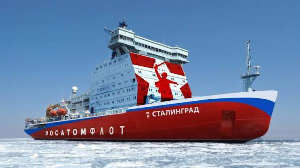
The 2026 Strategy is the first Arctic strategic document to mention the concept of the “Trans-Arctic Transport Corridor” (TATC). This is defined as “a unified system of routes, including the Northern Sea Route (NSR), inland waterways connected with it, and transport infrastructure facilities, providing for the comprehensive development of the territories of the Arctic Zone and the Russian Far East, as well as domestic, international, and transit routes for cargo and passenger transportation along the coast of Russia.”
The TATC is a Russian multimodal logistics network that links western ports such as Saint Petersburg and Murmansk with the Northern Sea Route (NSR) and eastern hubs such as Vladivostok, connecting to the Asia-Pacific region and markets in Asia.
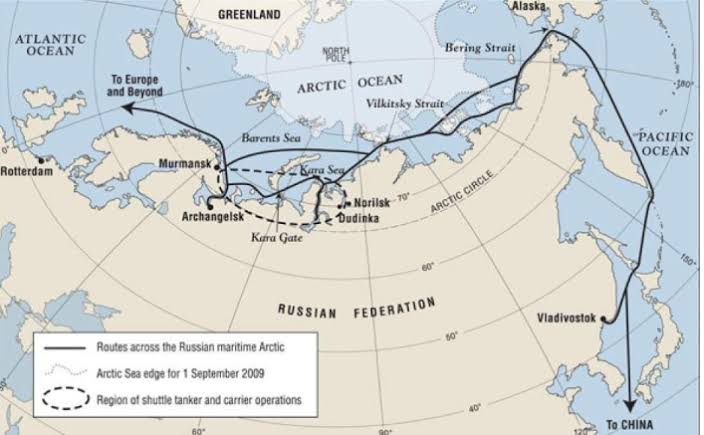
In September, Putin stated that the Northern Sea Route, an ambitious project emerging as an alternative to the Suez Canal, must be navigable year-round. The TATC encompasses the Northern Sea Route, inland seas and ports, and transport infrastructure facilities along the entire Russian Arctic coastline. Due to global warming, the corridor is emerging as a viable alternative to other international logistics routes.
Putin stated that developing this route would create new opportunities for transit and coastal freight transport and ensure an uninterrupted supply to Russia’s Arctic regions. “Overall, we expect that by the end of the current decade, the volume of cargo transported along the Trans‑Arctic corridor will amount to no less than 70 million tons per year-that is, it will grow at least twofold compared to the current level,” the President said at the plenary session of the Eastern Economic Forum in Vladivostok on 3 September 2026.
The Strategy sets cargo volume targets for between 70 to 110 million tons by 2030 and between 110 and 150 million tons by 2035 (up from 37.9 million tons in 2024).
To put that into context, the 70 million tonnes 2030 target is equivalent to 70,000 kilotonnes and close to half the annual volumes of the total output of ports such as Hong Kong, Kaohsiung, Hamburg, and Corpus Christi. At the higher end, the 150 million tonnes 2035 target is equivalent to 150,000 kilotonnes and roughly equivalent to the entire annual tonnage handled by these same ports.
Arctic shipping and transport connectivity are central to Russia’s economic future. The Arctic accounts for roughly 5.9% of Russia’s GDP. The 2026 Strategy calls for raising that share to 8.4%, with high-tech and knowledge-intensive industries contributing 9.8% of the total. In nominal GDP terms, this equates to about US$171 billion as of 2026, rising to an estimated US$311 billion in 2030 factoring in current GDP growth trends.
Russia is open to foreign participation in Arctic shipping, but only from partners “constructively disposed towards Russia” – meaning friendly countries. Moscow sees the TATC as a potential vehicle for international cooperation with non-Western countries. Meanwhile, non-Arctic states are increasingly interested in this corridor. In August 2026, South Korea’s PanStar Acro container ship completed a trial voyage from Busan to Europe via the NSR, returning to Korea after 50 days. South Korea also aims to operate regular Arctic shipping by 2030 and has been redeveloping its Yeosu Gwangyang Port specifically for this purpose.
The Strategy also bolsters Russia’s legal position on the Northern Sea Route. It calls for “ensuring the immutability of the historically formed legal regime of internal sea waters of the Russian Federation.”
Arctic Security

The 2026 Strategy section pairing “Strategic Stability” with “Mutually Beneficial International Cooperation” is also new and significant. “Strategic stability” is typically used in the context of discussions on disincentivizing the use of nuclear weapons.
Security has always been paramount in Russian Arctic strategy, but the 2026 Strategy’s security provisions are the most detailed and expansive of any Russian Arctic doctrinal document. Where the 2023 Foreign Policy Concept spoke broadly of “neutralizing” the militarization policies of unfriendly states, the new Strategy is specific.
The 2026 Arctic Strategy names NATO and the European Union as primary antagonists pursuing a “policy of containment” against Russia. The text highlights the accession of Finland and Sweden and the United Kingdom’s military activities, as catalysts for the region’s militarization. In response, the Strategy mandates maintaining the combat readiness of Russia’s Armed Forces to repel aggression and calls for the continuous modernization of military infrastructure adapted to Arctic conditions.
The Strategy also explicitly addresses NATO’s nuclear posture in the Arctic, noting that “NATO views the Arctic as one of the potential theaters of military operations and is practicing the use of armed forces in Arctic conditions, including the possibility of using nuclear weapons.”
The Strategy also introduces the “prevention of extremist and terrorist activities, countering external ideological and value‑based expansion and destructive informational and psychological influence on citizens, especially on Indigenous peoples. This is a significant rhetorical change. The protection of Indigenous peoples was previously framed largely through traditional economic activity and environmental protection. Now it is closely linked to national security and countering information warfare. Furthermore, the Strategy places heavy emphasis on protecting “traditional Russian spiritual-moral values, culture, and historical memory” and countering “legal, protective ecological topics as instruments of external pressure.”
Impact On Europe

The European Union has also been making statements about the Arctic, although largely these have been based on defensive issues and not its trade potential, while the idea of using Russian waters remains anathema. This current mindset is problematic for Europe, however, as the NSR and TATC represent a huge potential cost saving if utilized for trade between Europe and Asia. Using the NSR between Europe and Asia typically saves around 10 to 14 days (roughly 30% to 40% in sailing time) compared to the current Suez Canal route. Given additional problems with the Suez route, the other alternative is a substantial 60 days if avoiding Russia and transiting to China via the Cape of Good Hope. Both the Suez and Cape routes will in time prove economically unsustainable, given that the NST/TATC routes between China and the EU using Russian waters provide savings of between US$200,000 and US$400,000 per voyage-while bypassing Suez Canal transit fees estimated at US$300,000 to US$700,000. The pending European economic trade logic lies firmly with using Russian waters and the Russian routes.
Summary
Russia’s 2026 Arctic Strategy does not signify a departure from the core principles of earlier policy. Economic development, environmental protection, the well-being of northern communities, national security, and the preservation of regional stability remain central objectives.
There is, however, a greater emphasis on the security dimensions of sovereignty, economic and technological self-reliance, and socioeconomic stability. International cooperation is still valued, but it is now more explicitly conditional on whether prospective partners are prepared to engage with Russia on terms Moscow considers mutually beneficial and respectful of its national interests.
The Strategy’s emphasis on the TATC illustrates this clearly. Russia wants shipping in its Arctic waters to be internationally competitive, but embedded within a transport network geared toward Russia’s territorial, economic, and strategic interests.
The same logic applies to the Arctic Council. Russia continues to value the prospect of resuming multilateral cooperation but insists on the recognition of, and respect for, its national interests in that process.
Overall, the 2026 Strategy indicates that Russia remains open to Arctic cooperation while adopting a more diverse and discerning approach to its international partners. Rather than ruling out future cooperation with Western Arctic states, it reflects Moscow’s view that such cooperation will be difficult to restore without improvements in political relations.
For Arctic governance, this focus on sovereignty may be hard to reconcile with the region’s interdependence. Climate change, maritime safety, environmental protection, and sustainable development still require international coordination, and Russia’s participation will remain essential to addressing these challenges. Yet the institutional environment in which such cooperation can occur is now substantially more complex than when the previous Strategy was adopted in 2020.