
 Русский








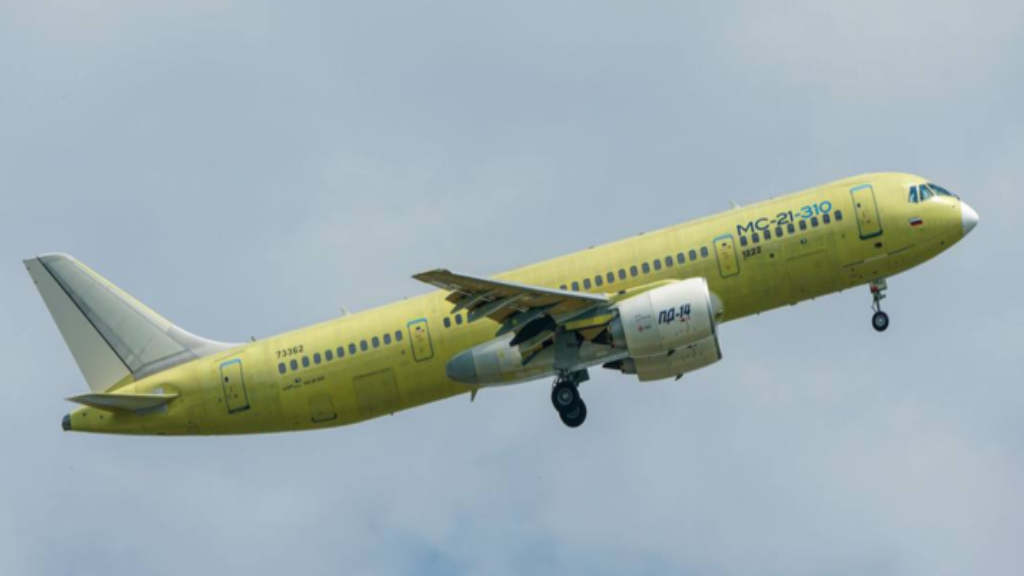

The first mass-produced MC-21-310 aircraft, built using entirely Russian-made components, has taken to the skies for the first time, the state-run Joint Aviation Corporation (OAK) has said. The narrow-body airliner had been in development since 2017. The first MS‑21 prototypes were equipped with American Pratt & Whitney PW1400G engines.
However, Western sanctions imposed on Russia’s aviation industry in February 2022 jeopardized the project and prompted Moscow to push for a fully domestically built variant. The MC-21-310 is powered by the Russian Aviadvigatel PD-14 engine, the first next-generation turbofan aircraft engine, which was introduced last year.
The new plane made its maiden flight on Monday at the testing airfield of the Irkutsk Aviation Plant. The passenger jet stayed airborne for an hour and a half, reaching heights of up to 6,000 meters and speeds of up to 600 km/h, according to the OAK.
Vadim Badekha, OAK’s CEO, said that “The Irkutsk Aviation Plant has now confirmed its readiness to manufacture the first batch of 18 MC-21 aircraft and to begin work on subsequent orders.” The first batch is expected to be delivered to Russia’s flagship carrier Aeroflot.
Russian President Vladimir Putin toured the Irkutsk plant last month, inspecting the airliner, which was being readied for its first flight. At the time, the CEO of the plant, Andrey Soynov, said the facility was seeking to expand its serial production capacities to produce at least 36 MC-21 airliners per annum.
Russian airlines have apparently ordered 200 of these aircraft, and it is possible that to meet demand, the MC-310 could also be built under license in the United Arab Emirates.
The MS‑21 project was initially conceived as a family of aircraft. The basic lineup included versions for 150, 181, and 212 passengers, with different range modifications planned for each. The declared range of the MS‑21‑310 reaches 3,830 kilometers, which enables it to carry more than 80% of passenger traffic within Russia.
Prior to the sanctions, commercial airline fleet data shows that Russian airlines operated 450 United States (Boeing) and European Union (Airbus) commercial narrowbody and widebody jets until 2022. While many of these remain in service, both Boeing and Airbus have refused to provide maintenance support, ultimately leading to Russian engineers having to do the job themselves. There have been no safety issues or incidents with these aircraft during this period. However, Russian aviation engineers will soon be able to function with fully Russian supply chains with the new MC-310 alternative to the aging Boeing and Airbus fleet.