 Русский





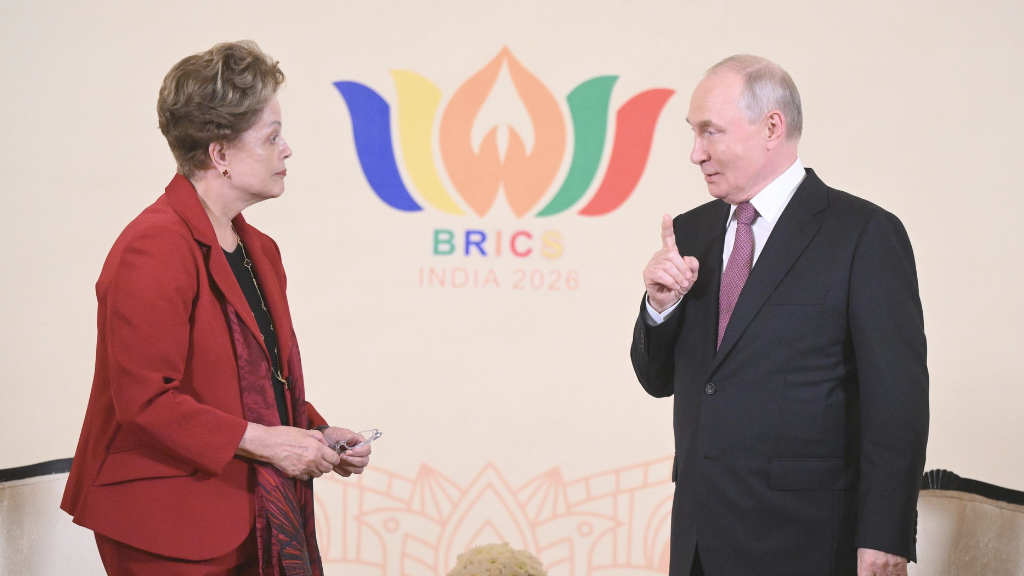

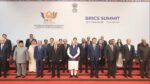
Russian President Vladimir Putin has met with Dilma Rousseff, the President of the New Development Bank (NDB) on the sidelines of the BRICS summit. The NDB is the collective BRICS bank and provides project financing to its members. In this article we summarise firstly what was said and follow this with the agreed plans for the NDB activities moving forward. These are substantive and game-changing, with considerable global trade and investment implications.
The meeting between Putin and Rousseff was also attended by Maxim Oreshkin, the Special Representative for Financial and Economic Cooperation with BRICS States and Interaction with the New Development Bank; Ivan Chebeskov, the Russian Deputy Minister of Finance; and Vladimir Chistyukhin, the Deputy Governor of the Russian Central Bank.
This is what Putin had to say:
“Mrs Rousseff, I am very glad to see you – this time in India. We met not long ago in Moscow, where we discussed matters relating to our cooperation with the New Development Bank and the Bank’s involvement. The Bank is operating energetically, doing much to advance the organisation’s development, and expanding its activities in key areas. We are very pleased that such an instrument was created.
We advocate the involvement of as many participants as possible in its work, and for its programmes to be broader in scope – covering a greater number of economic sectors within the BRICS member countries. You are also aware of our proposals regarding the creation of new platforms, including investment-oriented and digital ones, to expand the Bank’s capabilities and make them more versatile, enabling the Bank, together with its participants and shareholders, to achieve even greater results.
I would like to thank you for our joint work, and to express the hope that not only will all our agreements be implemented, but that – working with our partners in the Bank’s member countries – we will find new instruments to boost the operations of this vital financial institution. I am very glad to see you here in New Delhi, and I am confident that today’s meeting will benefit our cooperation.”
Mrs Rousseff replied:
“It is a great honour for me to be here again and to speak with you in person, Mr President, because I believe that Russia’s participation in the NDB is vitally important – both for strengthening the Global South and for the BRICS organisation as a whole.
I am very optimistic about the future, as we have taken steps to address the difficulties and the profound injustice that Russia faced on the part of the Bank. After all, Russia has always played a pivotal role and acted with integrity towards the Bank. Unfortunately, for various reasons, things unfolded as they did. Yet now, it seems to me, we have found the right path to putting this injustice right.
I believe that the projects we have adopted within the Bank will benefit all partner countries – as well as Russia and all other members.”
NDB Membership
Mrs. Rousseff’s reply referenced the fact that Russia’s participation in the NDB has been suspended due to the bank being threatened with sanctions if it engaged with Russia. Consequently, the bank has been unable to involve Russia in any of its projects since 2022.
The NDB is capitalised with authorized capital of US$100 billion, which was originally divided into one million shares with a par value of US$100,000 each when the bank was formed in 2015. US$50 billion was contributed equally by the founding members, while the total subscribed capital has since grown slightly over time as new members have joined. The banks shareholders currently include the governments of Brazil, Russia, India, China, and South Africa as the founding members, with the United Arab Emirates, Bangladesh, Egypt, Algeria, Colombia and Uzbekistan all subsequently joining over the following years.
In addition, Uruguay, Ethiopia, Angola and Zimbabwe have signed agreements to join the NDB, however are pending the final deposit of their instruments of accession. Membership and participation in the NDB is not limited exclusively to BRICS members.
NDB Methodology

The NDB is rated AA+ by Standard & Poors and AA positive by Fitch ratings. This means the bank is able to raise capital at lower interest rates than many of its members and can distribute funds to them at lower rates than they would be able to achieve. For example, South Africa’s current sovereign credit rating is BB, Bangladesh is B+, while Colombia’s is BB-. The NDB can raise capital and distribute it at better rates than some of its members can achieve.
NDB Projects

The bank focuses on mobilizing resources for infrastructure and sustainable development projects in emerging markets and developing countries and therefore has a green initiative agenda. These include clean and renewable energy, transport, water and sanitation, environmental protection, and digital/social infrastructure. At least 40% of total approvals are dedicated to climate change mitigation and adaptation projects. Other project examples can be seen here.
The banks 2022-2026 General Strategy has focused on achieving cumulative approvals of US$60 billion, with US$30 billion financed directly from its own balance sheet. A distinct feature of its model is reducing exchange rate volatility by increasing local currency financing to 30% of total commitments. The bank targets 30% of its financing for non-sovereign/private operations and aims for 20% of operations to be co-financed with other multilateral development banks.
Other recent examples are as follows:
- South Africa: A US$1 billion performance-based municipal infrastructure and trading services reform program (September 2026).
- India: REC Energy Infrastructure clean energy project, approved for up to US$300 million, alongside ongoing support for the Lucknow Metro Rail Phase 1B (August 2026).
- Brazil: Regional Sustainable Infrastructure Development Program totaling US$1 billion (US$500 million NDB financing) targeting logistics, transport, and renewable energy across macro-regions (December 2025).
- China: Yunnan Yuxi International Logistics Port and various regional solar power initiatives. (December 2025)
NDB’s own figures cite 139 approved and financed projects worth US$42.9 billion.
The New Development Banks New Direction & The Implications

With the current General Strategy period coming to an end, discussions at the BRICS summit have revolved around a new positioning for the NDB and the activities it carries out. Putin himself referred to this in his BRICS speech, calling for strengthening the NDB’s capacity and updating its business model. Putin suggested a new investment platform, to be operated by the NDB, capable of mobilising private capital, including potentially through digital assets.
Within the BRICS New Delhi Declaration there are now specific directions for this. The Declaration supports stronger NDB financing, new investment mechanisms, insurance and risk-management cooperation, while the broader 2026 agenda included the Putin-proposed New Investment Platform and BRICS multilateral guarantees.
The New Development Bank’s New Investment Platform aims to bring in private-sector funds for large projects. It helps developing nations get resources without the strict requirements and rules associated with Western financing. This is partially achieved by avoiding the US dollar and encouraging the use of domestic currencies to lower financial risks.
The significance is that this will complete a transaction chain from invoicing and payment to settlement, insurance, project financing and investment rather than simply replacing the currency used in individual trade transactions. This also connects directly with proposals for BRICS Pay, depository and clearing infrastructure, a reinsurance mechanism and an NDB-linked investment platform.
BRICS Pay
This suggests that the financial sanctions issue may also become a thing of the past. While Russia and Iran remain disconnected from SWIFT, the NDB is not. However, BRICS bloc Finance Ministers and Central Bank Governors have asked the BRICS Payment Task Force (BPTF) to continue work on alternative cross-border payment solutions that are faster, cheaper and more accessible.
The BRICS approach is not based on introducing a common currency but on making existing national systems more interoperable and increasing the use of local currencies. This includes collaborating with India’s Unified Payment Interface (UPI), which offers financial settlement alternatives to the SWIFT network. UPI is in many ways superior to SWIFT as it is a real-time domestic retail payment system, whereas SWIFT is a global interbank financial messaging network used primarily for international wire transfers. UPI directly moves funds between individual and merchant bank accounts, whereas SWIFT does not move money itself; it securely transmits payment instructions between banks that settle via correspondent accounts. UPI is generally commission free for transactions. SWIFT transfers involve higher fixed and variable fees charged by participating intermediary banks.
UPI has also proven its operational trustworthiness – it processed over 250 billion transactions last year, accounting for more than half of the total global transaction volumes. Its use is also expanding. In Asia, it is connected with the banking systems in Bhutan, Cambodia, Maldives, Nepal, Singapore, and Sri Lanka, with Qatar and the UAE in the Middle East, with Mauritius in Africa. Others are likely to follow. UPI can be expected to become part of the foundation platform for BRICS Pay.
That means that when the BRICS Pay mechanism is rolled out, the threat of Western financial sanctions becomes a moot point. Banks such as the NDB can transfer their funds to whomever they want. For Russia, this means finally gaining access to NDB related funding – capital that is required, with Putin specifically mentioning this, to invest in projects in the Russian Far East, the Northern Sea Route and other Trans-Arctic Corridors. Other BRICS members will want to finance this also in order to secure their own energy supply chains.
Summary
The New Delhi Declaration recognised the New Development Bank as a strategic institution for development and infrastructure in emerging economies and encouraged it to expand resource mobilisation, local-currency financing, funding diversification and support for economic integration. The NDB component therefore strengthens this economic architecture and provides the institutional financing pillar of this architecture. The Declaration’s support for strengthening the NDB therefore has direct implications for Russian infrastructure, industrial and technology projects seeking access to BRICS-linked financing. With 139 projects worth nearly US$43 billion already in place, the NDB is now being positioned for a larger role in BRICS development finance. For Russia, this could connect domestic companies with infrastructure, energy, transport, digital and industrial projects across the expanded BRICS market. For the BRICS countries and NDB members concerned, it will revolutionize global trade and investment as they free themselves from Western interference.