 Русский




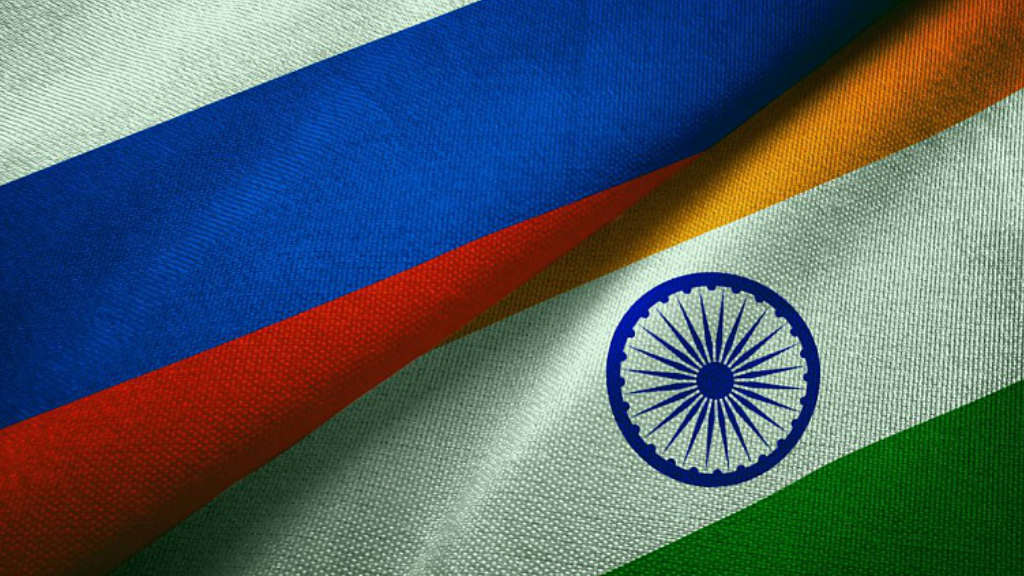

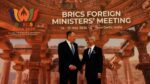
India’s Foreign Minister, Subrahmanyam Jaishankar is in Russia for high-level talks as the two countries prepare for Russian President Vladimir Putin’s visit to India next month to attend the annual BRICS Heads of State summit, as well as to discuss bilateral cooperation.
Russia-India Trade: Latest Developments
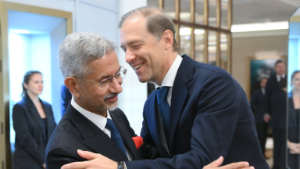
Jaishankar discussed trade and defense cooperation with Russian First Deputy Prime Minister Denis Manturov, with both Co-chairing the 27th Session of the India-Russia Inter-Governmental Commission on Trade, Economic, Scientific, Technological and Cultural Cooperation (IRIGC-TEC) on Monday (August 24). Jaishankar stated at that meeting that “The India-Russia partnership has consistently demonstrated resilience and adaptability. Even amidst a complex international landscape our engagement has continued to deepen, reflecting the mutual interest and confidence that define our bilateral partnership.”
The IRIGC‑TEC is one of the pillars of the India‑Russia Intergovernmental Commission (IRIGC), a mechanism to monitor bilateral progress across trade and economic cooperation, which was established in 1992. The relationship between the two traditional friends has deepened as Western countries have tried to use economic and trade levers to isolate Russia and punish countries friendly to Moscow.
India-Russia bilateral trade has boomed since then, with India now the second largest importer of Russian oil. However, the threat of steep US tariffs on countries buying Russian oil, under a new sanctions bill that has cleared the US Senate, looms over New Delhi. India has consistently maintained that its purchases of Russian oil are driven by energy security concerns and ensuring affordable energy for its 1.4 billion population.
Both countries are also looking at local currency settlement of trade transactions and linking payment systems as they seek to address the large trade gap created by lower Indian exports. Other topics of bilateral economic interest include the Northern Sea Route, also known as the Arctic route, a promising sea route along Russia’s northern coast through which Indian plans to send its first ship next year, and a recent plan mooted by Russia to build a rail link to India.
New Delhi and Moscow are also expected to discuss a possible sale of Russia’s advanced fifth-generation stealth fighter, the Su-57. In June, Putin noted that Russia has offered the aircraft to India as a joint project. “We are ready to supply India with this aircraft, to keep developing it. We don’t have any issues or limitations. The same goes for air defense systems.”
Some reports have said that New Delhi declined the offer, and instead plans to prioritize upgrades of its workhorse Su-30 MKI fighter aircraft. However, talks have continued behind the scenes, as the Indian Air Force seeks to fill its stealth fighter gap amid reports that arch-rival Pakistan could soon field Chinese J-35 stealth jets.
The two sides also discussed the use of Indian labour in Russia, having previously signed a labor mobility agreement in December last year. New Delhi is stepping up efforts to find jobs for its skilled workers as the United States, traditionally the biggest recipient of Indian workers and professionals, has adopted tighter anti-immigration policies. Russia also has a very low unemployment rate which is creating gaps in its workforce and hindering productivity. Further talks on the pact are likely to result in the easier migration of Indian labour to Russia.
Manturov also stated that the bilateral trade turnover between India and Russia grew 8% in the first half of 2026, adding that both exports and imports showed expansion. He said that “Positive trends have seen for both Russian exports and imports from India. Our goal is not only to increase trade but also to diversify it. Trade in agricultural produce and foodstuffs, machine building goods, metallurgy and forest products is expanding as well as traditional supplies of fuel and mineral fertilizers from Russia. Imports from India include pharmaceuticals, agricultural products industrial raw materials, equipment and components and light industry goods.”
India and Russia are pursuing a bilateral trade target of US$100 billion to be reached by 2030, which was set by President Vladimir Putin in December when he visited New Delhi.
Jaishankar said bilateral trade has increased more than fourfold in the last four years, from around US$13 billion in 2021-22 to over US$60 billion in 2025-26. He also noted, however, that the rapid expansion has increased the trade imbalance, and said that progress on market access, removal of tariff and non-tariff barriers, and strengthening payment mechanisms will be critical in addressing the imbalance.
In addressing the tariffs issue, Manturov said the free trade agreement (FTA) that the Russia-led Eurasian Economic Union has been negotiating with India since August last year will be a new driver for sustainable trade growth, saying that “Its preparation is in an active stage and it is important to maintain a high pace of negotiations.” Both sides are already preparing for the increase in logistics and infrastructure capacity requirements to handle larger volumes of bilateral trade.
Manturov also underscored the competitive advantages of the Northern Sea Route, noting that state-backed Rosatom is discussing mutually beneficial formats for cooperation on the Arctic route, adding that “The use of this Arctic route will reduce transport costs for economic operators.” India has shown keen interest in the route amid global shipping disruptions, and plans to send its first cargo ship along the passage next year.
Manturov also stressed the need to improve mutual access of goods alongside “an expansion of direct contacts between the business circles of our countries.” He emphasized the need to stimulate business participation in exhibitions and fairs and highlighted the INNOROM India international industrial exhibition which will be held for the first time in New Delhi on the eve of the BRICS summit next month.
Manturov also highlighted multiple areas where cooperation with India is deepening – from industrial cooperation, for its role in “ensuring the technological sovereignty of our countries” to space, in particular “in manned spaceflight, rocket engines, and satellite navigation.”
He also noted the “potential for expansion and cooperation in the metallurgy and mining industries, including joint development of deposits and processing of non-ferrous, rare, and rare earth metals.” Indian minerals and metals companies have recently reached out to their Russian counterparts as they seek to secure supplies of critical rare-earths and minerals amid global supply chain disruptions.
Manturov noted the cooperation in energy security – with India now the second largest importer of Russian crude – and underscored joint investment projects for the extraction and processing of hydrocarbons. He added that the successful experience of cooperation on the Kudankulam nuclear power plant project could be a basis for building new power plants across India, including small-scale reactors.
Russia-India Relations: Putin’s Comments & 2026 SCO Summit
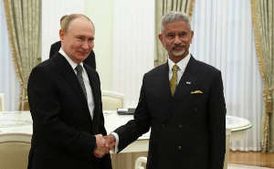
Jaishankar also met with Russian President Putin in Moscow, along with Russian Foreign Minister Sergei Lavrov, First Deputy Prime Minister, Co-Chair of the Russia-India Commission on Trade, Economic, Scientific, Technical and Cultural Cooperation Denis Manturov, Deputy Chief of Staff of the Presidential Executive Office Maxim Oreshkin, and Aide to the President Yury Ushakov. Ambassador Extraordinary and Plenipotentiary of India to Russia Vinay Kumar and Joint Secretary for the Eurasia Division at the Ministry of External Affairs of India Mayank Singh took part in the meeting on India’s side.
Putin said that “We are very glad to see you, dear Mr. Minister. I know that you and your Russian counterpart, Mr. Manturov have already done all the work that needs to be done and will have discussed the most important issues. There are many of them. One of these issues – not just fuel – is, of course, the supply of mineralizers. We are doing everything we can to resolve the issue for Indian farmers, for agriculture; we are increasing these exports and are prepared to continue doing so.” Fertilizer shipments to India from the Middle East have been disrupted by the conflict there triggered by US-Israeli attacks on Iran.
According to data from the Indian Ministry of Commerce and Industry, India increased imports of Russian fertilizers 41% to 6.5 million tonnes in 2025. Russia was the biggest supplier, followed by China, Saudi Arabia, Morocco and Oman.
Putin also praised Indian Prime Minister Narendra Modi, attributing the recent growth in bilateral trade turnover amid a hostile geopolitical environment directly to Modi’s “close personal attention” to relations between the two nations. He said that “I am pleased to note that our trade turnover has grown this year. While it decreased slightly last year, it is rising this year, and this is due in part – and perhaps above all – to the efforts of the prime minister, Narendra Modi, who gives the development of Russian-Indian relations close personal attention. I would like to ask you to convey my best wishes to Mr. Modi. I hope to see him soon, as we planned, within the framework of the Shanghai Cooperation Organization.” Jaishankar delivered a personal message to the Russian president from Modi, who also said he looked forward to their meeting at Bishkek. Modi and Putin are slated to attend the SCO Heads of State Council summit in Bishkek, Kyrgyzstan, next week.
BRICS New Delhi Summit 2026
Putin is set to visit India for the BRICS summit to be held under India’s rotating presidency on September 12-13 in New Delhi. The theme for this year’s summit is “Building for Resilience, Innovation, Cooperation and Sustainability”.
The focus areas & agenda will include:
- Global Governance & Reform
Pushing for reforms within the United Nations (UN) and the World Trade Organization (WTO) to better represent developing nations. - Digital Public Infrastructure
Showcasing open-architecture digital frameworks as scalable development models for the Global South. - Emerging Technology
Strengthening collaborative governance surrounding artificial intelligence (AI) and digital trade. - Sustainability & Transition
Aligning collective efforts on green finance, climate action, and energy transitions.
Current Intra-BRICS trade is worth about US$1.17 trillion. The BRICS economies account for about 27% of global output and 24% of exports, indicating substantial untapped potential for internal integration.